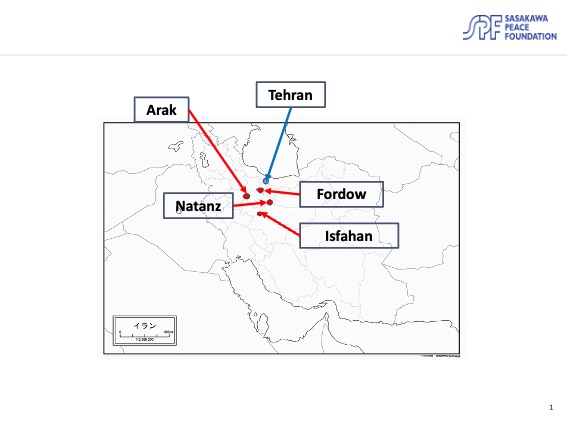
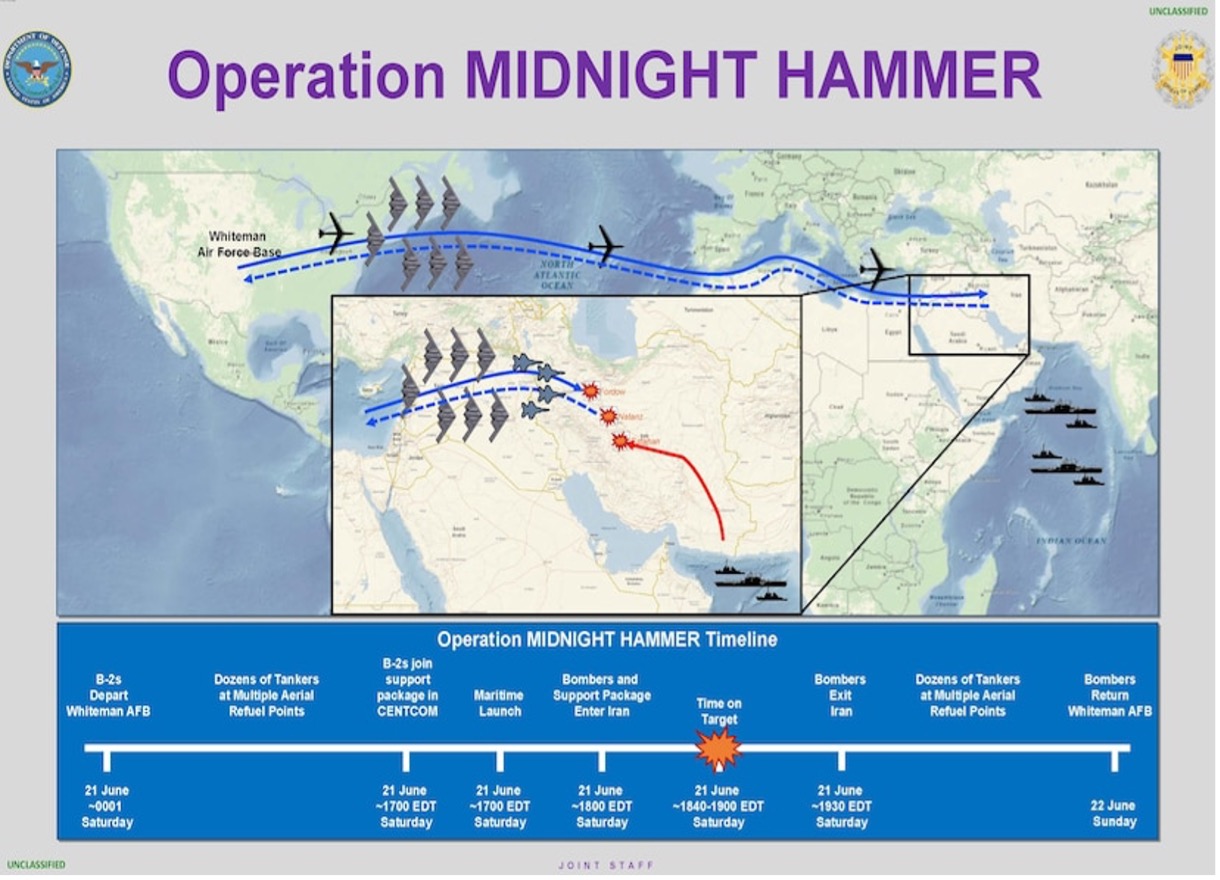
Based on the operational status of Iran’s nuclear-related facilities, the following characteristics define the current state of its nuclear program:
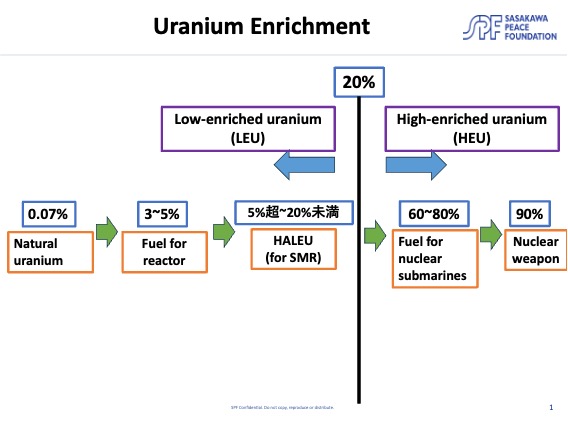
・The program is centered on uranium enrichment, with Iran possessing a large stockpile of uranium enriched to 60%.
・Iran is believed to be capable of acquiring weapons-grade highly enriched uranium (HEU) within a matter of weeks.
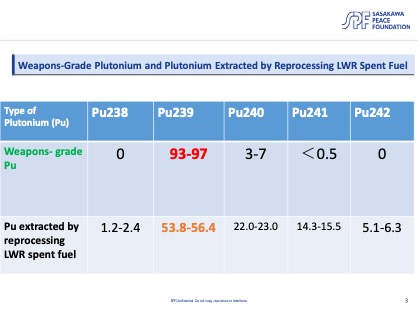
・Iran has not acquired spent fuel reprocessing technology, and therefore cannot produce plutonium.
According to a report delivered by IAEA Director General Rafael Grossi to the United Nations Security Council on June 20, 2025, Iran’s stockpile of 60% enriched uranium exceeds 400 kilograms.[6]Under the Joint Comprehensive Plan of Action (JCPOA), uranium enrichment in Iran was restricted to the Natanz facility, with a maximum enrichment level of 3.67%. However, following the unilateral withdrawal of the Trump administration from the JCPOA in 2018, Iran began producing and storing uranium enriched to 60% from 2021 onward.
Iran officially claims that the purpose of enriching uranium to around 60% is to produce molybdenum-99 (Mo-99), a nuclear material used to generate technetium-99m (Tc-99m)—a radioisotope widely employed in medical imaging for detecting cancer and examining bones and organs.[7] According to nuclear expert Tomonori Iwamoto, “By burning uranium fuel enriched to over 60% in a reactor and reprocessing the spent fuel, high-quality Mo-99 can be obtained.”
However, even if Mo-99 production is the stated goal, it would require spent fuel reprocessing technology, which Iran has not yet acquired. This technical gap casts doubt on the feasibility of Iran’s medical justification and raises concerns about potential dual-use capabilities.
Regarding weapons-grade plutonium, Iran currently lacks the capability to produce it. The construction of the Arak heavy water reactor was suspended under the Joint Comprehensive Plan of Action (JCPOA). Iran has not yet acquired spent fuel reprocessing technology, which is essential for plutonium extraction.
These facts suggest two underlying strategic intentions behind Iran’s nuclear development:
・Maintaining uranium enrichment at 60% creates a technical setup whereby, with further enrichment, Iran could reach 90% weapons-grade uranium in approximately three weeks—should it choose to do so.
・By framing its program as medically oriented, Iran may seek future international acceptance—particularly from the IAEA and global stakeholders—to acquire reprocessing technology. This would enable Iran to eventually produce plutonium-based weapons material, if necessary.
According to nuclear expert Tomonori Iwamoto, the global supply of medical radioisotopes is insufficient. This makes Iran’s stated goal of producing molybdenum-99 (Mo-99)—used to generate technetium-99m (Tc-99m) for cancer and organ imaging—more palatable to the international community as a peaceful application of nuclear technology.
As previously noted, once Iran achieves 60% enrichment, reaching 90% is technically straightforward. By feeding its 400 kg stockpile of 60% enriched uranium back into centrifuges to remove non-U-235 isotopes, Iran could produce weapons-grade material. Assuming 22 kg of HEU per warhead, this stockpile could yield material for approximately 10 uranium-based nuclear weapons.
While a rudimentary nuclear explosive device could potentially be assembled within a few months, integrating such a warhead into missiles or aircraft would require additional steps—including nuclear testing, miniaturization, and delivery system adaptation—posing significant technical and strategic challenges.