Source: IAEA
(2) Relationship between plutonium production and nuclear warhead buildup
In any case, the quantity of plutonium believed to be currently possessed by China (around 2.9 metric tons) is much smaller compared to plutonium stockpiles in other major nuclear states, and it would not be easy to catch up with the United States and Russia in the number of nuclear warheads (see Table 3).
Table 3: National plutonium holdings
| Country |
Total plutonium |
Plutonium available for
military purposes |
| Russia |
193 |
88±8 |
| United States |
87.6 |
38.4 |
| United Kingdom |
120 |
3.2 |
| France |
102 |
6±1 |
| China |
3 |
2.9±0.6 |
| Pakistan |
0.58 |
0.58±0.2 |
| India |
11 |
0.7±0.16 |
| Israel |
0.9 |
0.9±0.1 |
| North Korea |
0.04 |
0.04 |
| Japan |
44.4 |
0 |
Source: International Panel on Fissile Materials
The fact that China is in possession of a relatively small amount of military plutonium is related to its nuclear strategy. After its successful nuclear test in 1964, China has pursued a minimum deterrence policy, which aims to deter nuclear attacks from adversaries by maintaining minimum retaliatory capabilities. More specifically, this involves building nuclear capabilities that could survive a first strike from the United States or the Soviet Union, so that China would be able to strike urban targets in the attacker country with the remaining warheads. Being inferior in economic power at the time, China sought to achieve an asymmetric equilibrium, which is to deter adversaries from using nuclear weapons by maintaining the ability to strike their urban targets, rather than a symmetric equilibrium, which is to build sufficient nuclear capabilities to destroy the attacker country with a second strike.[13] However, following the end of the Cold War, the United States began to modernize its nuclear arsenal. In 2001, the United States announced its withdrawal from the Anti-Ballistic Missile Treaty (ABMT)[14], which it had concluded with the Soviet Union, to reinforce its missile defense capabilities. These developments have undermined the assumptions upon which China’s minimum deterrence policy is based. This is because it has become difficult for China to secure a second-strike capability against the United States, due to the increased probability of any remaining warheads being nullified by the enhanced US missile defense capabilities.[15] Against this backdrop, China appears to have begun pursuing the ability—comparable to that of the United States—to mutually deliver a decisive blow to the other, by increasing the number of nuclear warheads and diversifying means of transport.[16]
With approximately 2.9 metric tons of plutonium at hand, China is capable of producing 725 to 965 additional nuclear warheads. Assuming that China has a stockpile of 600 warheads, its plutonium holdings would run out when the number of warheads reaches a level nearly equal to the upper limit for deployed nuclear warheads that had been imposed on the United States and Russia under the New START. However, if China is to follow standards for the management nuclear weapons and materials similar to those applied in the United States, it would be impractical to deploy all of the nuclear warheads available. As nuclear warheads require periodic checkups, including the replenishment of tritium every four to five years, to maintain their explosive capability, both the United States and Russia have more than 3,000 non-operational nuclear warheads. If China aims to parallel the United States in the number of warheads deployed, it needs to establish a rotational deployment system by increasing the number of non-operational nuclear warheads. However, this cannot be achieved with the current level of plutonium holdings.
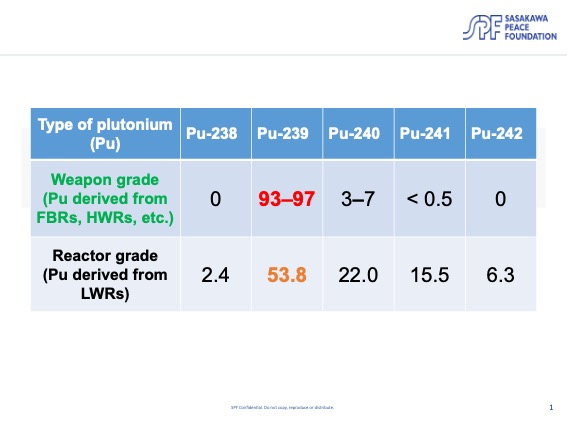
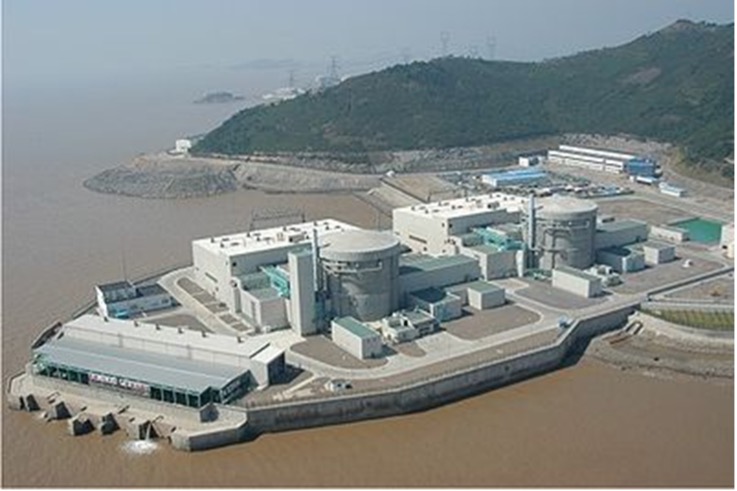
Meanwhile, even though China has stopped reporting its plutonium holdings under INFCIRC-549, it would face a significant hurdle to putting the plutonium produced by reprocessing spent nuclear fuel from the self-proclaimed civilian FBRs and HWRs to military use, because such an act would imperil the national credibility of China. As a nuclear-weapon state under the NPT, China is not subject to IAEA safeguards, but in its agreement with the IAEA in 1988, China declared that “nuclear material and equipment imported to China will only be used for peaceful purposes.”[17] China’s FBRs use fuel imported from Russia, while its HWRs are of Canadian origin. At least, diverting plutonium derived from those currently operational FBRs and HWRs for military purposes would likely amount to a grave violation of an international agreement.
4. Future developments concerning plutonium production and nuclear in China
In light of these circumstances, how China’s stockpile of plutonium will change in the next two years would be an important indicator in assessing the pace of nuclear warhead buildup going forward in China and the upper limit for the number of nuclear warheads. It is thus necessary to continue tracking the stockpile of plutonium and the number of nuclear warheads held by China. I would like to point out a couple of things that need to be done for that purpose.
First, we need to think how to improve the transparency of China’s nuclear strategy. To achieve that end, a nuclear arms control agreement should be entered into between the United States and China, or possibly among the three countries including Russia, to establish a mutual verification system including onsite inspection. However, we cannot expect this to happen under the ongoing difficult international situation. Furthermore, there is unfortunately very little, if any, room for Japan to get involved in arms control negotiations between or among those nuclear-weapon states.
Meanwhile, in preventing the diversion of civilian nuclear technology, which should be pursued as a second option, Japan can play a role and there is room for cooperation with China. Should China divert its civilian technology for military purposes in violation of its agreement with the IAEA, it would lose its face before those countries that joined the NPT as non-nuclear-weapon states and have been subject to stringent IAEA safeguards. The emergence of a country daring to withdraw from the NPT to become a nuclear-armed state could cause a nuclear proliferation domino effect, which would be an unwelcome situation for China. As a country holding fast to its commitment to peaceful use of civilian nuclear technology in cooperation with the IAEA, Japan should strongly urge China to abide by its commitment to peaceful use of civilian nuclear technology. This would contribute to improving the national security environment of Japan, a country that would be directly impacted by China’s nuclear buildup.