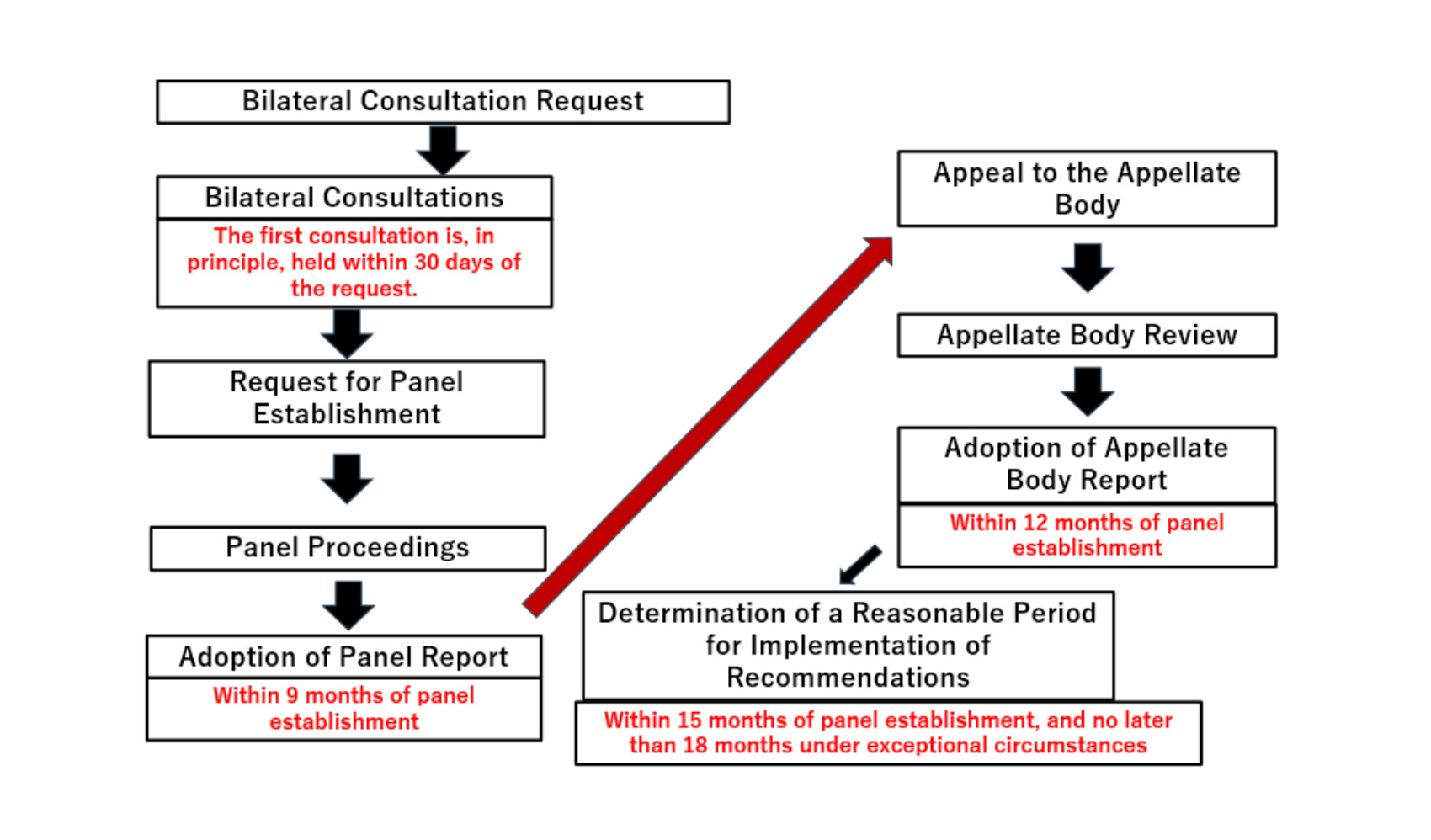
As shown in Figure 2, the WTO dispute settlement system first seeks resolution through consultations among the parties concerned. In this case, consultations failed, leading to the establishment of a dispute settlement panel. Based on the arguments advanced by Japan, the United States, the EU and China, three principal legal issues emerged:
- - Whether the imposition of export taxes violated China's commitment under Article 11.3 of its WTO Accession Protocol not to levy export duties except under specifically authorized circumstances;
- - Whether export quotas and other quantitative restrictions violated Article XI:1 of the General Agreement on Tariffs and Trade (GATT), which generally prohibits quantitative restrictions on exports and imports;
- - Whether China's export controls could be justified under the environmental exceptions of GATT Article XX(b) or the conservation of exhaustible natural resources exception under GATT Article XX(g).
In March 2014, the WTO panel rejected China’s arguments and upheld the claims brought by Japan and the other complainants, finding that China’s export restrictions were inconsistent with WTO rules. China appealed the ruling to the WTO Appellate Body in April of the same year. However, in August 2014, the Appellate Body largely affirmed the panel’s findings and again ruled against China.[17]
This was not the first such case. In 2009, the United States and the EU challenged Chinese export restrictions on nine industrial raw materials, including manganese and zinc. In 2012, the WTO Appellate Body reached conclusions broadly similar to those in the rare earth dispute, finding that China’s measures violated its WTO obligations.[18]
These cases illustrate that during the 2010s, the WTO continued to function as an effective arbiter of international trade disputes and played an important role in enforcing the rules governing the global trading system. Although China accepted certain WTO rulings and introduced limited corrective measures, it also sought alternative legal justifications that would allow it to preserve greater freedom of action in future export control policies. One such justification was the national security exception contained in Article XXI of the GATT. This provision permits WTO members to restrict exports of dual-use goods and other strategically sensitive products when essential security interests are at stake. Because the interpretation and invocation of Article XXI are to a significant extent left to the discretion of individual member states, concerns have long been raised regarding the potential for arbitrary application.[19] Indeed, when China announced export restrictions targeting Japan in January 2026, it justified the measures on grounds of preventing military end use and safeguarding national security.
An even more significant development occurred in 2019, when the first Trump administration in the United States refused to approve appointments to the WTO Appellate Body, citing dissatisfaction with rulings that it believed disadvantaged U.S. interests. As a result, the Appellate Body lost the quorum necessary to hear appeals. Deprived of its highest adjudicatory body, the WTO lost much of its capacity to serve as the guardian of the international trading system and entered a period of institutional paralysis.[20]
5. Conclusion: Policy Recommendations for Japan
An examination of how China developed its capacity to weaponize critical minerals suggests that effective responses will be neither simple nor immediate. Given China’s entrenched position across critical mineral supply chains and the concurrent weakening of international dispute-settlement mechanisms, the effects of Chinese export restrictions are likely to persist over the long term. In response, Japan should adopt a strategy that encompasses short-, medium-, and long-term measures.
First, in the short term, Japan should continue to diversify its supply chains beyond China. Tokyo has already pursued supply diversification by securing rare earth procurement agreements through investments in and financing for mining and processing projects in countries such as Australia and through cooperation with European partners.[21] Admittedly, certain critical minerals, including some medium and heavy rare earth elements discussed earlier, remain difficult to source outside China. Nevertheless, reducing dependence on China has become a shared challenge for advanced industrial democracies. Japan should therefore deepen cooperation with allies and like-minded partners to develop alternative supply chains and strengthen collective resilience.
Second, in the medium term, Japan should seek to establish a limited but strategically significant degree of domestic self-sufficiency. In February 2026, exploratory operations conducted south of Minamitorishima Island confirmed the presence of medium and heavy rare earth elements in deep-sea mud deposits located approximately 5,700 meters below the ocean surface.[22] If Japan can rebuild domestic capabilities in refining, advanced processing, and the manufacture of downstream products such as rare earth magnets, it would significantly enhance its resilience against future Chinese export restrictions. The characteristics of rare earth-rich deep-sea mud may also work in Japan’s favor. Unlike conventional terrestrial ores, deep-sea deposits do not require extensive crushing processes before extraction and processing. Moreover, they contain lower concentrations of radioactive elements such as thorium than many land-based rare earth deposits. Analyses of the Minamitorishima samples likewise detected no significant levels of environmental contaminants. These factors could make the development of a domestic rare earth supply chain both technically and environmentally more feasible than is often assumed.
Third, in the long term, Japan should contribute to restoring the effectiveness of the international trading system. Since the WTO's dispute-settlement mechanism became dysfunctional, unilateral trade measures undertaken at the discretion of individual states have become increasingly common. China’s export restrictions on critical minerals are one example, but similar trends can be observed in tariff policies adopted by major economies, including the United States. Persuading Washington to support the restoration of WTO functions will not be easy, particularly given the recent introduction of additional tariff measures by the Trump administration.[23] Nevertheless, Japan should work closely with countries that share an interest in strengthening the multilateral trading system, including the EU and Canada, while also preparing policy options that could be pursued under a future U.S. administration. There are modest grounds for optimism. The United States has continued to participate in discussions on WTO dispute-settlement reform and has put forward proposals regarding possible institutional changes.[24] Moreover, when President Trump announced a list of international organizations from which the United States intended to withdraw in January 2026, the WTO was notably absent. While far from a guarantee of institutional renewal, this omission offers a small but meaningful basis for hope that progress toward WTO reform remains possible.
Ultimately, there is no quick solution to the challenge posed by China’s weaponization of critical minerals. China spent decades constructing its current position of dominance across critical mineral supply chains, and it is unrealistic to expect Japan to develop an effective counterstrategy within a short period. The most practical course of action is therefore to work closely with allies and like-minded countries while steadily building institutional and industrial capacities capable of minimizing the impact of future export restrictions.