The International Panel on Fissile Materials (IPFM) studies trends in stocks of nuclear materials around the world. In April 2024, the IPFM published the latest data on the stocks of plutonium by country (see Table 1).
Table 1: Stocks of Plutonium by Country
| Country |
Total Plutonium (Pu) (tons) |
Of this, Pu available for weapons (tons) |
| Russia |
193 |
88 |
| United States |
87.6 |
38.4 |
| United Kingdom |
119.6 |
3.2 |
| France |
98 |
6 |
| China |
3 |
2.9 |
| Pakistan |
0.54 |
0.54 |
| India |
10 |
0.7 |
| Israel |
0.9 |
0.9 |
| North Korea |
0.04 |
0.04 |
| Japan |
45.1 |
0 |
Source: International Panel on Fissile Materials
Plutonium needed to produce one nuclear weapon is estimated at 3.5 kilograms, give or take 0.5 kilos, for calculation. This means that if China used its whole stock of plutonium, it would produce up to a little fewer than 1,500 nuclear warheads. This number is almost equal to the maximum nuclear warheads (1,550) that the United States and Russia are allowed to deploy as stipulated in the New Strategic Arms Reduction Treaty (New START) signed between the two nuclear powers. However, in light of nuclear arsenal operation and management, it is unrealistic to deploy all warheads these countries hold. The United States and Russia each have stockpiles of more than 3,000 non-operational nuclear warheads. If China had a strategic vision of deploying as many nuclear warheads as the United States, the country would need to do something about the present state, in which it holds less plutonium than the United Kingdom and France that have fewer nuclear warheads than China (the UK: 225, France: 290[3]) in order to produce more plutonium. It would also be essential that China increase its stockpile of non-operational nuclear arms. This is why the FBR in Fujian Province is attracting attention.
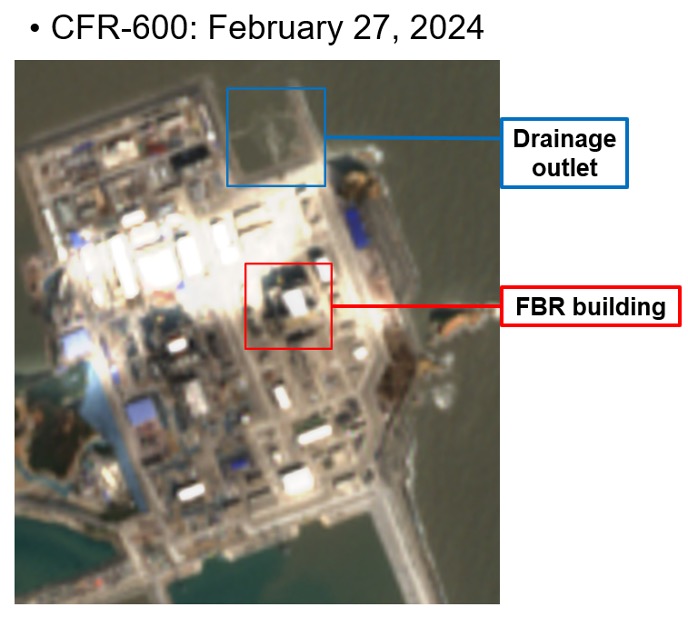
According to an IAEA report, in 2017, China began the construction of this FBR named CFR-600 (maximum output of 600 MW) in Fujian Province.[4] The report states “The first fuel loading will be launched at 2023,” and in late 2022, core fuel was delivered from Russia. Furthermore, in July 2023 and thereafter, a massive discharge of water into the sea was continuously observed, apparently after cooling the reactor. This indicates that CFR-600 came into test operation in that summer or thereafter (see Satellite Image 1).
Satellite Image 1: Swirls of Water Discharged from the Drainage of CFR-600