According to a report from the International Atomic Energy Agency (IAEA), China began building an FBR named CFR-600 (with a capacity of 600 MW) in Fujian in 2017 [4]. On December 28, 2022, the Russian state-owned atomic energy corporation ROSATOM announced that it had delivered the initial fuel load necessary for the FBR's operation to China [5]. In October 2023, Sasakawa Peace Foundation confirmed, based on the analysis of satellite images, that steam was coming out from a ventilation stack and concluded that the reactor was ready to start operation (refer to “China's Fast Breeder Reactor Operating? Possibility of Accelerating Nuclear Arms Race” by Yuki Kobayashi). However, the Chinese government and China National Nuclear Corporation (CNNC), the FBR's operator, have not revealed any information on CFR [6], and there is other information suggesting a delay in its operational plan. Accordingly, we decided to analyze satellite images again with experts.
Whether steam was coming out from the ventilation stack can be confirmed with high-quality, high-resolution images, which are difficult to acquire. This time, we focused on water drainage from the facility instead. To keep reactor facilities from reaching high temperatures, a nuclear power station, including those with an FBR, draws a large amount of water from a river or the sea, making it circulate through pipes and drain out for cooling. While the reactor is running, a substantial amount of water is constantly drained out from a large drain outlet, around which water whirls can clearly be identified in satellite pictures of average image quality. At the end of last year, the IAEA announced that an experimental reactor that was being built in Nyonbyon, North Korea, showed signs of starting operation [7], citing drained water as one piece of evidence. Water drainage can be a factor in determining whether CFR-600 has started operation.
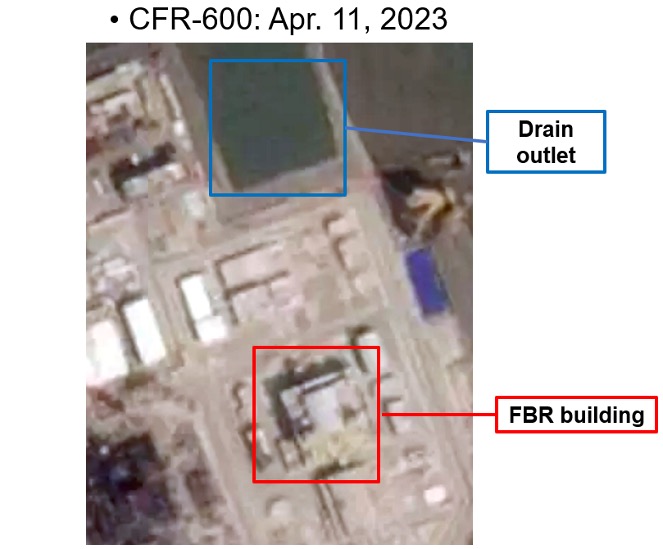
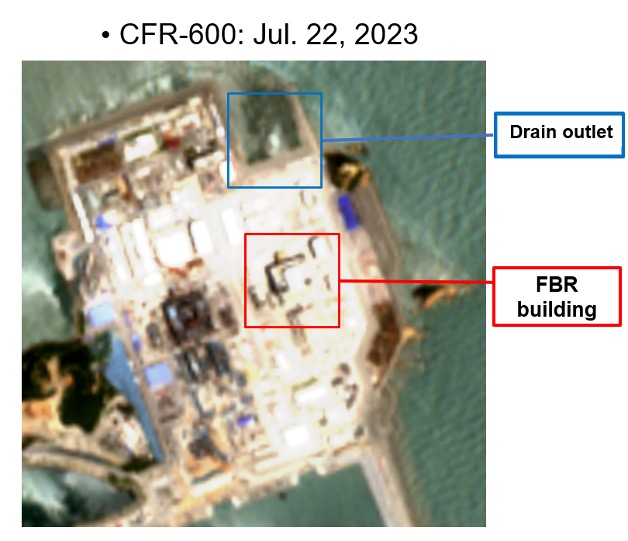
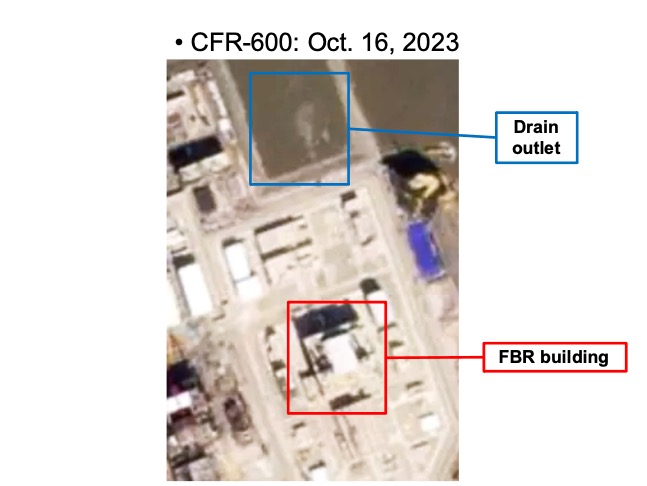
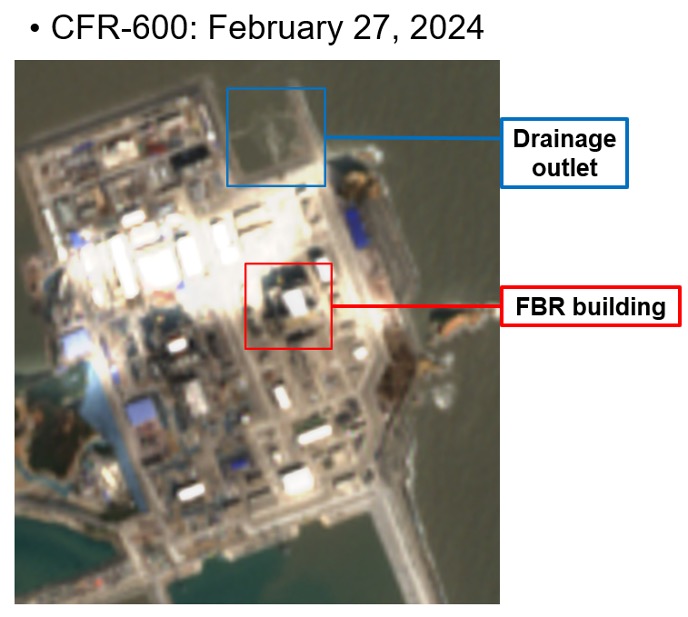
The following satellite images of the FBR's grounds (Satellite Images 1, 2, 3 and 4) were taken on April 11, July 22 and October 16, 2023, and February 27, 2024, respectively. Located along the coast, CFR-600 uses seawater for cooling. Let's look at the portion facing the sea, above the building housing the reactor.
Satellite Image 1