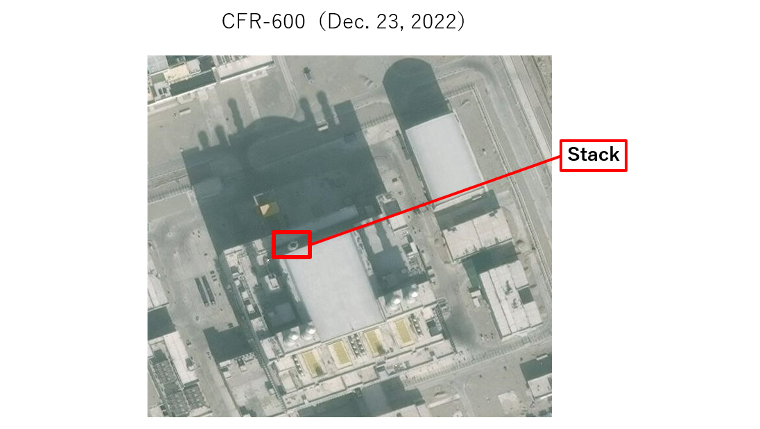
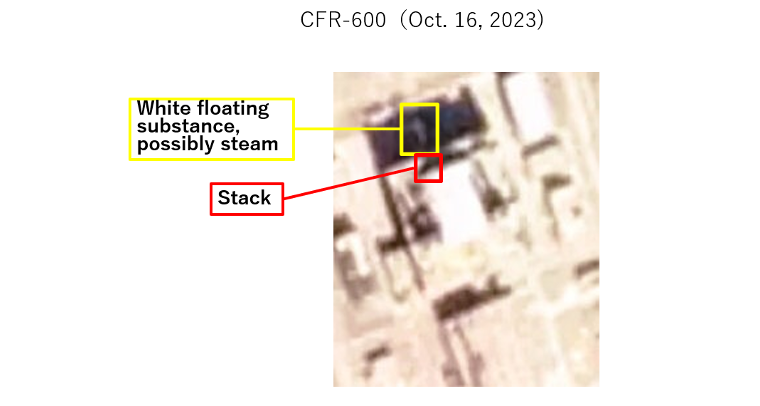
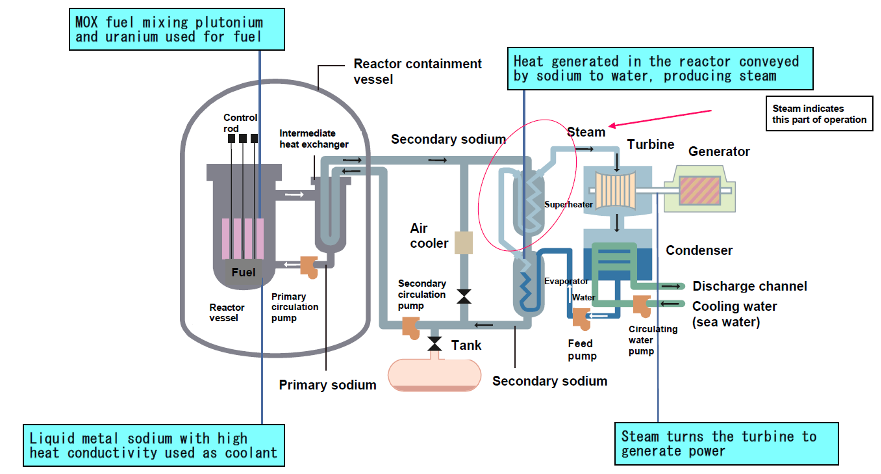
(Source) Provided by Tomonori Iwamoto: https://www.ene100.jp/www/wp-content/uploads/zumen/7-6-1.jpg
Monju's experience before it started operation also corroborates Iwamoto's analysis.
Table 1: Main Chronology of Monju
| May 1991 |
Buildings housing FBR, turbine completed |
| December 1992 |
Start of performance test |
| April 1994 |
Achieve first criticality |
| July 1995 |
Start of power generation, transmission |
| December 1995 |
Fire caused by leaking of sodium used for cooling reactor; prolonged suspension of operation |
| May 2010 |
Resumption of operation |
| August 2010 |
Fall of 3.3-ton equipment inside reactor; suspension of operation |
| December 2016 |
Government decides to decommission Monju |
(Source) Created by author based on Japan Atomic Energy Agency (JAEA), “Fast Breeder Reactor Monju” [in Japanese]
In the case of Japan's Monju, it took 16 months to insert fuel into the reactor, start the performance test, and reach first criticality,[6] i.e. to start nuclear fission of fuel in the reactor and begin operation. Iwamoto pointed out that, “The situation in China is different from Japan with strict safety reviews. Also, if the FBR in Fujian Province is meant for military use and the purpose is to obtain plutonium, there will be no need to do any detailed inspection of the power generation and transmission facilities, so the amount of time before the start of operation will be much shorter than Monju.”
Since the first load of nuclear fuel was delivered by Russia late last year, it is reckoned that performance test started in the January–March period this year. At least seven months have passed since then, and considering plans for the initial phase submitted to the IAEA stated that operation will start this year, it is highly possible that Satellite Image 2 is an indication that reactor operation has started, as Iwamoto maintained.
The successful operation of this FBR will mean a great leap in China's capacity to produce plutonium needed for nuclear armament. Looking at the history of nuclear arms development of other countries, graphite reactors were usually used by the advanced nations during the initial period of atomic energy use and are currently used to produce weapon-grade plutonium in countries with inferior technological capability. Graphite reactors use natural uranium directly for fuel, so production of fuel does not take a long time. It is also easy to extract plutonium for nuclear weapons by reprocessing spent fuel. On the other hand, plutonium content in one spent fuel rod is merely one gram, so it is necessary to incinerate a large amount of fuel repeatedly to produce weapon-class plutonium. North Korea uses graphite reactors for its nuclear development.
Meanwhile, in addition to the CFR-600, China is building another FBR, aiming at start of operation in 2026. Steady operation of the two FBRs alone will enable China to acquire up to more than 330 kilograms of weapon-class plutonium each year, and it is estimated that its stockpile of weapon-class plutonium will be 2.9 ± 0.6 tons at the end of 2030. Since one nuclear warhead is calculated to require 3.5 ± 0.5 kilograms of plutonium, this translates into 830 ± 210 warheads. This shows that the U.S. Defense Department's analysis that “China will have over 1,000 nuclear warheads by 2030” is compatible with the projected increase in China's production of plutonium.
Two points must be borne in mind when monitoring China's FBRs from now on.
First, China has consistently insisted that its FBRs are for civilian use. If so, it is not subject to criticism from Japan and other countries. However, even in the case of civilian use, China needs to proactively offer proof to the international community, such as by accepting IAEA inspections. China is allowed to possess nuclear arms under the Nuclear Nonproliferation Treaty (NPT), and it has no obligation to accept IAEA inspection, but it is in a position to serve as model for other countries in terms of non-conversion of nuclear technology and nuclear substances for civilian use for military purposes. There is room for Japan to offer cooperation in this area. Historically, Japan is the only non-nuclear power that is allowed to use technology to reprocess spent fuel to extract plutonium and to operate FBRs. It has cooperated with IAEA to develop the inspection methods and monitoring technology to verify civilian use. It should play a unique role in calling on China, its neighbor, to adopt such technology to prevent conversion to military use.
Second, even in case of conversion to military use, China will not be able to acquire a substantial amount of plutonium immediately. There are also technical challenges in the operation of FRBs, which have caused Western countries to withdraw from FBR development or freeze their development plans. A particular problem is the difficulty of managing liquid sodium, which reacts violently and becomes combustible when in contact with water or oxygen. Leakage of sodium from the pipelines started a fire in Monju, resulting in prolonged suspension of operation (see Table 1). Even if the reactor operates smoothly, production of a sufficient amount of plutonium will not be possible in around two years. Furthermore, plutonium produced in the reactor cannot be used for nuclear weapons directly; reprocessing is required. According to Iwamoto, reprocessing of FBR spent fuel requires more sophisticated technology than the reprocessing of spent fuel of regular reactors currently used by Japan and other countries. Since China will also have to establish such sophisticated reprocessing technology, it will need at least three years to set up a system for mass production of plutonium. During this period, Japan and the international community must apply strong pressure on China not to convert nuclear substances for military use.