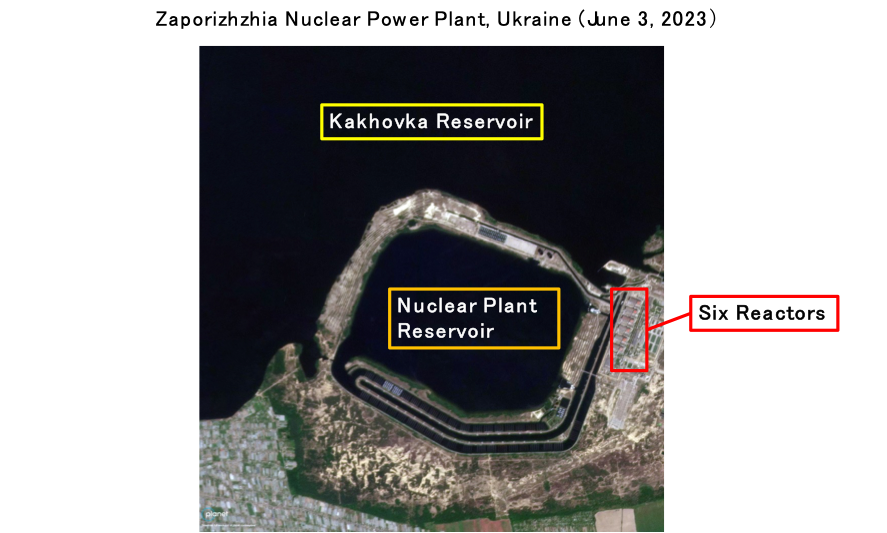
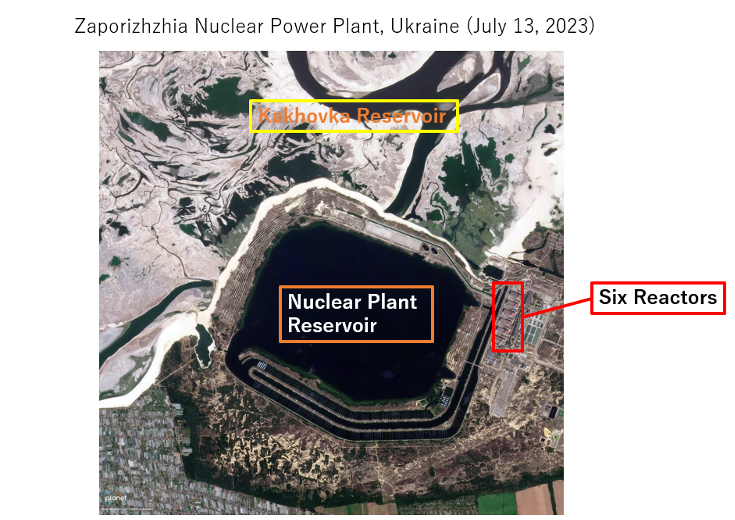
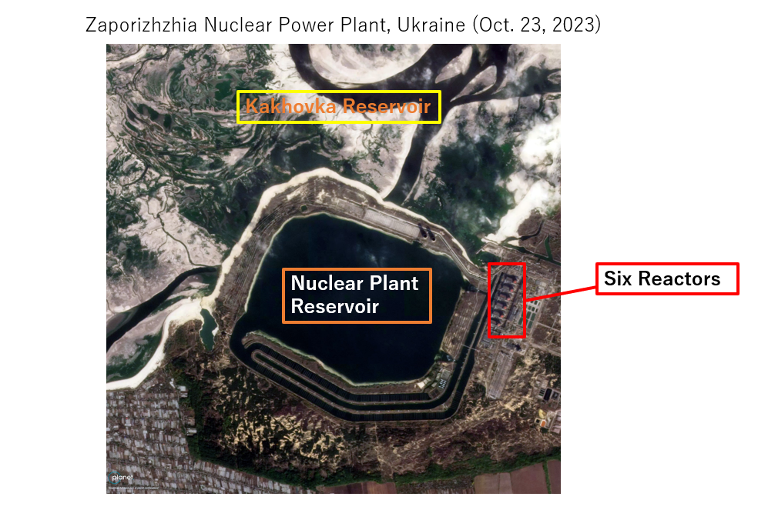
Eighteen months have passed since the Zaporizhzhia Nuclear Power Plant in southeastern Ukraine, the nuclear plant with the top power generation capacity in Europe, was captured by the Russian forces. In August and September 2022, there were bombings around the nuclear plant, which both Ukraine and Russia blamed on the other side, giving rise to concerns about massive leakage of radioactive substances caused by damages in the reactors and spent fuel. However, there is now another problem. In June 2023, the Kakhovka Dam located in the lower reaches of the Dnieper-Kakhovka Reservoir, which is the source of cooling water for the nuclear reactors, was breached. Subsequently, the reservoir was found to have dried up. At about this time, the reactors at Zaporizhzhia have frequently reached temperatures above 100oC. While high temperatures in the reactors may not necessarily lead to any immediate danger, the discontinuation of cooling water injection leads to the evaporation of water in the reactors, causing the nuclear fuel to stick out from the water surface, which may activate a meltdown from its own heat.
What is the situation at the nuclear plant's reservoir today, five months after the destruction of the dam? Is the condition of high temperatures in the reactors related to the condition of the reservoir? At Sasakawa Peace Foundation, we examined the situation at the nuclear plant using newly acquired satellite images and reports by the International Atomic Energy Agency (IAEA).
There are six Russian pressurized water reactors called VVERs operating at the Zaporizhzhia NPP. In the reactors, power is generated by sending high-temperature, high-pressure water produced by heat generated with nuclear fuel to the steam generator, which produces steam fed to the turbines. While the VVER was developed by the former Soviet Union, the ones used at Zaporizhzhia are third generation VVERs, which have containment vessels protecting the reactors, thus ensuring a level of safety comparable to that of Western technologies. Each of the six reactors has the capacity to generate 1,000 MWe (megawatt) of electricity, making a total capacity of 6,000 MWe. This capacity ranks third in the world, after TEPCO's Kashiwazaki-Kariwa Nuclear Plant (total capacity of 8,212 MWe for its seven reactors) and one other nuclear facility. Until the start of the Russian military invasion on Feb. 24, 2022, Zaporizhzhia NPP accounted for 20% of power supply in Ukraine. On Sept. 11, 2022, its No. 6 Reactor, the only one left running after the seizure, was shut down for security reasons, ending the operation of all reactors.
Temperature remains high for some time and massive amounts of heat continue to be produced inside nuclear power generation facilities even if reactors are shut down and nuclear fission of the fuel is stopped. Therefore, it is necessary to inject water into the reactors to cool the nuclear fuel. This means that water source is vital for nuclear plants.
However, the destruction of the Kakhovka Dam in the lower reaches of the water source in the Russian-occupied area on June 6, 2023, is preventing the securing of water source. Ukraine and Russia both accused the other party of sabotage, but it is reckoned that the breach was caused by explosives placed by the Russian side to obstruct the Ukrainian forces' counteroffensive.[1] The Dnieper River, which lost its capability to control the flow and amount of water, rushed straight into the Black Sea, and the Kakhovka Reservoir dried up soon after the dam was destroyed. Sasakawa Peace Foundation, in cooperation with Prof. Hidenori Watanave of the University of Tokyo Graduate School, a satellite image analysis expert, compared and analyzed satellite images before and after the dam's destruction to investigate changes in the [Zaporizhzhia NPP's] water reservoir and its present condition.