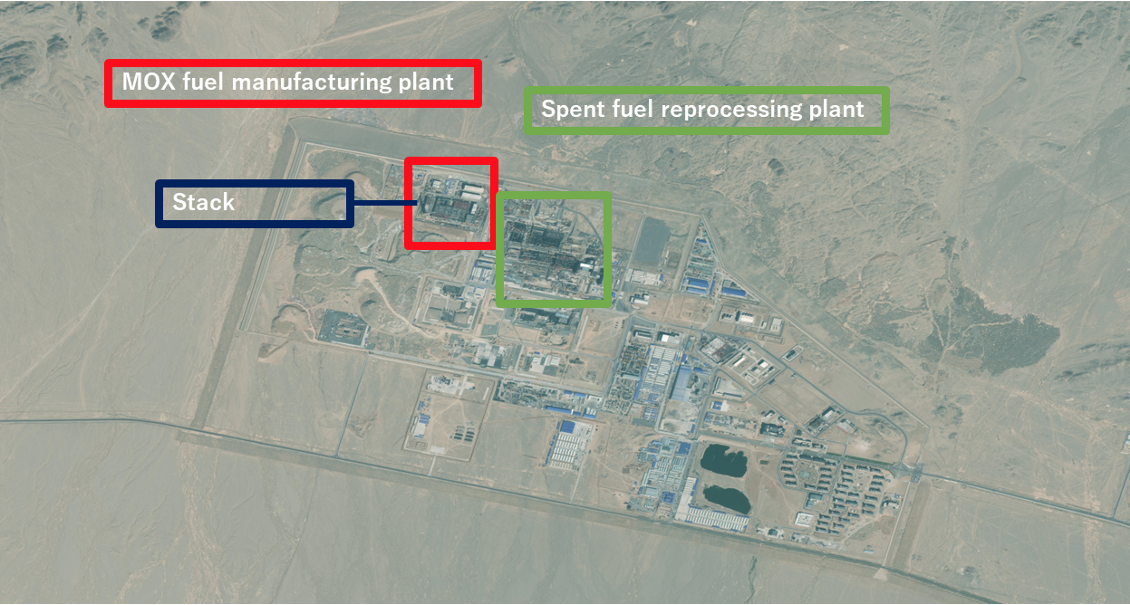
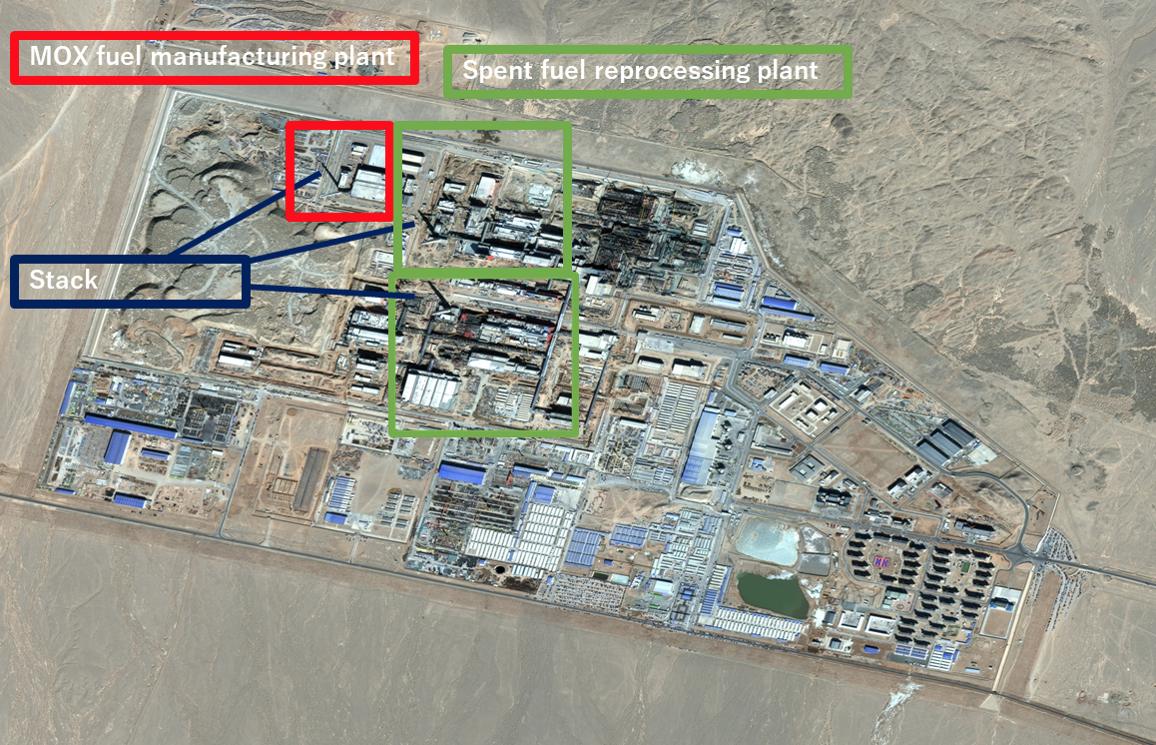
The reprocessing facilities which extract plutonium from spent fuel used in conventional nuclear reactors are marked with green squares and the MOX fuel plant which mixes the extracted plutonium with uranium is marked with a red square. While this may be a bit difficult to see in Satellite Image 1, which was taken from some distance, in Satellite Image 2, Plant 1 (below) and Plant 2 in the reprocessing facilities can be distinguished.
Comparing the two images, one can clearly see that the construction has advanced over the three years. Tomonori Iwamoto, Secretary General of the Institute of Nuclear Materials Management (INMM) Japan Chapter notes that a white tower (stack) protrudes from Plant 1 and Plant 2 respectively in Satellite Image 2. These are marked with blue lines on the images, and their long shadows are clearly shown, demonstrating that these structures are substantially high. These are facilities for the shearing and dissolving of spent fuel in the first process of extracting plutonium from spent fuel, and because minute quantities of radioactive gas are generated in that process, they are discharged from the stacks. According to Iwamoto, the reprocessing of spent fuel passes through the following four processes.
(1) Shearing and dissolving: The spent fuel is broken down into small pieces and immersed in nitric acid.
(2) Separation: The uranium, plutonium, and other fission products that have been dissolved in nitric acid are separated.
(3) Refining: The uranium and plutonium are each refined.
(4) Productization: The uranium and plutonium are powdered and made into a form that is suitable for MOX fuel fabrication.
The nuclear fuel reprocessing facility at Rokkasho Village, Aomori Prefecture in Japan has already cleared all of the above processes in trial operations. However, after productization, problems emerged in the vitrification process of mixing highly radioactive liquid waste generated in the reprocessing process with glass raw materials for final disposal. Operations were delayed because it took time to resolve this and because new safety measures works became necessary after the 2011 disaster at the Fukushima Daiichi Nuclear Power Plant.
Satellite Image 2 shows that at the Kansu Province site, the facilities for process (1) have been completed at both Plant 1 and Plant 2, and further that the foundation construction for the other processes has been completed at Plant 1, which has reached the stage of carrying in equipment. Based on such facts, Iwamoto notes that “there is a high possibility that at least Plant 1 will begin operations within a few years.”
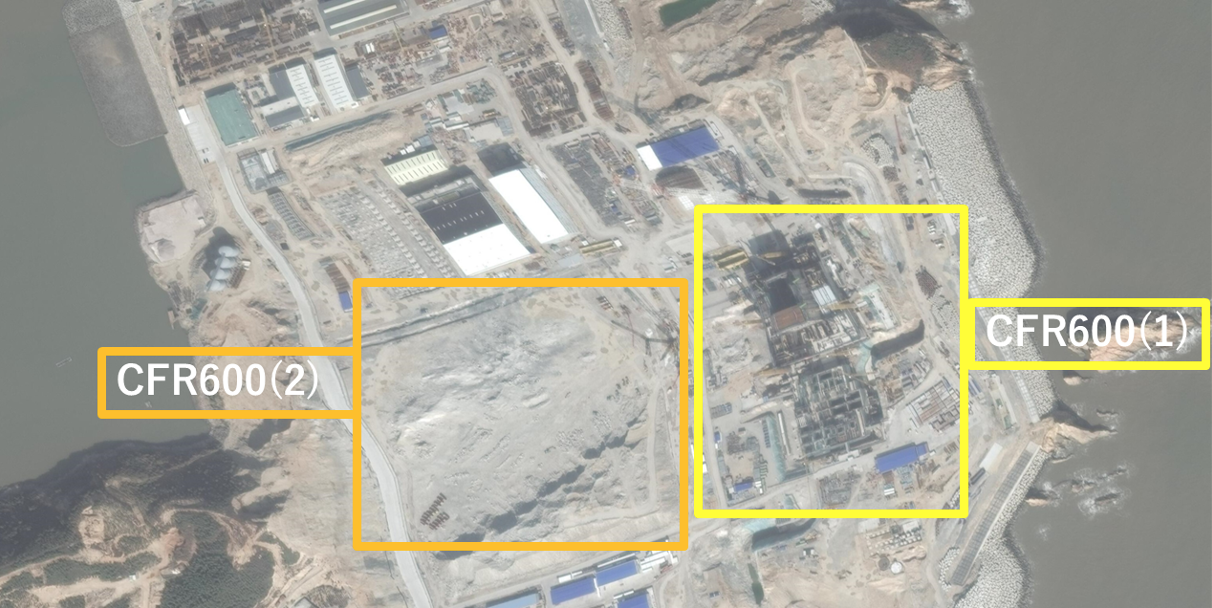
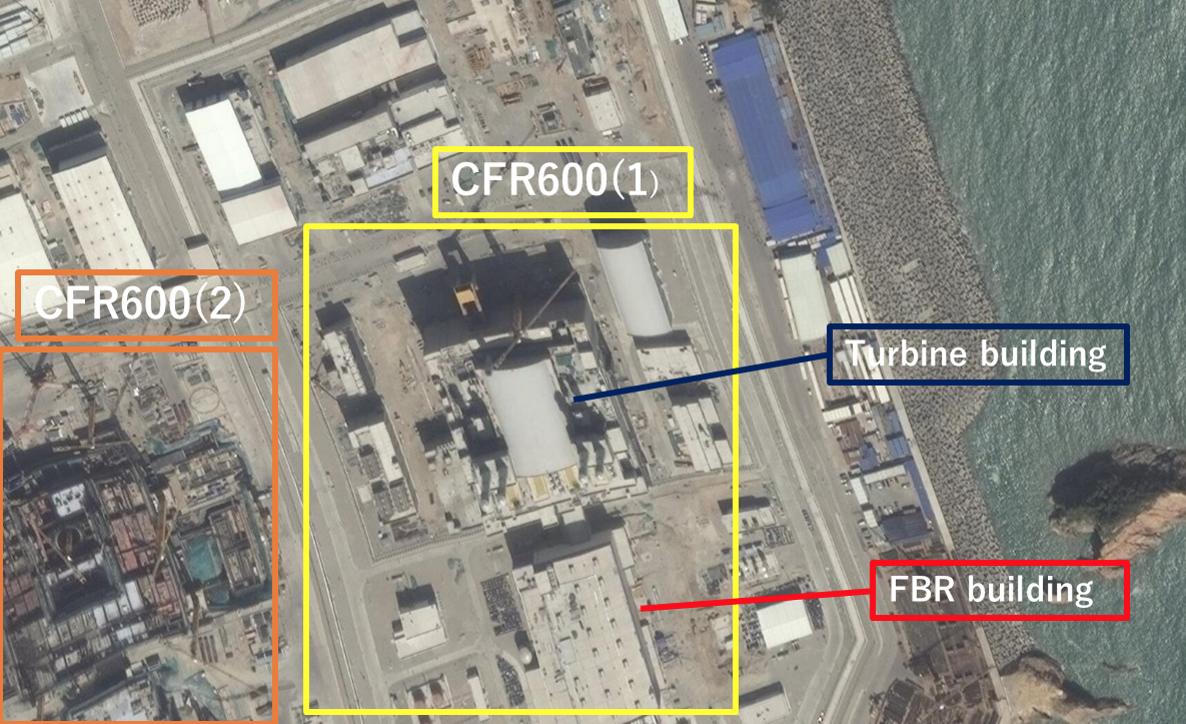
FBRs which are expected to use the plutonium generated from the reprocessing plants “produce” new plutonium from the nuclear fuel reaction during operations, enabling the recovery of more plutonium than the amount that is input, so they are known as “dream nuclear reactors.”[4] Japan led technological development toward the commercialization of FBRs together with the US and France, and was operating the “Monju” FBR. However, there are difficulties with the control of the sodium used to cool the reactor, and at present the development of FBRs has been ceased or suspended aside from Russia and China. China is constructing two large FBRs called CFR600 near the coast in Fujian Province, which are scheduled to begin operations in around 2023 and 2026 respectively.
The following photographs are satellite images of the FBRs construction site. Satellite Image 3 was taken on January 30, 2020 and Satellite Image 4 was taken on September 30, 2022.