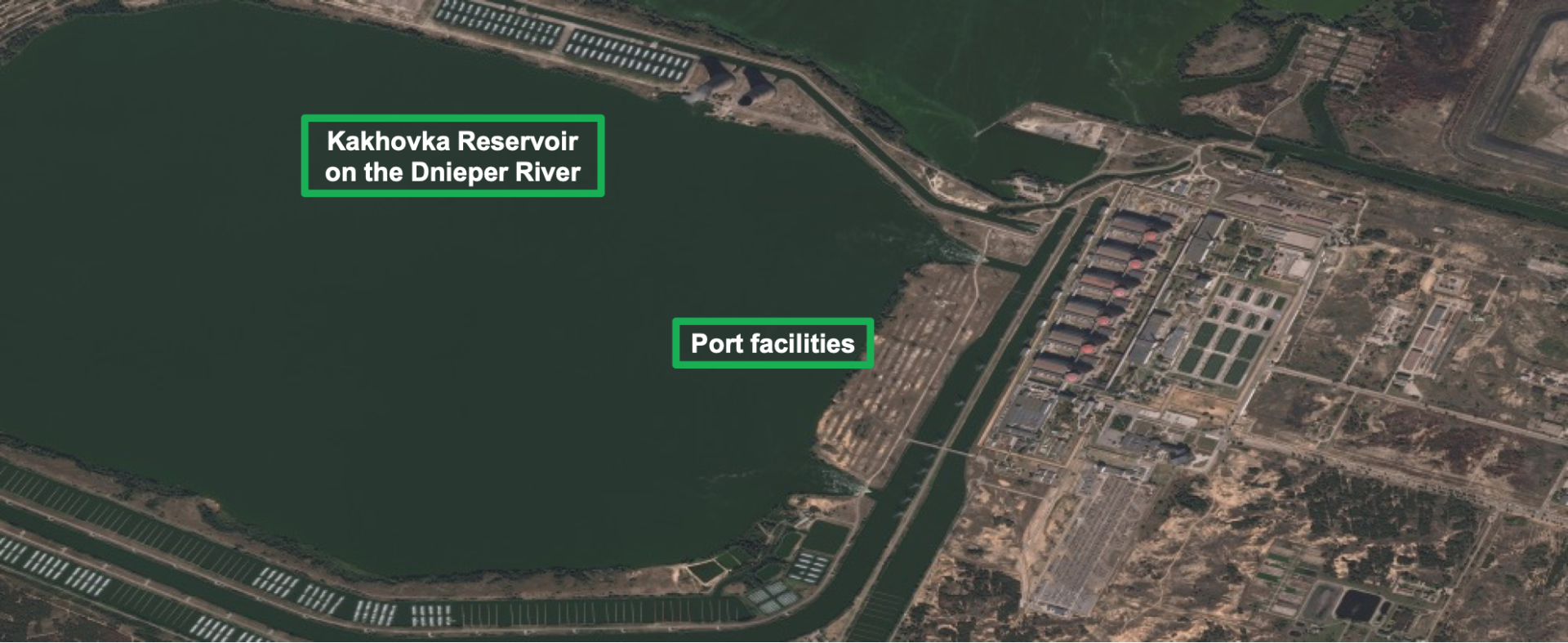
In Satellite Image 3, another characteristic of nuclear power plants is observable. Since a huge amount of water is needed to cool reactors, the presence of abundant water resources nearby is essential. The Zaporizhzhia NPP is located on the shore of the Kakhovka Reservoir on the Dnieper River. When we look at the reservoir in Satellite Image 3, we can see piping systems to supply water to reactor buildings and extensive port facilities for receiving nuclear fuel and other shipments.
The Dnieper River, which originates in the Valdai Hills (at an altitude of 220 m) in northern Russia, runs through Belarus and across Ukraine—passing through its capital city of Kiev, Zaporizhzhia, and the southern part of the Kherson Oblast—before flowing into the Black Sea. It is a major river with a total length of approximately 2,290 km, and vast stretches of land along its basin are covered with fertile black soil. For this reason, the central and southern parts of Ukraine have been called the “Breadbasket of Europe” since the time of Czarist Russia. Today, Ukraine is the fifth largest wheat exporter in the world, making agriculture its main industry. According to data for 2019 and 2020 from the State Statistics Services of Ukraine, crops account for 19% of the country's total exports (which are worth about 49.2 billion dollars).
Ironically, an aspect of this fact serves to increase the value of the Zaporizhzhia NPP as a “nuclear shield.” In the event of a massive discharge of radioactive substances, the damage would have an immeasurable impact on global food security. Moreover, should this happen, radioactive contamination would spread into Russian-controlled Crimea as well as wide areas across Europe. Energoatom, the Ukrainian state enterprise operating the Zaporizhzhia NPP, has already published projections on the possible spread of radioactive substances[2].
Potential causes that could lead to such a disaster include damage to power cables and resulting control room inoperability and/or loss of the reactor cooling function. When the reactor cooling function is disabled, the temperature and pressure inside the reactor rise to abnormal levels as nuclear fuel rods begin to melt, rupturing the reactor itself and the containment vessel protecting it. Furthermore, a large amount of hydrogen gas is generated in the meltdown process. The gas is released from the reactor and accumulates inside the building housing the reactor and reactor vessel, causing an explosion and hence a massive discharge of radioactive substances into the environment.
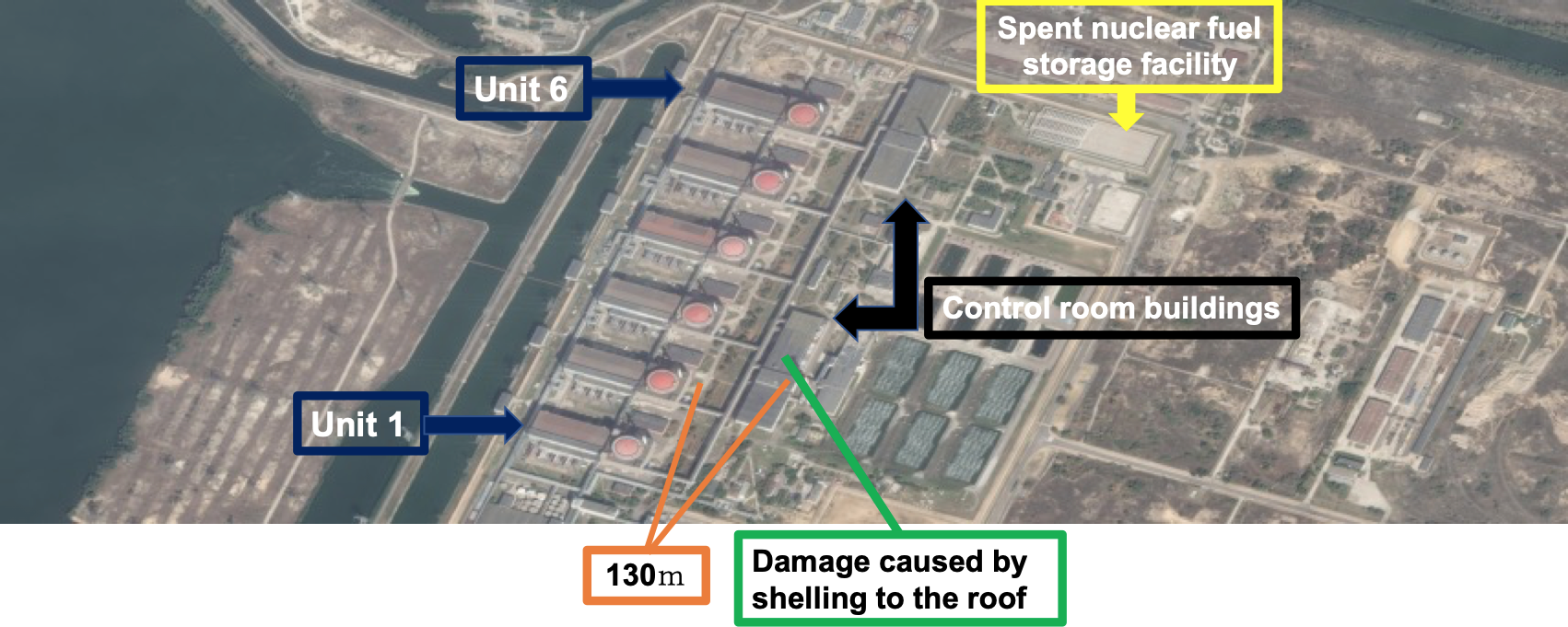
Satellite Image 1 reveals another point of concern. The IAEA inspection confirmed damage caused by shelling to the roof of a building believed to house a central control room, as indicated in green in the image. The building is only 130 m away from the Unit 2 reactor building, indicating that the Zaporizhzhia NPP is in grave peril.
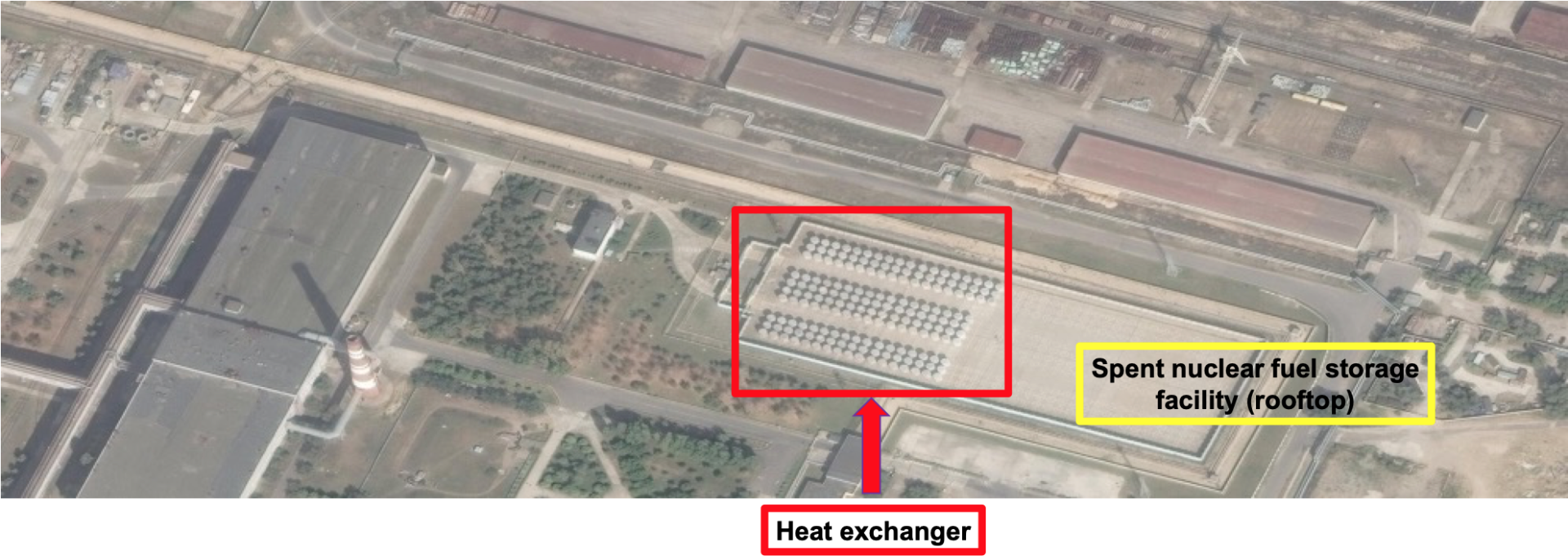
Proper management of spent fuel is also of critical importance. Unlike reactors, which are made of high-strength steel and individually protected by containment vessels so as to withstand even the impact of an intentional plane crash, the spent fuel storage facility shown in Satellite Image 2 is vulnerable to external attacks. If exposed to the atmosphere, the spent fuel stored inside the building will generate radiation.
Although all reactors at the Zaporizhzhia NPP are currently shut down, this does not mean that safety is secured. Even after reactors are turned off, they need continual cooling as nuclear fuel continues to generate enormous heat. When nuclear fuel rods begin to melt, things develop quickly, and crises cascade with one triggering another. In the case of the Fukushima Daiichi accident, a sequence of events—an explosion at the Unit 1 reactor building, another at the Unit 3 reactor building, damage to the containment vessel for the Unit 2 reactor, and an explosion and fire at the Unit 4 spent fuel pool—occurred in a space of five days after the devastating earthquake and tsunami hit the nuclear power plant. Following the explosion and fire at the Unit 4 spent fuel pool, the Japanese government assumed the possibility that eastern Japan could become mostly inhabitable in the worst-case scenario[3].
In the light of all these circumstances and prospects, the IAEA is currently consulting with both Russia and Ukraine to establish a “safety and security zone” at the Zaporizhzhia NPP and in its vicinity. Amid reports of Ukrainian forces deploying troops on the bank of the Dnieper opposite the plant in a counteroffensive, I sincerely hope that the two countries recognize the magnitude of potential threats posed by nuclear power and avoid a situation that would cause a far-reaching impact across the region including neighboring countries.