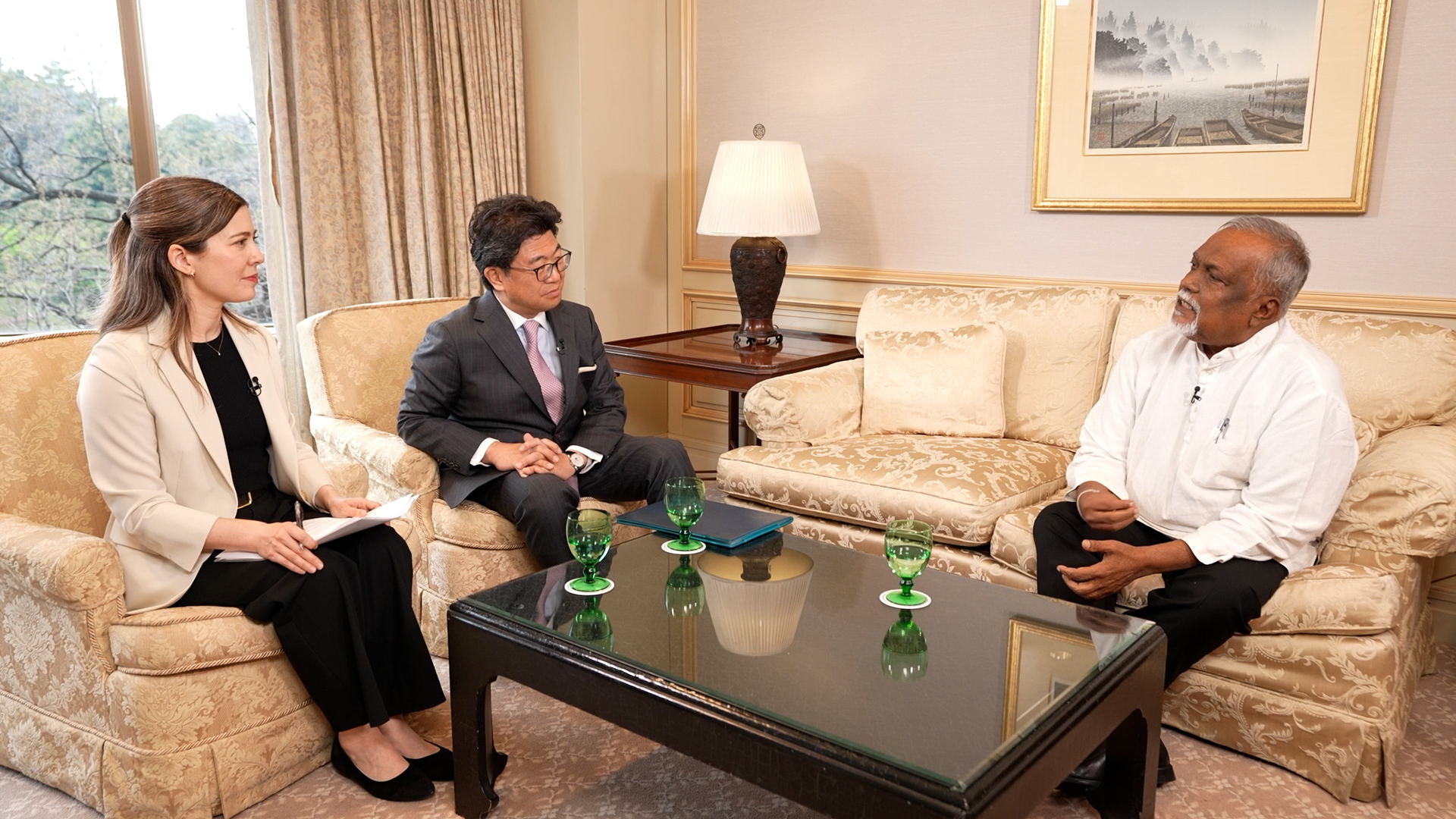
I'm pleased to welcome you to a conversation about peacebuilding in practice. First, I would like to ask Mr. Harsha, given your decades of experience working in communities and on the ground in Sri Lanka, as well as your very international perspective, I hope you can tell us about what the current situation is in Sri Lanka at this time. What is happening on the ground?
Mr. Harsha:
Well, I have to first tell you that there were several other personalities who have committed to bring peace back to Sri Lanka.
When peacebuilding, there are several roles to play. My role is mostly in the development aspect, where people, when they lost their houses, they were in the refugee camps. So our task with The Nippon Foundation and the Sasakawa Peace Foundation was really bringing these people back to their homes. That is how we started peacebuilding.
But there were many other actors. When peacebuilding is there, there are several roles, very important roles. One is human rights. So, there were a lot of human rights defenders in Sri Lanka who have committed a lot with a lot of challenges, the various challenges they faced.
Then there are people who really trained others on peacebuilding. All of them have contributed a lot. So, my role was really bringing people back to their own homes because these people have left everything, they lost everything. They were pained, they were sad, they were angry, they lost everything.
So, bringing them back. Altogether, 350,000 people lost their houses. They lost their breadwinners. They lost their people. So, for us, bringing them back to their original places was not a simple thing. Because you have to give them confidence. You have to give them hope that, you have a future, your children will get education. You will go back and build your own economy.
So, if you really look at the present situation, we have done a huge work with the international community. And people, like I have mentioned here, after the 30 years of war, the first outsider who had gone to the war area where everything was broken, there were no roads, houses were broken, no schools, nothing, bridges were broken.
The first person who visited was actually Sasakawa san. He visited and he promised to our president, to our country, to our people, that The Nippon Foundation and the Sasakawa Peace Foundation will help. So, The Nippon Foundation started building up houses, schools, and we have built up 100 schools.
And the Sasakawa Peace Foundation brought other experiences, starting with all the religious leaders. We brought them together. They were angry with each other. It was not possible for a Buddhist monk to sit with Catholic priests and Muslim imams, but they all got together and discussed everything and that is how we have built up peace in the country.
Today, the people have gone back and people do not remember. Most of the youngsters cannot remember there was a war for 30 years.
So, I think Sri Lanka is one of the best places where reconciliation and reintegration was done. But still, a lot of things have to be done because there are certain aspects in Sri Lanka where some of the extremist groups, with their nationalism and all kinds of other stuff, are still disturbing the building of peace.
So, some of us and other people like human rights defenders, other peacebuilders, are all working towards real long-term peace.
I want to touch on that point you mentioned. Of course, with 30 years of conflict and then a long peace mediation process, what were some of the difficulties or challenges experienced in that process and what did you learn from that experience?
Mr. Harsha:
The most important thing is, we have a 1.5 million diaspora, the people who have left Sri Lanka. Out of the 1.5 million, around 1 million are actually from minority Tamil groups who have left due to war, due to this conflict.
So, they have gone with the pain. Some of them have certainly gone with anger. So, the diaspora community still does not know what's going on back in Sri Lanka. They were refugees, and since I was a High Commissioner in Canada, I met some of them, and I have listened to them.
Some of them have lost their father, some of them have lost their mother. They have lost everything. So, they can only remember what has happened to them. But they do not know that now, things have come back to normal, they can go. Now, if you go to Colombo, there are certain areas where the only-Tamil communities are living peacefully. You can go anywhere, everywhere.
But those things are not so known to those people who are in the diaspora community. And I don't blame them. But they still think it was an injustice, something which was done by the majority community to them. That's why they were like that.
So, it's a huge challenge because if you really look at it from the Canadian point of view, the minority vote base is very strong. So, if you really look at it, myself, the Indian High Commissioner, the Bangladeshi High Commissioner, we always, when we get together in Ottawa, discuss that.
Because of this minority vote base, even the government decisions are biased to that. Whenever I meet foreign ministry people, I can understand that they don't look at the reality.
So, when you are asking about the challenges, the international community sometimes does not understand the real issues back home. They are just looking at it from their own perspective and most probably, they are looking at other – If you compare the Middle East or an African country, with an Asian country, our culture is different. Our way of thinking is different. How we live is different. Our civilizations and values are different.
So, these are the two different ways of looking at it. So one of the biggest challenges is, the Western way of looking at peacebuilding is another challenge. So, there are two challenges from the outside. The diaspora, and also the western way of looking at peacebuilding. Internally, there are still a lot of extremists. Because in the south, people think, "We are winners." In the north, people feel like, "We are losers."
So, when there is that psychological barrier, one group is thinking, "We won. Why should we have to do this and that?" There are certain injustices that have happened to the minority. So, this has to be done through justice, through human rights value systems.
But if those things are not done, we have not really done the right thing for the people who are affected, who are victims. That is how the winners are looking at it.
So, some of the extreme groups from the south do not understand that there are international obligations for a country to look into the injustices that have happened. And for people who have lost their breadwinners, what has happened to them, where are they? That has to be answered.
Then the minority group also has to come and understand that now, the war is finished. We have to integrate, we have to look into it, things like that. So, those are some of the internal challenges.
If you really go back to a historical perspective, they were actually looking at their own way of governing in the north and east. So, then there has to be a constitutional aspect also. That needs to be done. So, those are internal challenges.
I think, I hope, the new government and new president is committed to do some of those things and carry on. So, we hope, in the coming future, there will be more positive results.
And I'm curious, as someone who's been working, again, with your decades of experience, and also experiencing this 30 years of conflict, has your perspective about the concept of peace – How would you define the concept of peace or has that evolved for you over time? Could you talk a little bit about that as well?
Mr. Harsha:
Well, since I'm more than just a development worker...I started as a filmmaker. So, I'm an artist. Now, for the last 30 years, I didn't do any film. But immediately after the war finished, we had done a music festival. So, that was one of our main ideas to bring back the youngsters to art, music, that kind of thing.
Because without discussing other aspects – we try to look at where youngsters, people can get together. So music, or art was one of the main things. So, for me, even today, when we are looking back – because now, in South Asia, the biggest issue is the radicalization.
If you really look at it, the people, or the youngsters don't believe in the present democracy. So, they feel like in the name of democracy, the politicians win the majority vote, and they come and then they try to corrupt the whole system. So, the youngsters have lost their trust in the system. So, when you look at it in social media, that's their anger, and they refuse the present social structure.
So, for me, I think, today's peacebuilding has to be redesigned differently, thinking about how we can change the way these youngsters are thinking. Because their answer is coming out with hate speech. And they sometimes look into fake news because social media is so strong.
So, presently, yesterday also, I talked to Sasakawa san about whether we can look into it more artistically to turn this social media into more music, more culture, more art, work together with some of the leading music universities in India, in Thailand and Sri Lanka, get together, work together, and bring youngsters where their message can be brought up in a more artistic and non-violent way.
So, presently, the challenge is how to bring social media into a more positive way to look at. So, to do that, we need to look more into the cinematics, music, art, culture. So, that is something that I am just looking at.
I just returned from India, meeting some people in culture, because Bollywood is so influential in South and Southeast Asia. So, I am interested to learn more about... Like how Korean music is influencing South Asia a lot.
So, it's a very important thing that I would like to discuss with the Sasakawa Peace Foundation and The Nippon Foundation, whether we can do something in Southeast Asia and South Asia to work based on culture, music, art, to bring the social media messages for youngsters, to bring them out of this hate speech and things like that, because their energy is very important.
Their power is very important. They are the future. 50% of our population is under 30 years old. So, that is something that we need to be doing. So, when you are asking about challenges on the future, present, peace, I think it's bringing youngsters back to positively answer their challenges in democratic society.
Thank you very much. Dr. Sunami, I'd be interested to hear about your response to these comments. Was there anything that struck you? I think we covered a lot of context in Sri Lanka, but also talking about the power of music and art and how that plays into these discussions as well. I was wondering if you had anything to add?
Dr. Sunami:
Well, first of all, I think the idea to actually separate some of the processes that are going on in the peacebuilding, depending on the phases of the development, and, of course, at the moment, people are looking at the conflict areas before they even reached a ceasefire agreement.
In other words, how to stop the killing first. And once you reach that phase, then we have to start thinking about how to build a new society that harmonizes the two sides and the conflicted area to take away some of the anger and some of the things that would then bring peace more permanently.
But that's very idealistic thinking. There's a lot of work that we need to do. And going back to the concept of community building, that's where I think that the key essence is, how much do you understand the community in the first place if you're coming in from outside of the community, trying to support the peacebuilding process in that particular community. And that's where we really need to understand the culture and history and so on and so forth.
Because a lot of the conflict areas go way back in history. It doesn't just start today. Some go back to the birth of certain religions and communities building around it, some of the institutions that are maybe a hundred years old and so on and so forth that are always built-in, in order to really – it's not necessarily constructed in a way that all the different parts of beliefs and different diversified ethnic backgrounds and so on and so forth will be harmonized, in the way that institutions are built.
I mean, most of them are quite unstable. And it's because it's a dynamic process that's going on. So, how can we then redesign, as you are saying, the new sort of communities that are considered more acceptable to diversity and differences and so on and so forth. That's a very important process.
And in that, the idea of understanding the community is very important. Working with the community and getting trust from the community, particularly if you're from the conflict areas where they are actually killing each other and how you then sit down and try to build the same sense of one community where each side can look at their future in that particular setting. So a lot of work needs to be done.
And the other thing is the youth generation, because that's where, the next generation is the one that has to make this peace sustainable. So the next generation needs education, de-radicalization, something that they can be hopeful about in their future lives. And so there are a lot of things. So I think the experience in Sri Lanka Mr. Harsha is bringing into this conversation is very important.
Thank you very much. I'm hoping to jump off on some points that came up in both of your comments about the fact that it's very important to understand the context of the region or to be well aware of what's happening on the ground. So, from Sri Lanka's perspective and based on this conversation we've been having, I hope you can talk a bit about why it's important to incorporate an Asian perspective into the peacebuilding process. So, what are your thoughts on this?
Mr. Harsha:
Well, I don't totally reject some of the Western way of thinking. Some of their studies and some of their way of working is okay. But what I'm worried about is, sometimes the donor-led – donor-led, I'm underlining – donor-led peace training programs sometimes do have agendas.
You can remember that when President Trump became president, he said that U.S. aid funds were diverted or invested in our part of the world to make political changes, regime change. He himself said that that's one of the reasons he's closing the U.S. aid. So, this is not what we say.
So, what I'm trying to say is, some of the Western donor-led peace programs were very much suspected by our own communities because of their agendas. You see?
So, a country like Sri Lanka, where 72% of the community are Buddhists and Hindus. So, most of the Western way of looking at this is more Christian, Catholic value-based. That's what I've seen, studying in a Catholic university.
So, there are so many things I learned from...My whole life, I was trained by one of the bishops in Manila. I always remember him as my guru. So, I'm not talking about that. I'm talking about some of those civilizational aspects from the West that are not going to fit into civilizational aspects of Asia. That's what I'm saying.
So, some of the work, look at what Mr. Sasakawa has done in Myanmar. He has a Japanese personality. He has succeeded more than...How many times have Americans and Norwegians visited Burma? But no one has succeeded to bring these fighting youngsters to a round table.
But Sasakawa san has succeeded.
So, what I'm saying is, why is that? Because that comes from an Asian background, that value system. You go and you listen to people. You don't – For me, as a student, I look at it, from the West, it comes more from theories and a kind of dogma. But in the East, it's more philosophical. We come from a very philosophical background.
So, we are listening. We don't impose. We don't go and say, "You have to listen to me and you have to turn to my religion or my language." We don't say that. That's a very Western way of thinking.
So, in the East, our part of the world, our civilization is we listen to people. We like to be together like a family. We treat it like that. So, that's a very different way of working with peacebuilding.
Just like Dr. Sunami just mentioned about the community, the most important thing is how you are looking at building up trust in the community. As long as the community, the people, don't trust you, you can't do any peace work back home. So, for that, you need to understand their values. How they are thinking, how they treat each other. Without understanding that, you can't build a peace.
That's why I am just telling you that in our part of the world, when you are peacebuilding, it has to come from our value system, our civilizational value system rather than from the Western way of thinking. But, as I told you from the beginning, there are certain things that we can learn from them, but not the models and their agendas.
Dr. Sunami, I am curious, with that background, what unique perspectives does Japan bring to the table when it comes to peacebuilding?
Dr. Sunami:
Well, again, peacebuilding is a process that depends heavily on the context. I spent several days, actually, when I first became the president of the foundation in Belfast, listening to the people who used to fight for independence or separation from the British in Northern Ireland, and all the generations of this conflict.
And now, of course, they are finding a way to settle, in a political process, that used to be radical activists turning into political parties, and they value more dialogue and the political process than fighting and guerrilla warfare. And so you listen to these people, and then you realize how deep in their community, first of all, this conflict is rooted.
So how could an Asian, in that process, really be part of the community? It's not possible. I mean, it's a different history, different community, has its own unique rooted problems and issues that they need to solve themselves. And either within, it's the Catholic Church community versus the British Protestants, argument going on. And so, as a Buddhist myself, it's hard to really engage.
But I learned a lot from the process, of course, because at the end of the day, they have to find who is the winner, and who is the loser. But also, the loser has to accept the loss. The winner has to understand how the losers felt by losing. And then they have to share a common future from that point of view. And so it's the same thing.
But Asians, for us, it's more like a different way of manifesting this process, this feeling. You have to make sure that if you lose a conflict, the losers have to save their face in an Asian way. And to be dignified and honorable about accepting the loss.
In a similar way, I guess, in Western conflicts, they are the same way. But it's just a different way that they express it, in their own context, their own culture. So there are many similarities in the peacebuilding, but then in the details, there are a lot of unique, deep-rooted issues that go with it.
If you don't understand this, you cannot go in there and then say, you guys start talking about peace, or this is your future. That won't work.
Mr. Harsha is right, because most of the mediation in the world today is led by Norwegians or Switzerland or more Western organized foundations like ours, and donor-led. And the donor would say, "Look, here's what I want you to do. Go in there. In ten years, find peace for them."
So the donor is sitting out there and saying, "Look, where is the result?" So you come back in five years. "Show me the result." And of course, you go in there trying to find a way to show them the process of peacebuilding. But the donor says, "No, no, no, that's not what we expected. That's not what I think peace is. I want to see the election happening. I want to see my understanding of what the democracy is."
And then beyond, that democracy is the best and only solution for the peace. And what do you mean by that democracy? It's something that the donor thinks is the answer. And so if you are in this sort of process, the people on the ground doing the work, we often work with them, even in the Southeast Asian context, with the Swiss and Swedes and British and other partners.
On the ground, they understand the difficulties. But behind them, there's a donor there. So they're asked to do what the donor is asking them to do. So that's the mechanism.
At the Sasakawa Peace Foundation, we don't have a donor. We, luckily, have our own resources that we can go to, and then we can say, Okay, ten years, fine, of course. We have to do this. We are always finding different issues, different things as we go around building peace. And we can stay with them, we can be with them. To see how the community develops as they want to see that community develop. We don't have to answer to the donors.
And on that point, I would like to talk a bit about the Sasakawa Peace Foundation and what potentially – you've laid out its unique ability or unique role in the peacebuilding field. I wonder if you could talk about any future plans that are coming up with the Sasakawa Peace Foundation specifically.
Dr. Sunami:
So we are establishing the Center for Mediation Support. The idea of mediation support is, of course, under the United Nations, what are the activities, what are the programs considered to be mediation support is clearly laid out. And we are part of this network of the peace mediation support community.
But the way we address these programs, the way we address what the process of peace mediation support is, is defined by our own experience. And our own experience comes from Asia. So looking at the list of the groups and organizations that are part of this network, we are very much a minority. I think we are the only Asian foundation that really signed up in this community from the first early phase of this UN activity.
And so we are, of course, bringing our experience to the community from the Asian perspective, which they value tremendously. Because some of the areas of conflict are not only Asian, but then places like the Middle East or West Asia or even Latin America, there are many conflict areas that are non-West.
Basically, they have their own traditional cultures. They have their own traditional way of building community. And so the peace mediation support needs a variety of approaches to fit into each unique setting of those conflicts.
But of course, overall, we all want to have, first of all, a stop to killing and find a system or mechanisms that decommission the weapons and other things and then find the reconstruction process and then build a new community and educate the next generations away from hate and revenge, anger, and all these things.
Because history is really always is going to be there. How do you understand this history in the future so that this doesn't come back to them and keep building the trust of those communities inside.
So these are common issues that we all share, but the approach is very different. And the timeline is very different. So in that case, our foundation is what we expect from the other foundations that are committed to peace mediation, to bring our own unique experience.
And of course, the experience in Sri Lanka is one of the very important experiences of how to find peace and a sustainable community that is looking for development together with those conflicted parties.
Mr. Harsha, I would love to hear about your expectations for this center that's being set up at the Sasakawa Peace Foundation or if you had any advice in terms of what kind of mediation support should be provided.
Mr. Harsha:
As Dr. Sunami mentioned, when it comes to the mediation, it always comes from the West. So I'm very happy that the Sasakawa Peace Foundation have decided to set up such an institute, such a program.
Because from the whole discussion today, what I'm trying to emphasize is just look at peacebuilding in Asia and our civilizational point of view. Otherwise, South and Southeast Asian peacebuilding is not something that is easy to do by different kinds of existing models.
So I'm very happy and I congratulate the Sasakawa Peace Foundation for just starting this mediation center.
Thank you very much. Is there any advice that you can provide us as well? I know it's difficult to suddenly...
Well, there are so many other people who are from our part of the world who have done a lot of work in this. So I think it's good for the Sasakawa Peace Foundation to get some of those people also to help you.
And I know there are a lot of people from India, Nepal, Sri Lanka, Thailand, who have done a lot of work in mediation. So that will be a contributing factor to strengthen your organization.
Thank you very much. So I have one last final question. I would like to ask both of you for a message to future generations. So for those young people who are interested in peacebuilding and the discussions that we've been having today, what message would you like to send to them? And perhaps I'll start with Dr. Sunami, if I could.
Dr. Sunami:
First of all, I think the experience that I had when I was growing up in a society is very different from what today's young generations are facing, particularly with the common use of Internet and how they connect with each other and how they communicate with each other, how they are looking at the world through the lens of the Internet, YouTube, and so on and so forth.
When I grew up, a lot of information was coming from books, newspapers, lectures by professors and teachers, and in-person communications, not so much of this overwhelming amount of information that you can get in seconds in your palm. I mean, that's a very different world that I'm personally still struggling with.
And to find trust among people that come from different backgrounds, different religious beliefs or values, in this context, in this environment, is something that is maybe a challenge, maybe an opportunity for young generations, but I hope that they will find the way to actually either virtually or even physically build a community for them that can be based on trust and be more confident about their future, that their lives are safe, they're free to do what they would like, to speak, or even think, or even get educated, or even have a life that is not being forced by how, where, or which family they're born to, but that they have their own dreams and live their life as they wish it to be.
And that's a big challenge, but I hope that the youth there can find their own way of, I don't know, I mean, hopefully not so much of peace mediation that they need to do in the future.
Thank you very much. And Mr. Harsha, as well, for young people who care about peace and want to take action, what is your message to them?
Mr. Harsha:
In our part of the world, the young people have shown their strength. If you really look at India, Sri Lanka, Nepal, Bangladesh, they got together and change the political structures, and they looked at what is best for them. So, if you really look at it, the youngsters have such a powerful strength and they really look at it as a society that has to be changed. That is something very important.
So, the only issue that I am worried about is that the means they use to make the changes, they have to be very careful because they need to understand about how you can bring your message positively.
And when you are looking at South Asia, there are several challenges. One is, a lot of drugs are coming in from various parts of the world and a lot of youngsters are using drugs. But they have to be very careful because their brothers, their sisters can be affected by the drugs. That's one thing. The second thing is, with the social media, they need to be careful with fake news and also violent ways of addressing the issue.
So, for the youngsters, it is very important to have non-violent communication because the world belongs to them. So, they need to see that they'll build a positive world.
For our part, as Dr. Sunami said, when we were studying, we were listening to our professors, we were listening to our mothers, we were listening to our teachers, gurus. But today, youngsters don't look at it like that. More than the values, they look at what they are getting from social media.
With that, they need to be careful, understand that they need to have a balance between their own value system, their family, their community, and also what they get from social media.
So, if they can have a balance and look at it in the future, we will have a very good, peaceful, and prosperous society.
Well, thank you Dr. Sunami, Mr. Harsha, for all of your insights and for this wonderful conversation. Thank you very much.
Dr. Sunami:
Thank you.
Mr. Harsha:
Thank you. I appreciate it.
Outro:
Thanks for listening to this special rebroadcast from the Harmony by Design Asia Dialogue Conversation series. Head over to SPF’s YouTube channel to watch the full video series, including an additional dialogue with former Thai Prime Minister Chuan Leekpai, and an additional conversation with Mr. Harsha Kumara Navaratne, Chairman of the Sevalanka Foundation in Sri Lanka.
Thanks for joining us for this episode of SPF World Views. We'll see you next time.