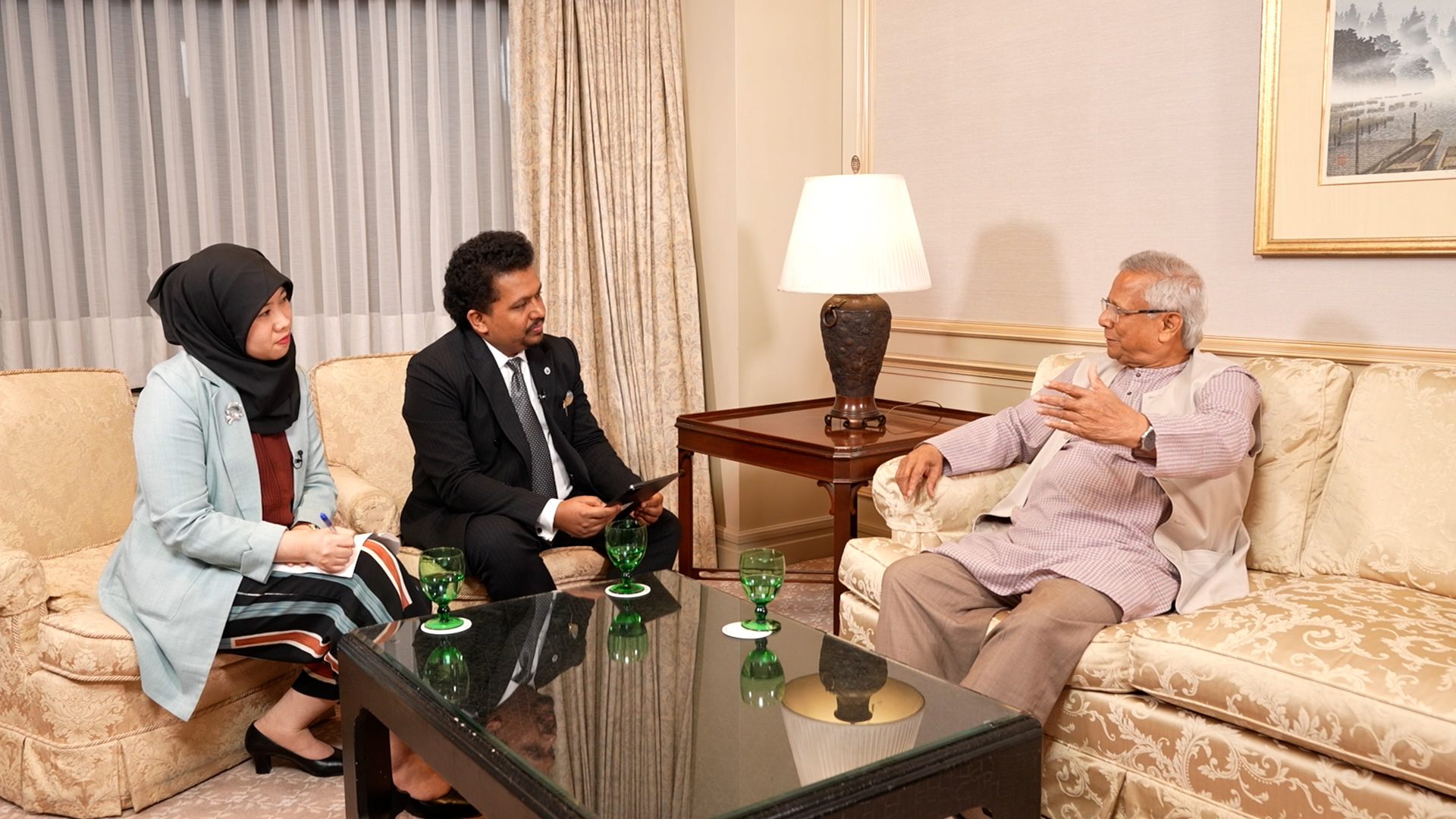
Dr. Emadul Islam:
Thank you, Excellency, for your available time and this talk.
In today's conversation, we would like to cover the two big issues that is social business and peacebuilding in a fragile context. So our first question to you is that you have long argued that poverty is not created by the poor, but by the system that excludes them. So my first question is, how do you connect economic exclusion to instability and conflict in fragile societies? Could you please share your experience?
Prof. Muhammad Yunus:
Thank you. Thank you for inviting me.
I'm very happy that you raised this very important issue of why people are poor. Usually, the explanation given is people are poor because they're not capable of taking care of themselves. They don't earn enough, they're not active enough to earn their livelihood or they lack something intellectually or physically, or they're not as equipped as a normal person.
But the more closely you look at the poor people, you see they are desperate to change their lives. They have all the abilities in the world. The system simply doesn't allow them to use those facilities and so on.
And then everybody blames them for that, for their failure. I see that's wrong. You have not created an environment where he can or she can come out of the poverty that they're in.
So, the conclusion I drew from my experiences is that poverty is not created by poor people. They are not the responsible persons for the creation of the poverty imposed on themselves. It's the theoretical framework that we created, the institutional framework that we created that is responsible for their poverty.
And I take the case in point is really the banking system. They need money to start their lives, but that money will never be given to them. Banks are supposed to lend money to help overcome the shortage of capital so that they can start their lives. But the bank will not touch anybody if they're poor. So that's really wrong.
Blame the banking system. They explain that we cannot lend money to poor people because they don't have collateral. I said again, that's a very strange argument. Why can't you develop a banking system where you don't need collateral? Then it solves the problem, because all you want is to make sure that your money comes back. So it's impossible to do that.
So I started my own way on how to handle this situation. I started a banking system without any collateral. Everybody said it cannot work. But we have repeatedly proven that it works as good as, or even better than the collateral-based banking system. So we can go to any person who is willing to try to change their life and bring more income to themselves. If the funding is necessary, this is the money we provide.
And that's the beginning of what we call now microcredit, small loans. But it is not the size of the loan that makes it important. It's the fact that it's not based on any collateral. Because to begin with, they cannot offer any collateral. So if you make it a condition, then it will never work.
So we created a system where you don't need to provide collateral but it still works. And then they said maybe it was working in Bangladesh, with a very peculiar Bangladeshi society. I said, no, it will work anywhere. So then it spread to other countries and it demonstrated that it works. That's how the idea of microcredit spread. That's how poor people have changed in this structure of institutions. Right kinds of institutions which are good for them.
Dr. Emadul Islam:
So, do you think, is it equally applicable in a fragile context?
Prof. Muhammad Yunus:
There is not any condition that a particular political situation has to exist before we go. So we don't presuppose any particular conditions.
It is the person who needs to earn an income and looking for money, and nobody gives the money. There's no institution which provides the first money to begin with. You go there, provide that.
So, it may be a fragile economy, it may be any other kind of economy. That's the broader picture. It's a very small picture that you are dealing with. You have a person who is desperate to earn an income, but the facilities are not available to make it happen. You help them, whether they're in a particular political setup or not, that's not relevant.
Dr. Emadul Islam:
Thank you, sir, but we would like to point out one of the issues in the fragile context that you are the interim government head of Bangladesh. So we are worried about Bangladesh's very big crisis. It's called the Rohingya refugee crisis in Bangladesh.
So our recent research in camps and policy advocacy highlighted that the Rohingya crisis has evolved from a humanitarian emergency into a regional security risk. And our findings show that, as is very much aligned with your philosophy, that the structural exclusions such as restricted mobility, limited income opportunities, which is attributed to the economic exclusions, and barriers of economic participation, significantly increases security risks among refugees.
So, I would like to ask you from your perspective, how can economic inclusion reduce security tension between displaced population and the host communities? What are your thoughts?
Prof. Muhammad Yunus:
The problems in a situation like the Rohingya camps in Bangladesh is you are living in the middle of villages around you with the normal Bangladeshi villages, with their poverty, with their struggle of making a life for their families and so on. In the middle of it, you have a camp.
The camp is taken care of by the international community. And then if you ask them to participate in the economy outside of the camp, then there's a tension. That tension doesn't make a good condition for people who are in the camp to live with, because the people outside the camp are not happy because there's a camp there.
The simple idea is, how come the whole world is trying to help you? Nobody helps us. So you are competing with somebody who is not helped by anybody, with someone who is helped by everybody. So that tension grows.
It's better to make sure that they do not increase the tension level by giving them additional support to the camp dwellers. So that's how the camp dwellers cannot go outside and participate in the economy of the neighbors.
So this is how we've been following.
Dr. Emadul Islam:
Yes. Thank you sir.
So, we'd like to come out again, with the peacebuilding items, because you know that, this world is the new world order. And there is a lot of conflict in different parts of the world. Traditional peace building is seen as the result of diplomats and soldiers. However, you have argued that poverty and exclusions are the root causes of instability.
In 2026, as we face protracted crises like war and conflict, why must we view entrepreneurship as a security strategy, not just a charity strategy?
Prof. Muhammad Yunus:
Well, it's a security strategy because people feel taken care of when allowed to express their entrepreneurial ability. They can take care of themselves. But, in most of the cases where you're in a camp situation, you don't have that opportunity. You are not acting, interacting with the economy outside of the camp, because it creates another set of problems.
So that way, although you can promote that idea of participating in an economy or creating your own economy, it remains as a small economy within yourself. You can sell things only among the camp dwellers.
That's not a big thing because whatever facility you have, I have the same facility. So there's not much trading or exchange of things anymore.
So that way, you cannot express your ability to take care of yourself by exchanges of goods and services. It's very limited opportunity. Very, extremely limited. That doesn't make a difference in the life that you live with the resources given to you by the people who are providing services to you for maintenance of your life.
Social business is important when you let people depend on charity. So, one way, you give them free food, free shelter, other amenities of life. But that's something that they don't have to work for.
But you can get some scope for social businesses. In exchange for giving free money, you say, okay, why don't you start your business and do the business among the dwellers of the camp and in the temporary residence you have. You repeat the same village situation. A village has an economy. So when you are pushed out of your village, you create a new village. And you are dependent on outsiders to help you.
So there, outsiders can do things, give them free money, free food to take care of them. At the same time, they can also start doing things, where you build your own economy.
Instead of giving them free food, you say ok, why don't you set up a shop? You have this item, this is a thing that you have expertise in. So we support you to start a business so that you do the business, like repetition of a village situation so that it's not simply donations coming in. You create your own economy to do that.
So that's possible. Again, it depends on the circumstances and the nature of the displacement that you have gone through.
Dr. Emadul Islam:
Yes. I totally agree with your wisdom. From another perspective, we would like to talk with you, about our Harmony by Design discussions in which we found that we cannot solve the conflict through regulation. So dialogue and negotiation is the key. What is your opinion regarding this?
Prof. Muhammad Yunus:
That's the bigger issue. It's not the issue related to those who are in the camps. It's an issue of the basis of the conflict itself, where the conflict came from.
In the case of the Rohingya, they are thrown out of their houses, out of their villages. Whether you go to Rohingya camps in Cox's Bazar, everybody will tell you, look, we are not here to beg for food from the international community. We are not beggars here.
We are a whole community here. Within our community, some were displaced out of our homes, forced out of our homes because our houses burned or we cannot live in a situation where we are put into. So we have to flee. We had to run away from that place and create the same community elsewhere.
We are a whole community here. We are teachers, lawyers, doctors. We are professional people. We are farmers. We have our land there. We have our cows. We have all the things that a farmer needs, we have them. We produce our own food. We are not begging for food from anybody. We can feed you. If we can go home.
So all we want to do is to go home where we used to be. So this is a different kind of community uprooted by some political circumstances. They're waiting to go home, and they'll continue to wait for it.
This is a community that we can help so that they can retain their relationships with each other and continue to wait for a return. So the solution is not just to feed them in this thing. The solution lies where the problem began. The problem in this case of Rohingya is in Myanmar. And the solution is in Myanmar. You cannot find a solution elsewhere.
So whatever you do, all we have to do is create an environment so that they can safely go home and stay there safely.
Dr. Emadul Islam:
Yes. We believe in that voluntary and dignified repatriation. May I request my colleague to add her Indonesia experience?
Dr. Dissa Ahdanisa:
Yes, professor. Moving on from the camps in Bangladesh to post-conflict and post-disaster areas in Indonesia, which is where we work right now at Sasakawa Peace Foundation. We are applying similar principles as the social business and social entrepreneurship values that you have been relentlessly teaching us as well.
And I want to bring you to Central Sulawesi, which is in the eastern part of Indonesia. It's far away, around three hours by plane from Jakarta and in one area called Palu, it was hit by a tsunami in 2018, and an earthquake, triple disaster.
And people have to find a way to get back on their feet using the economy or using the tools, they cannot just rely on grants from others outsiders. So we are working with local government to create policies specifically to support social enterprises as the engines of recovery.
So today, I have two questions on this.
First, on the context of post-disaster, in Palu we're working with the local government to push for social entrepreneurship. But oftentimes, local governments actually struggle to understand what social business is, as business and social missions usually don't go together, that's how they understand it. And we are trying to bridge that gap.
But my question is, how can we encourage more Asian governments to promote social business or social enterprises as a strategy to recover local economy like we are trying to do right now in Central Sulawesi, and to bring more government to pilot or to adopt social businesses as a value?
Prof. Muhammad Yunus:
The idea of social business comes when normal activities, families and individuals fail, because of the outside interference, because of accidents, because of natural disasters, whatever, so that you are not able to continue in that situation. Here you are dependent on outsiders.
At one time, in the beginning, you cannot afford to put in your resources because you have lost all the resources. So somebody has to put money into your hand so that you can start this. If you are a farmer and you start farming, if you are a businessman and you start your business, so on and so forth.
But gradually we have to do it in a way that you can get closer to normal economic behavior. So there, you don't bring all the issues of economic behavior. You don't repeat the same donation kind of thing. Free food, free things.
So it's in between. I give you food with the understanding that when you are able, you'll return the food that I give you. I give you money. The same condition that, when you are able, you return the money.
It is a kind of softer version of the regular economy. If you go to a bank, they will not give you the money. So I want to make sure this is a softer version of the thing that I help you overcome your problem, when you are fit, you can start doing things in a normal way.
Here in social business, one important thing is, in the real business world, you want to make money if you are doing business with somebody. Here, the other side is not capable of behaving in a normal situation because of the situation which they are in.
So there, we make it softer. It's okay, you do it in a softer way in which we give you the money. I don't want to make money out of you. All I want is for you to return what I have given and that it comes back to me.
So it’s not a business with a profit motive. It’s a business with a problem-solving motive.
I'm trying to help you overcome your present situation. When you are fully recovered, then we can have a regular business relationship. I make money, and you benefit from your services that I'm providing. It's a marketplace again.
Before we can go into the marketplace situation, we have a kind of softer relationship where I'm not asking for the complete recovery of my money plus the profit part of it.
So I said, then the business is a social business, meaning this is a business to help you make money for yourself. When we talk about business, businesses look for profit. Here, we are not looking for profit. All we want is to get money back. So you create a situation where you can return the money that I originally gave you.
Dr. Dissa Ahdanisa:
And the softer version is actually also equipping them to be less dependent on aid.
Prof. Muhammad Yunus:
Absolutely. Yes.
That's number one. We are trying to get you off the charity. This is not free money that we're giving. You take it and your expectation grows, you want more because it's free.
After you have gone through that, there's a phase in which you have to do that in a crisis situation. In a crisis situation, on day one, you're going to say you have to pay me back. At that time, I don't even know that I'll exist tomorrow. So there we help each other in a humanitarian way, but that life has to come to an end.
It is not going to the full economic relationship where I want to make money. I want to be in a market situation, a softer situation. At this point, whatever I give you, you return the same thing. Not the profit part, extra part of it. So that's where the social business comes in.
Dr. Dissa Ahdanisa:
And from this, we are pushing local governments to work with and understand this concept.
At the same time, not far from Palu, around five hours by car, there's an area called Poso that was torn apart by conflict for a very long time and they just got out of the conflict around ten years ago. Our work there is actually to deradicalize former combatants as well as their wives, and train them to generate meaningful income.
We found that when families have economic dignity, the lure of returning back to radicalization or violence actually fades. From your experience, how crucial is the role of women? In our case, it's the wives of the combatants, in the transition period from conflict to the economy of peace, creating an economy in a more peaceful time.
Prof. Muhammad Yunus:
In difficult situations, whether it is a natural disaster, or whether it is a political disaster, or a war situation, women in the family become the mainstay, hold the family together because they have to take care of the children. They won't give it up. They are in a very sacrificing mode. Men don't have that mode. They are in a fighting mode.
Women bring the order in the family, they make sure the children are fed, they are fed themselves and bring food on the table the earliest opportunity they get. So the starting point is always to go to the woman in the family and they bring order in the family.
And it's very difficult to persuade the men who is in a fighting mode to turn the gun around and so on. They want to do things in their way. The sobering effect comes from the family, women and children and so on. She tries to persuade what is better for the family and so on and so forth.
So it's very important that we go to the women in the family to bring that, and let them understand, let them handle the uneasy situation that exists in the family and between the families and so on, how to overcome that. So they become the kind of factor which brings order in the neighborhood and the families around you, and that becomes very important in a difficult situation.
Dr. Dissa Ahdanisa:
So women really are the agents of change in this crisis.
Prof. Muhammad Yunus:
Absolutely, absolutely. Yes. And a very, very important factor in bringing in order for families.
Dr. Dissa Ahdanisa:
Yeah. Thank you so much.
Before I hand back to my colleague, who will be probably talking about the three zeros, I want to connect with your concept of three zeros also.
You mentioned zero poverty, zero employment, zero net carbon and you're also a big advocate of the power of youth. Also, a lot of young people really look up to you. If I can ask your advice for youths in these regions, in fragile contexts, in post-disaster, post-conflict areas, what is the most critical skill that they need to build the future? Is it technology? Is it resilience? Is it empathy or is it something else?
Prof. Muhammad Yunus:
Youth is a very important factor, in all the situations that you described. For one thing, they are fighters in the odd circumstances they are in. They want to solve this problem, and they are in a better situation than their elders because of the new technology they possess.
You have a phone. Father has a phone. The son or daughter has a phone. But the services that they can provide through the phone is more familiar to the young people than the older people. Older people know a little bit how to use the phone, but there are circumstances where they can use the phone. But the young people go beyond that. They have social media and everything. They can mobilize people.
Many of the problems that we've seen tension within countries like in Bangladesh, in Sri Lanka, in Nepal, uprisings of young people, the defiant, the government itself, pulled down the government just by being together and the mobile phone connecting each other.
The government fell in Sri Lanka, the government fell in Bangladesh, This government fell in Nepal, one after another. So that's the power that the young people have.
This is a bigger picture. But even in a smaller situation, young people have the solution. They get together, they come up with ideas, because they can communicate with each other. That tool for communication is a very strong thing that impacts them. So they come up with ideas and spread it quickly, very quickly.
So that way, I'd say young people have to be paid a lot of attention to so that they can lead you out of the trouble that we got into. If not, they can do the reverse, can make it more acute, because they have the same tools to make it worse. So we have to be very careful.
Usually, older people ignore the young people. "Oh, what do you know? You were just born the other day. You don't have any experience. We are experienced people."
That's where the conflict comes. And the more the older people insist on their experience and their expertise and so on, it irritates the young people because they cannot replace what they don't have, they cannot bring it.
The thing is, still, their judgment is better than the older people's because they don't know enough. I have the communication. I've got everything. So I've become stronger than you, anything you can bring.
So it's good to listen to the young people in situations like that, rather than they go in the wrong way, and explore themselves and create more difficulties. So it's good to work together with young people and let them handle it in their own way. And you can advise, but let them see what the solution is.
Dr. Dissa Ahdanisa:
So there are roles, everybody has their own role.
Prof. Muhammad Yunus:
Absolutely, an important role.
Dr. Dissa Ahdanisa:
Thank you, professor. Please, Dr. Emadul.
Dr. Emadul Islam:
Thank you. So we've already covered all of the issues. But before concluding, we would like to ask another 2 or 3 questions.
In our Harmony by Design, we already covered the issue that the Western model, the European model of peacebuilding and mediation is not working in the Asian context. So we would like to promote the Asia-centric approach.
Since the Peacebuilding Program at the Sasakawa Peace Foundation, we are working on this issue for the last 15 years in Bangladesh, Thailand, Indonesia and many other parts of the world. What is your suggestion?
Prof. Muhammad Yunus:
It's a very good effort. But, Eastern communities and villages and their natural relationships with each other are very different than the European ones.
So how to make use of this?
The family connections and the connections between the old and the young, men and women...There's a certain order in eastern societies, communities, that we traditionally follow, which may not be the same thing in Western societies. It's good to use this facility, the very strong bond between family members in Eastern societies and in Asian societies.
So that I think is a very important distinction you make, and these experiences will be very useful as we go along, how to make use of them. And today, it becomes more powerful because of the technology. Technology brings stronger bonds with each other and wider bonds with each other. Stronger and wider, so you reach out more. It's not just a family right here. Also, your family's connection is a long distance one. So people converge into those kinds of things.
Many of the families, like in Bangladesh, they have family members in the Middle East working, or in some other countries. They're working in Europe. But when the crisis comes, they're all together on the communication devices that they have. So they create another virtual village. It's not a physical village. It's a virtual village through the internet. And they bring lots of ideas to solve those problems.
I think that advantage we have, having a wider kind of relationship and a distant relationship, but a very strong relationship, makes this happen. So I would say that it's very important that we pay attention to that. And young people can provide the leadership in it because they understand the power of the technology much better than the older generation in those families.
Dr. Emadul Islam:
Yeah. So, again, in relation to the power of the technology, do you find any difficulties for the next generation?
Prof. Muhammad Yunus:
Difficulties will always be there one kind or another. But my point is, as you have the younger generation coming up, as I keep pointing out, the younger you are, the more powerful you are. This is the reverse of the older ideas. The older you are, the wiser you are. Now that has reversed.
The younger you are, the wiser you are. Because you have so many inputs coming from all directions. You are not dependent on your memories, your experiences only. It's a diverse thing in front of you.
So don't ignore the young people, saying, "Oh, what do you know, we have grown old not just by passing days. We have gathered experiences, so you have to listen to the old people." That kind of statement, I don’t think is very useful, because the young people are very familiar with more experiences coming to them, and they mobilize very quickly. And they see things in a more clear fashion because it's a consultative process for the young people.
The older people go through the process of getting experiences by themselves, by the events that took place. They witness the events and so on.
Young people are not witnessing the events, they're communicating the results of the events, what is happening in your place and my place, where you are, and they come to a common feeling and a common kind of experience which they want to share and solve the immediate problems they have.
That creates a tension between the older generation and the younger generation, which is the better way to resolve? I would go with the younger generation, because of the extent of communication they have.
Dr. Emadul Islam:
We also agree with you in your statement that the young generation is key for ensuring peacebuilding in the world.
As we conclude, the Sasakawa Peace Foundation has been bridging this reality from the Rohingya camps in Bangladesh, to Indonesia, to the communities in Indonesia with Japanese support.
So my last question is, what is your message to Japan and the international community regarding the role of economic empowerment to peacebuilding?
Prof. Muhammad Yunus:
It's very important. Economics is the key in all situations. So, you have to put it in the center of whatever we are doing, doing good things, all said and done. But if you have not addressed economic issues, they will not last long because it will start falling apart.
So economic issues have to be brought into the picture, and there will be problems in bringing in those economic issues, but until we find the solution, even the first approach to the solution, you are not fulfilling the objective of peacekeeping because it will fall apart again. So you have to cement the whole thing with economic ties.
Whatever relationship that you built in that conflict resolution, there must be an economic aspect to it so that it glues together, so that the solution sticks, doesn't fall apart again.
Outro:
Thanks for listening to this special rebroadcast from the Harmony by Design Asia Dialogue Conversation series. Head over to SPF’s YouTube channel to watch the full video series, including an additional dialogue with former Thai Prime Minister Chuan Leekpai, and an additional conversation with Mr. Harsha Kumara Navaratne, Chairman of the Sevalanka Foundation in Sri Lanka.
Thanks for joining us for this episode of SPF World Views. We'll see you next time.