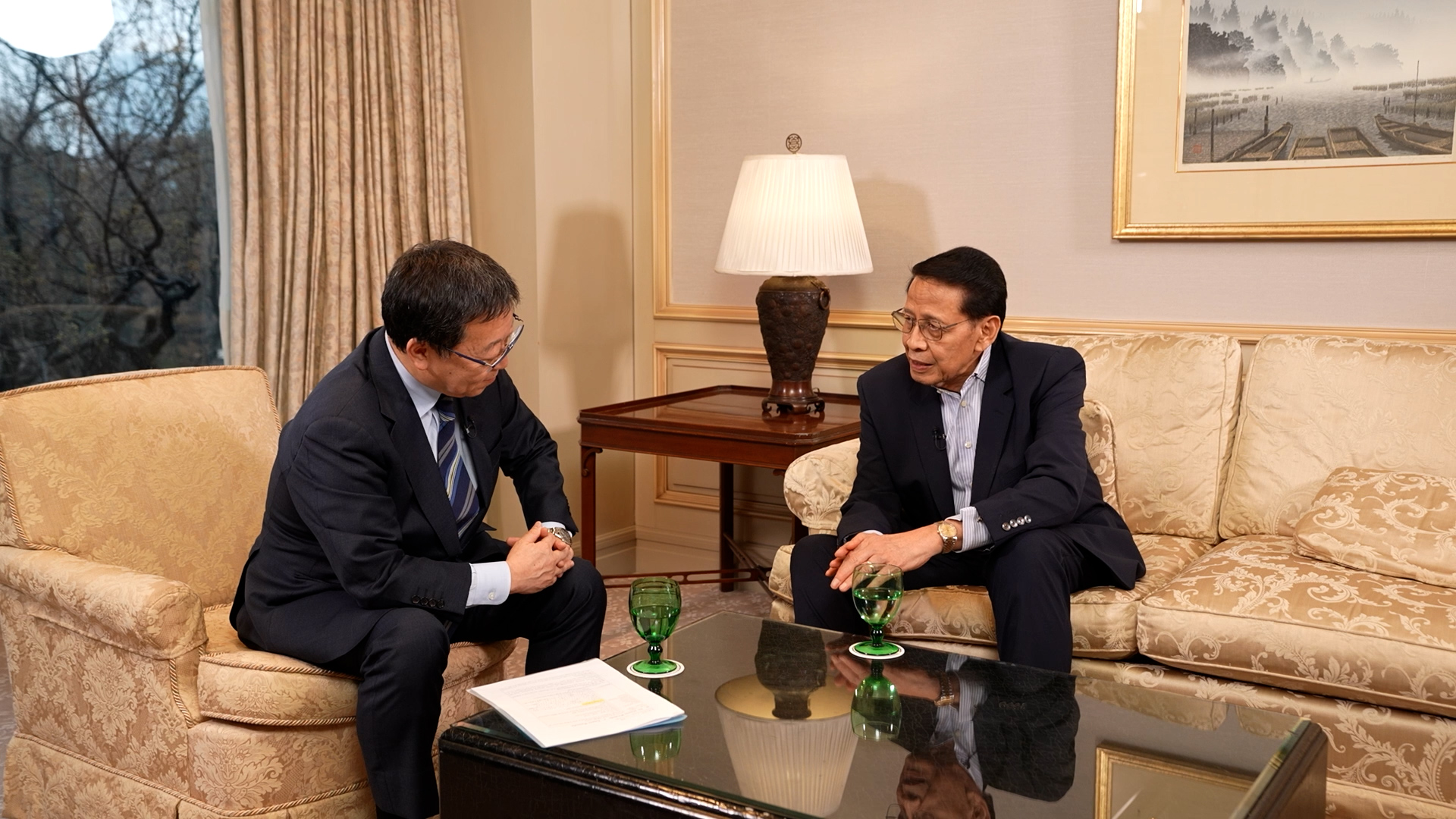
Watanabe san:
Hello. I'm Tsuneo “Nabe” Watanabe. I'm a senior fellow of Sasakawa Peace Foundation, and it's a great privilege to have the former foreign minister of Indonesia, Dr. Hassan Wirajuda, here.
And actually, we had a very good discussion yesterday and the day before yesterday. We talked about many things, and today, I'd like to discuss, of course, Japan's diplomacy, ASEAN's diplomacy, as well as Indonesian diplomacy, and the regional order, too.
So I'd like you to briefly introduce yourself. So Dr. Wirajuda, please.
Dr. Wirajuda:
I'm Hassan Wirajuda, former minister of foreign affairs of Indonesia.
I was the foreign minister of Indonesia under two different administrations, President Megawati and President Yudhoyono, for, in total, nine years.
I'm pleased to join our discussion here in Tokyo, organized by the Sasakawa Peace Foundation, and I benefited a lot. And I hope, also, to contribute to enrich our discussion yesterday.
Watanabe san:
Thank you very much.
And I'll introduce myself briefly. I'm a senior fellow at the Sasakawa Peace Foundation, but before that, actually, I spent time on fellowship research work in a Japan think tank and a U.S. think tank.
And in the U.S. think tank, I worked in the Center for Strategic and International Studies in Washington, D.C.
Dr. Wirajuda:
CSIS?
Watanabe san:
CSIS. And also, actually, you served for President Yudhoyono of Indonesia, and I had the privilege to talk with him when we actually were organizing an ASEAN value conference in Tokyo, and we invited him and he kindly accepted.
Anyway, so Indonesia is a very, very important country to Japan, but another thing is it's a very important democracy in Asia, East Asia. So I think that's a very important thing that we share as a value.
So first question, actually, I'm very curious about how you see the trend of democracy in the region, in East Asia, in Asia, and in the world.
I'm asking because now, U.S. democracy is somehow in doubt, and several non-government organizations ranked U.S. democracy as very much lower than before.
Anyway, I'm very curious how you see the trend of democracy.
Dr. Wirajuda:
Well, it's unfortunate that in the West, in particular, in the U.S. and Europe, democracy is declining.
In Europe, it was primarily because of the problems they call nationalism and populism. In the U.S., we know that, especially during this current administration, democracy is no longer in the vocabulary of the existing administrations.
As a result, discussions on democracy all over the world are also in decline, to my regret.
Here in Asia, I believe Japan is the oldest democracy, and continuously enjoys not only peace and security, but the democratic systems remain intact, I would say.
In Indonesia, in a relatively short period of time, after 30 years of military-dominated government, we were able to transform Indonesia in a relatively short period of time to be a full-fledged democracy.
This was the product of reforms initiated in 1998-1999, following the East Asian monetary crisis that we suffered.
So, our democracy was very vibrant. We have, since 1999, direct elections of our local government's heads, governor and district heads, and likewise, since 2004, for the first time, and continuing to this day, direct elections of president and vice president.
So in a relatively short period of time, democracy has taken root. We have a solid basis, because our people, more than 80 percent, believe in democracy.
But of course, like what's happening in the world, in Indonesia too, democracy is no longer widely discussed. We practice regular elections, and the quality of our elections is generally good, though money politics is now an issue.
But at the regional and international level, I initiated the Bali Democracy Forum in 2008. And unfortunately, during the time of President Joko Widodo, we hosted the Bali Democracy Forum, but on the part of our governments, I would say they did not enthusiastically support the process.
I initiated, in the same year, 2008, what I call Bali Institute of Peace and Democracy, where we organized programs, both thematic and country-specific, on how we could share our experience and best practices with countries aspiring to be democracies, like a program with Egypt, with Tunisia, in the wake of the Arab Spring, with Myanmar, with even Fiji. And I found quite a positive response from many countries which aspire to be democracies.
Now, as part of the general climate in the world, in the regions, unfortunately, there is a rather temporary rest, I would say, but I hope that in the near future, we should be able to recover. And I believe Indonesia and Japan can do much to revive the waves of democracies in Asia, in particular.
Watanabe san:
Thank you very much.
That's a good point, actually, that Japan and Indonesia share a very important history, that we both had military-controlled governments. And somehow, we experienced how to get over such kinds of undemocratic regimes. So I think, in that sense, Asia has a lot of history and value that we can somehow share with the Western world, too.
Dr. Wirajuda:
That's right.
Watanabe san:
So, I think that's very encouraging to me.
And going to the diplomacy, I'm impressed with your experience in the several conflict resolutions in the region, and also your, of course, leadership and values in democracy, too.
So currently, in our region, some people say Indo-Pacific or East Asia...Somehow, the competition between China and the United States is one issue. And the other one is, of course, the U.S. is losing some attractiveness or losing power, I would say, in the region.
Anyway, Japan and Indonesia and other ASEAN countries are always surviving by figuring out how to somehow influence the two major powers in the region, too. The difference is that Japan is an allied partner with the United States. Indonesia is more independent.
So I would like to learn a lot from your thoughts on how to survive in the current East Asia.
Dr. Wirajuda:
We may learn from the past history. From 1948 until, say, 1989, we, the whole world, witnessed the most serious Cold War that not only involved the United States and the Soviet Union, but also involved quite divergent ideologies, a liberal and free market economy on the one hand, a centrally planned economy based on socialism or communism.
In addition, each bloc had its military pact. NATO on the part of the United States and its allies in Europe, and Moscow and its Eastern European countries had their Warsaw Pact.
Now, actually, we are in much better shape because the tension is practically between the United States and China. In ideology, it's not so much.
China might claim that they are a socialist economy, but in practice, China also adopts a free market, free trade. And there are no military blocs opposed to each other, neither those of the United States nor China.
That's why, learning from the past, if we, Indonesia, Japan, and many other countries, survived during the 40 years of the Cold War...
We are not currently having a Cold War as we experienced in the past. That's from the more positive, optimistic side of the current tensions that we are witnessing happening between the United States and China.
Of course, during the first Trump administration, they labeled it as a trade war. But to me, it's not only a question of trade. Actually, the competition between the U.S. and China involves military, technology, and even outer space.
And that's why, perhaps with trade, it could be settled much easier. But other issues of differences like competition in technology, military, as well as outer space, are in total, more difficult to see. But to me, unlike the old Cold War, I think the degree and intensity is much less. So that's how I see it.
And of course, the tensions between these two superpowers can have potential negative consequences, including war. Because, in particular, in our area, in Asia, we have several areas of potential conflict. South China Sea, Northeast China Sea, then Taiwan Straits, and the North Korea nuclear issue.
I think the challenge for all of us countries in the region is how to reduce tensions. If not to solve those problems, at least to continue dialogue.
But also, between the two superpowers themselves, United States and China, as I mentioned yesterday in our discussions, there must be dialogue and direct communication. Because otherwise, the areas of potential conflict could develop into open conflicts that are devastating, not only to our region, but also to the rest of the world.
I think countries in the region themselves, mid-power or however you define it, could play a role to bridge the gap, to bridge the misunderstanding. After all, some countries in the regions are both friends to United States and to China, and we should not just sit quiet.
There should be more active efforts to play our role, not as mediator, but at least to promote dialogue between the two conflicting parties, with a view to, in the beginning, reduce the tension and make sure the two countries realize the need to have peaceful coexistence. And in the end, of course, to resolve the conflict, whatever they have. So an active role is expected.
Watanabe san:
Thank you. Yeah, I am impressed.
An active role, that's probably what Japan, Indonesia, or other Asian countries really need to try to shape relations between the big two superpowers, China and the United States.
And that reminds me of another worry of Japan. We are worried about U.S.-China competition and conflict, but at the same time, we are also worried about rapprochement between U.S. and China, especially, recently, President Trump mentioned the G2, U.S.-China G2, meaning two countries governing a region.
And somehow, China's intention may be, okay, let's share the Pacific and the western part is for China, and the eastern part is for U.S., and this kind of thing.
So are you worried about such U.S.-China G2 rapprochement?
Dr. Wirajuda:
Rapprochement is good.
Watanabe san:
Good? Not worrying?
Dr. Wirajuda:
Not worrying. We should not worry.
Because rapprochement may lead to acceptance by both countries, whatever differences they have in many different areas, they, in the end, should realize that they should coexist, accept peaceful coexistence.
Interestingly, during the Cold War, we had two superpowers, the United States and the Soviet Union. Of course, unlike today, perhaps in those days, leaders of the United States and the Soviet Union didn't talk with each other. Here, there is potential for leaders of the United States and China to talk, as we have witnessed on the margins of many meetings, in particular when ASEAN hosted a summit or Indonesia hosted the G20, the President of United States and the President of Russia or China met.
So in other words, the role of countries in the region, Japan, Indonesia, ASEAN, could provide a venue in line with our role to be a good convener when leaders of those opposing countries find it comfortable to sit, to talk within the ambience of regional cooperation.
So I think despite their differences, there are signs by both President of the United States and President of China to meet, to begin to talk. This is a positive sign.
We should not worry too much because after all, this is not a world where we have two superpowers. It's not only bipolar, it's multi-polar politics. How can they talk only between the both of them and divide whatever we have in the region among themselves? We know we have Russia to balance.
Watanabe san:
Okay. Yeah, it's impressive.
The reason that I joined the discussion yesterday with you and other senior Asian leaders is I was pretty much impressed that all the participants are not so worried about U.S., China, G2, whatever.
And I was asking myself why that is, compared to the Japanese.
Dr. Wirajuda:
Actually, you should do better because Japan is clearly a treaty ally of the United States.
Watanabe san:
Right. Yeah, that's it.
So probably, Japan is psychologically too dependent on the U.S. There's too much worry about the U.S. having rapprochement with China.
Of course, as you suggested, good relations between China and the U.S. is a good thing to Japan too.
Dr. Wirajuda:
Right. Yeah.
Watanabe san:
So Japan probably really needs to change its mindset. And actually, I'm proposing, not only me, but our project, is proposing Japan's new diplomacy that we call the Plan A+.
Plan A is Japan's past diplomacy, relying on the U.S.-Japan alliance. And that's very much the centerpiece for Japan's diplomacy and security policy. And that's Plan A.
So if we are losing alliance with the United States and there's too much worry, we are considering Plan B or Plan C.
And actually, we tried to consider Plan B, that's without an alliance with the United States, and we try to create mid-power diplomacy, like recently the Canadian Prime Minister Carney proposed. But probably, that's not enough to secure our own country.
And Plan C is getting closer to China, and trying to put Japan in a quasi-alliance or whatever. That also very much brings instability. The reason is, the U.S. is worried too much.
Anyway, so our conclusion is to go with Plan A+.
The U.S.-Japan alliance remains. We still utilize this, but with less reliance on this, and do more for Japan's own defense capability and mid-power diplomacy including ASEAN, too.
I think we really need the closer cooperation with South Korea, and Australia, and ASEAN countries, and also Europe. So that idea is probably the future. And of course, we need to be less dependent on the Chinese economy, but we keep the good economic relations with China.
So that's our proposal, and I'd like to hear your impression of this description.
Dr. Wirajuda:
I understood that with this A+ plan, Japan, in your view, would be heading toward Japan having strategic autonomy.
Of course, Japan continues to maintain its close relationship with the United States, but at the same time, understanding that Japan, at least in recent years, cannot rely fully, like the European countries cannot rely fully, on United States' support.
But I think it's also good. For example, I understand that when President Trump tells European allies to spend more budget on military, not to depend on United States, in a way, for so long, since the end of the Second World War, Europeans have been enjoying that they spend only 2% of their budget for military. That's why they progress more economically at the burden of the United States. To me, it's reasonable.
For so long, Europeans enjoyed themselves at the expense of the U.S. But it's also natural that Europe, and in this case also, Japan, that for your own use, you spend a reasonable percentage of your budget for protection of your countries, still maintaining a degree of close relationship with the United States, as Japan and Europe are close allies of the United States.
But this is a reading of the world and the regional situation, particularly in Asia, only from the security perspectives. What is missing, in my view, reading your paper for plan A+, is that on the diplomatic side, on the diplomatic process of shaping the norms of cooperation in the neighborhood of East Asia. I think it should be done at least in balance with your security concerns.
I mentioned yesterday the need for us to make progress on our commitment in 2004 to establish an East Asia Summit. Unfortunately, after 20 years, not much progress was made.
From my perspective on ASEAN, because ASEAN is sitting in the driver's seat, we have not developed that policy quite adequately.
Number one on the agenda of the East Asia Summit was so much on economic cooperations, but less on politics and security.
While the foundation, the framework of cooperation on politics and security are there already, it is the ultimate goal to establish an East Asia community.
This, to me, is even more important today, because we cannot rely on the world order. The world order is continually weakening, and it's no longer effective, each region should manage their own household, be in promoting peace and security, and also prosperity.
Look at in Europe. For so long, they've had a European community and European Union. They manage their region quite well. Why not us? And after all, we already have a mechanism in place.
ASEAN, for 57 years, enjoyed relative peace and security. The United Nations spent not a single dollar to help create the Southeast Asia region that is peaceful. It is the work of our own.
And that's why, in my view, when global cooperation, global order, is weakening and no longer effective, under Article 52 of the United Nations Charter, we should make our own arrangements, working together to create our own regions to be more peaceful, secure, and prosperous.
Because we already have a mechanism in place. We're not starting from zero. And I would say on prosperity, we have quite the mechanism. ASEAN-Japan Free Trade Agreement, ASEAN-China, ASEAN-India, ASEAN-Australia, and New Zealand.
We have the ASEAN Regional Forum. It's the sole forum for security dialogue in the region. What we need is to strengthen this process.
It's an urgent need now because at the global level, we see we cannot rely on the global order. Rule-based order somewhat has been sidelined by great powers. So we have to manage our own.
Watanabe san:
Thank you very much. Your suggestion for creating an East Asian summit, an East Asian community, is really a very good timing for this.
As you mentioned, the European community and NATO, both actually the product of World War II, clearly mean that, okay, Germany and France fought a serious war twice, and somehow, they realized they really need economic cooperation to survive, right?
I think the same thing... you mentioned, now, global world order is weakening. So we really need a regional order to maintain our own prosperity and security too. So I think an East Asian community would be for both, security and diplomacy, and also economic trade too.
I think, as you said, already, we have some frameworks, and the leadership to bring them to opportunities.
Dr. Wirajuda:
Unfortunately, countries in Northeast Asia, China, Japan, and South Korea, you have traded with each other, you invest with each other, but on the matter of political security, there's still a big gap.
And in Southeast Asia, we appreciate actually, when those three countries, starting in 2024, began with a foreign ministers' summit of the three countries and a summit of Presidents and Prime Ministers.
But it hasn't, in the past 20 years, reached quite a degree. We actually applauded that, here, a good step towards progress would be made.
And therefore, when we talk about East Asia, in Southeast Asia, we have quite a degree of dialogue. We expect to see how you countries in Northeast Asia speed up the process among yourselves.
So in the end, these two pillars, Northeast Asia and Southeast Asia, would be important components or pillars of the East Asia community.
Watanabe san:
I think one thing I'd like to add is Japan, China, South Korea all have declining economies because of declining population, so that's not so good for each country, but it's a good thing to cooperate with each other.
If China is a very very rising power, I don't think China has intentions to create more cooperation with other countries on a level playing field.
But from now on, probably, China may have more incentives. And South Korea and Japan have already moved, as we need to cooperate.
Dr. Wirajuda:
Look at it from the positive side. I know the Japanese population is declining. You have a problem with aging. But don't forget, in your neighborhood, in your region, we have a surplus of population.
We can complement each other.
Watanabe san:
That's actually what I wanted to say. ASEAN countries are younger countries than us, and the whole East Asian region is still growing, of course...
Dr. Wirajuda:
Exactly, exactly.
Watanabe san:
So the issue is more about closer communication, closer diplomacy, closer economy, right?
Dr. Wirajuda:
Exactly. Right.
Watanabe san:
That's probably very important for us.
So based on this whole idea, actually, I fully agree with your idea. So what is your recommendation for how Japan should work with ASEAN and other countries together for moving in such a direction? Please, any good advice?
Dr. Wirajuda:
In Southeast Asia, in ASEAN, agreements that we reached in 2009, which we call ASEAN Economic Blueprints, including part of the ASEAN Economic Committee, in which we agreed, ten countries in Southeast Asia agreed to allow a free flow of goods, services, capital, and skilled workers.
Singapore really needs skilled workers. Even Malaysia and Thailand as well. So we train our people to work in Singapore. More than 100,000 Indonesians work in Singapore. Many of our engineers, accountants, not medical doctors, but quite a lot of professionals, workers from Indonesia work in Singapore, likewise in Malaysia.
So of course, with this, we simplify the process for permits and visas, and simply, that kind of practice could be expanded. Even Australia... one time, I visited Australia, and they told us they have shortage of electricians. And they asked whether it is possible for Indonesia to send electricians without complicated visas, because every three months they can go back to Bali on a three-hour flight and then return.
And that kind of arrangement is what you can make, if we have, as you said, good communication, good arrangements to overcome the problems that you are facing, or South Korea, because of the population problems you have in view of aging.
Watanabe san:
Yeah. I happened to talk with a young diplomat from South Korea this morning.
Dr. Wirajuda:
Yeah, yeah.
Watanabe san:
She's very much interested in how Japan is thinking about diplomacy and cooperation with South Korea, too.
I think nowadays, thanks to China and the U.S., now South Korea and Japan both are really moved that we need to cooperate seriously.
Dr. Wirajuda:
Right.
Watanabe san:
That's clear, you could say that South Korea and Japan really need to cooperate with ASEAN. It's definitely the time to. And I'm sure China really needs to cooperate too.
Dr. Wirajuda:
Yeah. They're quite open to that.
Watanabe san:
Yeah, and eventually, the U.S. may come back. May come back, meaning, looking back at the U.S.'s history, they are pretty much interested in trade and economic relations with East Asia.
Dr. Wirajuda:
That's true.
Watanabe san:
So that gives a lot of hope, actually, and also somehow a very positive, optimistic view. I really appreciate it. You and your colleagues from the senior Asian leaders really gave us some optimistic and productive...
Dr. Wirajuda:
Don't preoccupy yourself with security.
Watanabe san:
Right.
Dr. Wirajuda:
Security is one problem, yes. But it could be addressed in totality with diplomacy, cooperation, economic cooperation.
Then, if you focus on whether you survive because of the change in the world environment, whether it's the concerns of security, yes, it would limit your perspectives.
Watanabe san:
Yeah, that's great. Thank you very much.
Dr. Wirajuda:
Thank you very much.
Outro:
Thanks for listening to this special rebroadcast from the Harmony by Design Asia Dialogue Conversation series. Head over to SPF’s YouTube channel to watch the full video series, including an additional dialogue with former Thai Prime Minister Chuan Leekpai, and an additional conversation with Mr. Harsha Kumara Navaratne, Chairman of the Sevalanka Foundation in Sri Lanka.
Thanks for joining us for this episode of SPF World Views. We'll see you next time.