Ocean Newsletter
No.604 April 20, 2026
From Asia to the World: ANEMONE Global's Challenge
KEYWORDS
Environmental DNA / Biodiversity / Nature-positive
MINEGISHI Yuki (Associate Professor, Atmosphere and Ocean Research Institute, The University of Tokyo)
With only four years left until the 2030 goal of halting biodiversity loss and achieving its restoration, we are now at a critical juncture. Biodiversity information is essential for transforming society into a nature-positive society that grows while regenerating natural capital. This paper introduces ANEMONE Global, an international biodiversity monitoring network using environmental DNA as an example of an information infrastructure that generates such biodiversity information.
Taking ANEMONE, Japan's Environmental DNA-based Biodiversity Monitoring Network, to the World
Human society has grown to date by consuming natural capital. However, it is clear that this approach is unsustainable, making it essential to transform society so that it grows while regenerating natural capital instead. What matters most here is understanding the actual state of nature, since regeneration is impossible without information on how much natural capital has been consumed and how much has been restored through conservation and other activities.
ANEMONE*1 grew out of a nationwide simultaneous survey of fish fauna*2 led by Professor Michio Kondoh of Tohoku University, and has since developed into a full biodiversity monitoring network. It tracks biodiversity through regular environmental DNA sampling along Japan's coasts, rivers, and lakes. All the resulting data is released free of charge through the dedicated “ANEMONE DB” database, and the DNA samples themselves are archived. With the cooperation of researchers and citizens across the country, nearly 10,000 observations have been conducted over five years, and the project has more recently begun producing published scientific papers as well.
A wide range of nature observation and monitoring efforts have been carried out in the past, but what sets ANEMONE apart from conventional biodiversity surveys is that it offers four simultaneous capabilities: participation possibility, comparability, traceability, and reusability. By standardizing equipment and protocols, ANEMONE allows citizens as well as scientists to take part in monitoring, and makes it possible to compare data across sites and over time. Archiving environmental DNA samples together with their metadata also allows for reanalysis whenever necessary. ANEMONE is a truly unique monitoring network that generates large-scale, high-quality biodiversity information through the participation of anyone who wishes to take part.
ANEMONE Global is the initiative to expand this network worldwide. Its aims are to visualize and understand the state of nature by monitoring global biodiversity using a unified methodology, and to build a system in which residents, including scientists, can gather biodiversity information about their own regions and put it to use in decision-making process for economic activity, environmental conservation, and other areas. At the heart of the initiative was a network of Southeast Asian mangrove researchers built up by Professor KAJITA Tadashi of the University of the Ryukyus through his own research, and members of a working group on the promotion of citizen science within the IOC Sub-Commission for the Western Pacific (WESTPAC), a regional subsidiary body of the Intergovernmental Oceanographic Commission (IOC), in which the author participates. One could say that the vision of ANEMONE Global was shared smoothly because it was built around Asian countries with a strong awareness of, and commitment to, collaboration between biodiversity conservation and local communities.
In the summer of 2024, with support from research funding including the Sasakawa Peace Foundation's Ocean Shot*3 program, 17 groups from 12 countries participated in the network's first coordinated monitoring campaign (Figure 1; Sioud et al. 2026). In the spring of 2025, the significance of this work was recognized, and the initiative was officially endorsed as an Ocean Decade Action under the UN Decade of Ocean Science. Then, in the autumn of 2025, the number of participating countries expanded to 17, and regular observation at fixed monitoring points began in earnest, marking the true start of global-scale biodiversity monitoring.
ANEMONE*1 grew out of a nationwide simultaneous survey of fish fauna*2 led by Professor Michio Kondoh of Tohoku University, and has since developed into a full biodiversity monitoring network. It tracks biodiversity through regular environmental DNA sampling along Japan's coasts, rivers, and lakes. All the resulting data is released free of charge through the dedicated “ANEMONE DB” database, and the DNA samples themselves are archived. With the cooperation of researchers and citizens across the country, nearly 10,000 observations have been conducted over five years, and the project has more recently begun producing published scientific papers as well.
A wide range of nature observation and monitoring efforts have been carried out in the past, but what sets ANEMONE apart from conventional biodiversity surveys is that it offers four simultaneous capabilities: participation possibility, comparability, traceability, and reusability. By standardizing equipment and protocols, ANEMONE allows citizens as well as scientists to take part in monitoring, and makes it possible to compare data across sites and over time. Archiving environmental DNA samples together with their metadata also allows for reanalysis whenever necessary. ANEMONE is a truly unique monitoring network that generates large-scale, high-quality biodiversity information through the participation of anyone who wishes to take part.
ANEMONE Global is the initiative to expand this network worldwide. Its aims are to visualize and understand the state of nature by monitoring global biodiversity using a unified methodology, and to build a system in which residents, including scientists, can gather biodiversity information about their own regions and put it to use in decision-making process for economic activity, environmental conservation, and other areas. At the heart of the initiative was a network of Southeast Asian mangrove researchers built up by Professor KAJITA Tadashi of the University of the Ryukyus through his own research, and members of a working group on the promotion of citizen science within the IOC Sub-Commission for the Western Pacific (WESTPAC), a regional subsidiary body of the Intergovernmental Oceanographic Commission (IOC), in which the author participates. One could say that the vision of ANEMONE Global was shared smoothly because it was built around Asian countries with a strong awareness of, and commitment to, collaboration between biodiversity conservation and local communities.
In the summer of 2024, with support from research funding including the Sasakawa Peace Foundation's Ocean Shot*3 program, 17 groups from 12 countries participated in the network's first coordinated monitoring campaign (Figure 1; Sioud et al. 2026). In the spring of 2025, the significance of this work was recognized, and the initiative was officially endorsed as an Ocean Decade Action under the UN Decade of Ocean Science. Then, in the autumn of 2025, the number of participating countries expanded to 17, and regular observation at fixed monitoring points began in earnest, marking the true start of global-scale biodiversity monitoring.
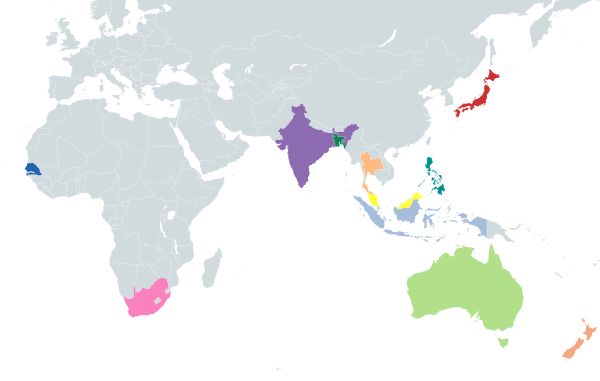
■Figure 1: Countries that took part in ANEMONE Global's first monitoring campaign
Connectivity, Standardization, and Sustainability: The Goals of ANEMONE Global
In February 2026, participants in ANEMONE Global's monitoring activities and representatives of monitoring networks from around the world came together for an international symposium (Figure 2). Mangrove researchers from Asia, who form the core of ANEMONE Global, presented their biodiversity research. Speakers from Europe and Canada gave presentations on EU monitoring networks and the standardization of observation technology, while speakers from Japan discussed the expansion of biodiversity databases and the manual published by the Japanese Society for Environmental DNA Studies, which can be regarded as a guiding document for environmental DNA research and surveys in Japan today. Alongside this exchange of information, many challenges yet to be overcome, as well as directions for future development, came into clearer focus.
To collect biodiversity information over broad geographic areas and put it to use for economic activities, environmental conservation, and other purposes, it is most efficient to connect ANEMONE Global with existing monitoring networks around the world. There is also an urgent need to develop systems capable of calculating indicators that reflect the state of nature (such as diversity indices and species richness) from the biodiversity information generated by these networks.
With support from the Cabinet Office's program for Bridging the gap between R&D and the IDeal society (Society 5.0) and Generating Economic and social value (BRiDGE) and other funding sources, ANEMONE Global is working to standardize its operational framework. Meanwhile, elsewhere in the world, efforts to internationally standardize each step from sampling through analysis have long been underway, centered on the International eDNA Standardization Task Force (iESTF), and metadata management policy (the FAIRe principles) has also been published. Bringing these various standardization efforts together effectively around environmental DNA monitoring will be extremely important for continuing to generate high-quality biodiversity information.
Furthermore, ANEMONE Global's activities and monitoring efforts are currently supported by several Japanese research grants, but these grants are limited in both scope and duration. Precisely because biodiversity information is indispensable to the transition to a nature-positive society, what is needed is not only the transfer of monitoring and analytical technologies, but also the establishment of analytical hubs and databases around the world, along with stable financial support to cover the costs of long-term monitoring.
To collect biodiversity information over broad geographic areas and put it to use for economic activities, environmental conservation, and other purposes, it is most efficient to connect ANEMONE Global with existing monitoring networks around the world. There is also an urgent need to develop systems capable of calculating indicators that reflect the state of nature (such as diversity indices and species richness) from the biodiversity information generated by these networks.
With support from the Cabinet Office's program for Bridging the gap between R&D and the IDeal society (Society 5.0) and Generating Economic and social value (BRiDGE) and other funding sources, ANEMONE Global is working to standardize its operational framework. Meanwhile, elsewhere in the world, efforts to internationally standardize each step from sampling through analysis have long been underway, centered on the International eDNA Standardization Task Force (iESTF), and metadata management policy (the FAIRe principles) has also been published. Bringing these various standardization efforts together effectively around environmental DNA monitoring will be extremely important for continuing to generate high-quality biodiversity information.
Furthermore, ANEMONE Global's activities and monitoring efforts are currently supported by several Japanese research grants, but these grants are limited in both scope and duration. Precisely because biodiversity information is indispensable to the transition to a nature-positive society, what is needed is not only the transfer of monitoring and analytical technologies, but also the establishment of analytical hubs and databases around the world, along with stable financial support to cover the costs of long-term monitoring.
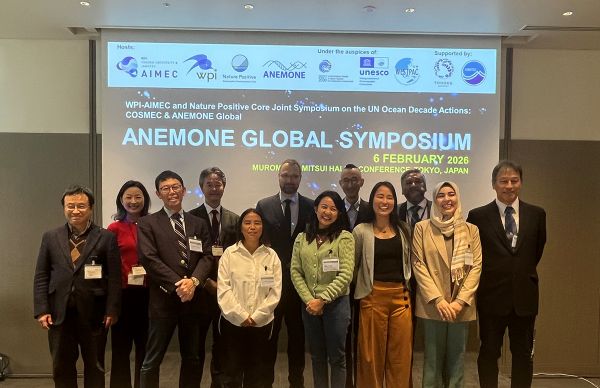
■Figure 2: Speakers at the ANEMONE Global symposium
Toward a Society Where Local Residents Monitor Their Own Local Nature
Otsuchi Bay in Iwate Prefecture, home to a marine research facility of the Atmosphere and Ocean Research Institute of the University of Tokyo, where the author is based, is one of ANEMONE's regular monitoring sites. The observations are carried out by members of the “Hama Research Club” at Iwate Prefectural Otsuchi High School, who come to the facility after school once a month as a club activity to collect and filter water samples before heading home. Not all of the students are especially interested in local nature or particularly inclined toward science, but the work itself, such as collecting water and filtering it with a syringe, seems to hold its own appeal. When conversation during the work turns to local nature or science, the students often show a flicker of interest, saying things like “oh, really?” and some even stop to look out at the sea on their way home. Watching them, I came to realize that anyone can engage with their local natural environment, regardless of their level of interest. In other words, people can come to notice local nature and its value simply by enjoying the monitoring work itself, or through everyday conversation. ANEMONE and ANEMONE Global are tools for visualizing and understanding the state of nature through biodiversity monitoring, but they are, at the same time, tools that enable anyone to engage with their local natural environment. A society in which local residents themselves observe the natural environment around them and maximize its value as a matter of course is, in the author's view, the form that a nature-positive society beyond the 2030 targets should take.
*1 ANEMONE https://anemone.bio/en
*2 Reiji MASUDA, “What Environmental DNA Brings to the Future of the Oceans,” Ocean Newsletter No. 435 (published September 20, 2018) https://www.spf.org/opri/en/newsletter/435_2.html
*3 Sasakawa Peace Foundation Ocean Shot Research Grant, “Holistic Genomic Approach to Asia-Pacific Marine Biodiversity” https://www.spf.org/opri/en/projects/oceanshot.html
*2 Reiji MASUDA, “What Environmental DNA Brings to the Future of the Oceans,” Ocean Newsletter No. 435 (published September 20, 2018) https://www.spf.org/opri/en/newsletter/435_2.html
*3 Sasakawa Peace Foundation Ocean Shot Research Grant, “Holistic Genomic Approach to Asia-Pacific Marine Biodiversity” https://www.spf.org/opri/en/projects/oceanshot.html