Projects
OCEAN SHOT


1. Purpose of the Project
The Sasakawa Peace Foundation (SPF) is more than a conventional think tank that conducts independent research and makes policy recommendations based on a high level of expertise in addressing global issues. Grounded in the field and committed to action and innovation, SPF operates as a “Think, Do, and Innovate Tank.” Within SPF, the Ocean Policy Research Institute (OPRI) works to help solve a wide range of ocean-related challenges and to advance the establishment of new ocean governance.
Covering 71% of the Earth’s surface, the ocean remains a frontier of discovery, with many areas still unexplored and not yet fully understood. The Ocean Shot Research Grant was established with funding support from The Nippon Foundation to promote innovative research that takes on this unknown frontier. As an ocean-focused counterpart to the Moonshot Research and Development Program*, it strongly supports ambitious research that seeks breakthrough results beyond the extension of conventional approaches.
* The “Moonshot” concept of research and development programs underway in Japan, like the 1960s Apollo moon landing project, calls for the large-scale mobilization of resources and innovations for the achievement of a specific goal, and is characterized by daring research based on bold ideas.
Covering 71% of the Earth’s surface, the ocean remains a frontier of discovery, with many areas still unexplored and not yet fully understood. The Ocean Shot Research Grant was established with funding support from The Nippon Foundation to promote innovative research that takes on this unknown frontier. As an ocean-focused counterpart to the Moonshot Research and Development Program*, it strongly supports ambitious research that seeks breakthrough results beyond the extension of conventional approaches.
* The “Moonshot” concept of research and development programs underway in Japan, like the 1960s Apollo moon landing project, calls for the large-scale mobilization of resources and innovations for the achievement of a specific goal, and is characterized by daring research based on bold ideas.
2. Research Themes Supported by Ocean Shot
The Ocean Shot Research Grant program provides substantial support for research dedicated to discovery, with a focus on the following two perspectives.
(1) New Discoveries of Ecosystems, Marine Species or Their Ecological Functions
The ocean is one of the principal environments in which life originated and evolved and is often described as the “cradle of life.” Indeed, many new species are still being discovered in the ocean every year, ranging from microorganisms and fish to marine mammals. This highlights not only the ocean’s extraordinary biodiversity, but also the vast extent of what remains unknown. Moreover, taxonomy and species description have not always received sustained research funding, and many marine organisms, though known to exist, remain shrouded in mystery. We invite research that helps unravel questions surrounding the distribution, development and reproduction, ecology and life history, and evolution of such organisms. In recent years, the ocean has been changing rapidly due to global warming and other environmental pressures, and these changes are already affecting marine life. There is a real possibility that species in need of discovery may be lost before their existence is even recognized. For this reason, research dedicated to discovery must be advanced without delay.
We also welcome discoveries focusing on biodiversity and ecosystems, including aspects of their flora and fauna. We hope applicants will discover new functions and mechanisms among systems formed out of the complicated interweaving and balance of diverse organisms, as seen in coral reefs, or in systems on which our knowledge has made little progress, such as deep seabed fauna, etc.
We also welcome discoveries focusing on biodiversity and ecosystems, including aspects of their flora and fauna. We hope applicants will discover new functions and mechanisms among systems formed out of the complicated interweaving and balance of diverse organisms, as seen in coral reefs, or in systems on which our knowledge has made little progress, such as deep seabed fauna, etc.
(2) New technologies or data science that facilitate ocean discoveries
New technologies and their combinations are effective in leading to new discoveries. Steady progress is also being made in analytical techniques capable of revealing phenomena previously buried under mountains of data. Mankind has sent space probes to the moon and Mars, making detailed maps possible, but the topography of the world’s ocean is still inadequately known. Also, the monitoring and sampling activities under high-pressure conditions is far more difficult than on land, and the development costs for equipment may be prohibitive. As the collected data is preserved with time resolution up to a minute, efforts must be made for its cross-sectoral use. If big data can be obtained, there is still the task of discovering within it what is of value in deepening our understanding of the ocean. For the discovery, in a timely manner, of the various phenomena and functions to be found in a dynamically changing ocean, the current level of our technologies is insufficient. We welcome proposals for developing new technologies that facilitate ocean discoveries from existing data or data sets.
3. Open Call Schedule
4th Open Call (new)
June 1, 2026 Release of the Fourth Call for applications
August 31, 2026: Application deadline
September–October 2026: preliminary screening (first review)
Late October 2026: Notification of first-stage results
November–December 2026: Second-stage review
January 2027: Notification of second-stage results
April 2027: Start of funding
August 31, 2026: Application deadline
September–October 2026: preliminary screening (first review)
Late October 2026: Notification of first-stage results
November–December 2026: Second-stage review
January 2027: Notification of second-stage results
April 2027: Start of funding
4. Research Projects Adopted
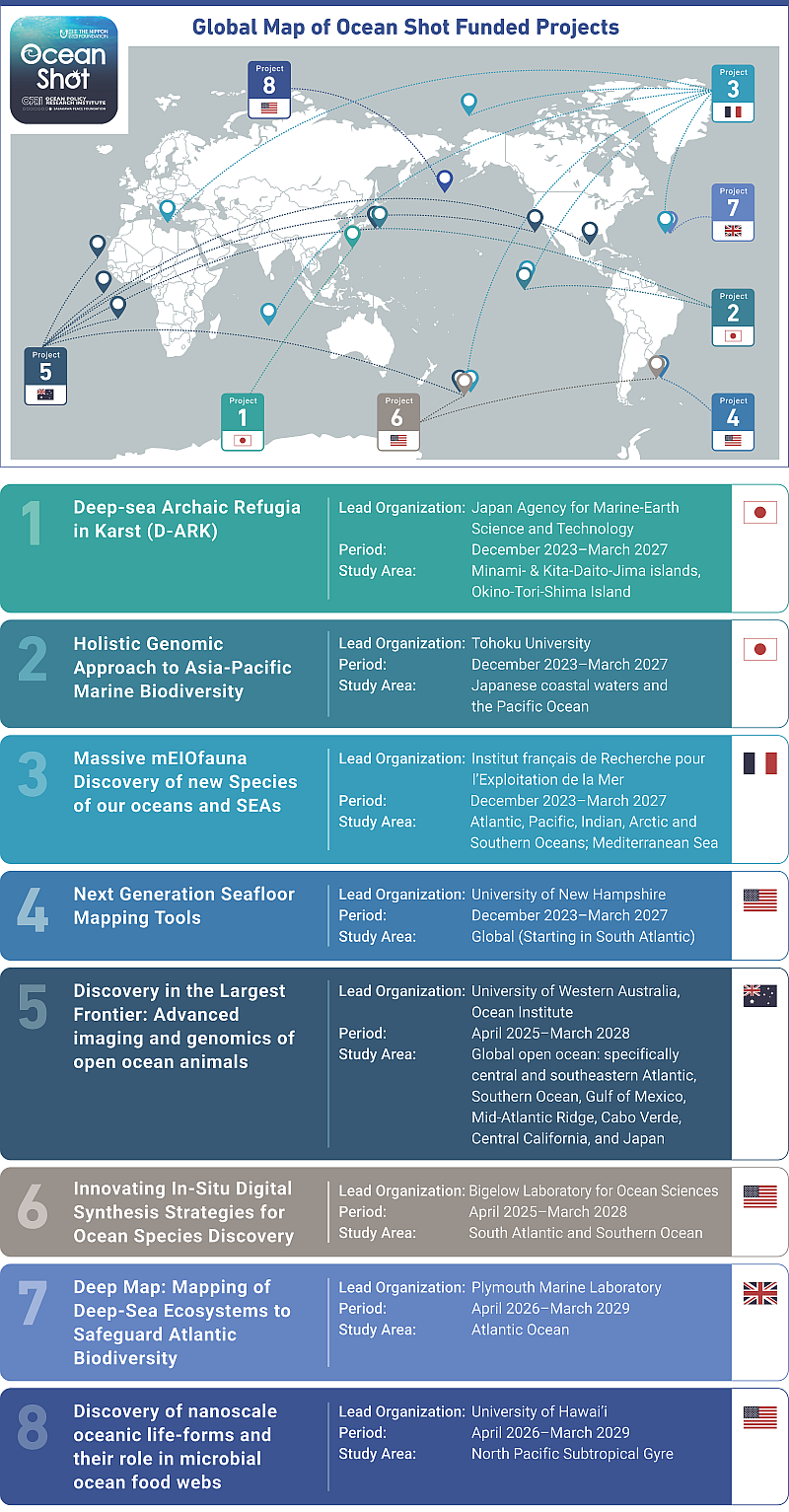
1st Open Call
1) Project title: Deep-sea Archaic Refugia in Karst (D-ARK) (Japanese site)
Representative research organization: Japan Agency for Marine-Earth Science and Technology (JAMSTEC)
2) Project title: Holistic Genomic Approach to Asia-Pacific Marine Biodiversity
Representative research organization: Tohoku University
3) Project title: Massive mEIOfauna DiscoverY of new Species of our oceans and SEAs (MEIODYSSEA)
Representative research organization: Institut français de Recherche pour l'Exploitation de la Mer (IFREMER)
4) Project title: Next Generation Seafloor Mapping Tools
Representative research organization: University of New Hampshire Center for Coastal and Ocean Mapping
Representative research organization: Japan Agency for Marine-Earth Science and Technology (JAMSTEC)
2) Project title: Holistic Genomic Approach to Asia-Pacific Marine Biodiversity
Representative research organization: Tohoku University
3) Project title: Massive mEIOfauna DiscoverY of new Species of our oceans and SEAs (MEIODYSSEA)
Representative research organization: Institut français de Recherche pour l'Exploitation de la Mer (IFREMER)
4) Project title: Next Generation Seafloor Mapping Tools
Representative research organization: University of New Hampshire Center for Coastal and Ocean Mapping
2nd Open Call
5) Project Title: Discovery in the Largest Frontier: Advanced imaging and genomics of open ocean animals
Representative Research Organization: University of Western Australia
6) Project Title: Innovating In-Situ Digital Synthesis Strategies for Ocean Species Discovery
Representative Research Organization: Bigelow Laboratory for Ocean Sciences
Representative Research Organization: University of Western Australia
6) Project Title: Innovating In-Situ Digital Synthesis Strategies for Ocean Species Discovery
Representative Research Organization: Bigelow Laboratory for Ocean Sciences
3rd Open Call
7) Project Title: DeepMap: Mapping of Deep-Sea Ecosystems to Safeguard Atlantic Biodiversity.
Representative Research Organization: Plymouth Marine Laboratory
8) Project Title: Discovery of nanoscale oceanic life-forms and their role in microbial ocean food webs
Representative Research Organization: University of Hawai'i
Representative Research Organization: Plymouth Marine Laboratory
8) Project Title: Discovery of nanoscale oceanic life-forms and their role in microbial ocean food webs
Representative Research Organization: University of Hawai'i