Ocean Newsletter
No.604 April 20, 2026
-
Migratory Birds Connecting Asia's Coastal Ecosystems and International Conservation Networks
-
From the Seas of My Hometown to the Seas of Asia: Youth Dialogue and Action Bringing People Together to Meet the Challenge of Marine Plastic Pollution
-
From Asia to the World: ANEMONE Global's Challenge
Migratory Birds Connecting Asia's Coastal Ecosystems and International Conservation Networks
KEYWORDS
Biodiversity Conservation / Wetlands / Economic Development
SHIMIZU Takehiko (Doctoral Candidate, Graduate School of Hokkaido University (JSPS Research Fellow DC1 / University of Queensland, Australia))
The region stretching from East and Southeast Asia to Oceania is a migration route for many waterbird species. However, due to human activities such as coastal development since the 20th century, coastal wetlands, which are their habitats, have been lost, and the number of waterbirds has drastically decreased. In response to this situation, 18 countries are collaborating, with various stakeholders, including governments and civil society organizations, to promote conservation activities. Nevertheless, further efforts are still needed to restore lost wetlands and waterbird populations.
Causes of Migratory Waterbird Decline: Changes in Asia's Coastal Environment
Many migratory bird species travel long distances across national borders. Migratory birds contribute not only to material cycling within ecosystems but also to signaling the changing seasons for people. More recently, they have also become a source of recreation and tourism through activities such as birdwatching. Today, however, roughly 45% of the world's migratory bird species are in decline. Among them, migratory waterbirds that depend on shallow coastal wetlands and migrate along East and Southeast Asia and Oceania have been experiencing particularly sharp population declines, making their conservation increasingly urgent.
The network of regions used by migratory waterbirds during their migration is known as a “flyway,” and nine major flyways are recognized worldwide. One of these, the East Asian-Australasian Flyway (EAAF), stretches from the Russian Far East through East and Southeast Asia to Oceania and is used by 216 waterbird species, making it the largest flyway in the world (Figure 1). However, 16% of the waterbird species within the EAAF are classified as threatened status (Critically Endangered, Endangered, or Vulnerable) by the International Union for Conservation of Nature (IUCN), and the populations of roughly half of the 216 species are in decline.
The primary cause of this decline is the rapid loss of coastal wetlands that serve as waterbird habitats, such as tidal flats, salt marshes, and sandy beaches. In the latter half of the 20th century, economic development significantly reduced the area of tidal flats in Japan and South Korea by roughly half, while the 21st century has seen large-scale coastal development across China and Southeast Asia. In Tokyo Bay, for example, research by the author and colleagues has shown that more than 90% of the tidal flats were lost between 1950 and 2000. Learning from these “failures of the past,” however, countries across Asia and Oceania have, since the 1970s, developed a growing spirit of international cooperation and undertaken coordinated efforts to prevent the further collapse of this habitat network.
The network of regions used by migratory waterbirds during their migration is known as a “flyway,” and nine major flyways are recognized worldwide. One of these, the East Asian-Australasian Flyway (EAAF), stretches from the Russian Far East through East and Southeast Asia to Oceania and is used by 216 waterbird species, making it the largest flyway in the world (Figure 1). However, 16% of the waterbird species within the EAAF are classified as threatened status (Critically Endangered, Endangered, or Vulnerable) by the International Union for Conservation of Nature (IUCN), and the populations of roughly half of the 216 species are in decline.
The primary cause of this decline is the rapid loss of coastal wetlands that serve as waterbird habitats, such as tidal flats, salt marshes, and sandy beaches. In the latter half of the 20th century, economic development significantly reduced the area of tidal flats in Japan and South Korea by roughly half, while the 21st century has seen large-scale coastal development across China and Southeast Asia. In Tokyo Bay, for example, research by the author and colleagues has shown that more than 90% of the tidal flats were lost between 1950 and 2000. Learning from these “failures of the past,” however, countries across Asia and Oceania have, since the 1970s, developed a growing spirit of international cooperation and undertaken coordinated efforts to prevent the further collapse of this habitat network.
A Multi-Stakeholder Partnership Supporting Flyway Conservation
The East Asian-Australasian Flyway Partnership (EAAFP) plays a key role in raising awareness of the importance of migratory waterbirds and their habitats within the EAAF, and in promoting practical conservation efforts. The EAAFP is a partnership comprising the governments of 18 countries, including Japan, China, the United States, and Russia, as well as international treaty secretariats and international NGOs and NPOs. Within the EAAFP, wetland and waterbird experts regularly review conservation measures, and decisions on conservation issues are made at the Meeting of Partners (MOP), which is held every two years. The EAAFP works to protect important wetlands for waterbirds and to carry out ongoing monitoring. For example, continued efforts to highlight the importance of conserving the world’s largest tidal flats in the Yellow Sea helped lead to the 2019 inscription of part of China's coast as a UNESCO World Heritage site.
The EAAFP also places considerable effort into public outreach activities that engage local communities. For example, the global population of the Black-faced Spoonbill declined to around 400 individuals in the 1990s, making it a Critically Endangered (CR) species. Experts both inside and outside the EAAFP have worked with citizens not only on ecological surveys but also on raising public interest and participation in conservation. Team SPOON,*1 a Japan-based international NGO, regularly holds participatory events centered on a picture book about the Black-faced Spoonbill*2 available in four languages, in which participants take turns reading it in their native languages. The author participated in an online gathering linking Imazu Tidal Flat in Fukuoka Prefecture, a wintering site for the species, with breeding grounds in South Korea, and many families with children took part. Participants enjoyed interacting and creating illustrations together online, and the event was lively throughout (Figure 2). Watching people of all ages, from children to adults, united in their hope for the survival of the Black-faced Spoonbill across generational and linguistic barriers, the author felt both a powerful sense of solidarity around conservation and, as a researcher in conservation ecology, a strong sense of responsibility to pass on these habitats and migratory birds to the wider public and to future generations. As a result of the tireless efforts of scientists and citizens alike, the Black-faced Spoonbill population surpassed 7,000 individuals in 2025, and its status on the IUCN Red List improved from “Endangered (EN)” to “Vulnerable (VU)”.
The EAAFP also places considerable effort into public outreach activities that engage local communities. For example, the global population of the Black-faced Spoonbill declined to around 400 individuals in the 1990s, making it a Critically Endangered (CR) species. Experts both inside and outside the EAAFP have worked with citizens not only on ecological surveys but also on raising public interest and participation in conservation. Team SPOON,*1 a Japan-based international NGO, regularly holds participatory events centered on a picture book about the Black-faced Spoonbill*2 available in four languages, in which participants take turns reading it in their native languages. The author participated in an online gathering linking Imazu Tidal Flat in Fukuoka Prefecture, a wintering site for the species, with breeding grounds in South Korea, and many families with children took part. Participants enjoyed interacting and creating illustrations together online, and the event was lively throughout (Figure 2). Watching people of all ages, from children to adults, united in their hope for the survival of the Black-faced Spoonbill across generational and linguistic barriers, the author felt both a powerful sense of solidarity around conservation and, as a researcher in conservation ecology, a strong sense of responsibility to pass on these habitats and migratory birds to the wider public and to future generations. As a result of the tireless efforts of scientists and citizens alike, the Black-faced Spoonbill population surpassed 7,000 individuals in 2025, and its status on the IUCN Red List improved from “Endangered (EN)” to “Vulnerable (VU)”.
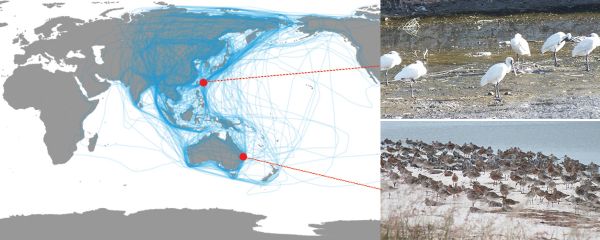
■Figure 1: Migration routes and examples of wintering sites of waterbird populations within the East Asian-Australasian Flyway (blue lines indicate the migration route of each population)
Map source: Wetlands International (2022)
Top right: A flock of the Black-faced Spoonbill (Naha, Okinawa Prefecture)
Bottom right: A flock of the Bar-tailed Godwit (Brisbane, Australia)
Top right: A flock of the Black-faced Spoonbill (Naha, Okinawa Prefecture)
Bottom right: A flock of the Bar-tailed Godwit (Brisbane, Australia)

■Figure 2: A workshop where participants create illustrations of the Black-faced Spoonbill
Future Challenges and Japan's Role
In today's international society, where national interests are becoming increasingly intertwined, examples of multiple countries and stakeholders cooperating to achieve a single goal, such as the EAAFP, are not common. This success may be due not only to a shared recognition of common challenges but also to the voluntary nature of the partnership, which does not compel its participating parties to provide funding or undertake specific actions. However, precisely because of this voluntary nature, the EAAFP faces challenges such as shortages of funding and personnel, as well as regional disparities in implementation. Moreover, while the designation of protected areas continues to advance, some areas still remain highly vulnerable to development, and the impacts of past large-scale wetland loss may persist to this day. As a result, concern is growing not only for species facing a critical risk of extinction, such as the Spoon-billed Sandpiper, but also for the further decline of currently common species such as the Dunlin and Red-necked Stint. In addition to protecting the remaining wetlands, wetland restoration and complementary measures such as the creation of artificial wetlands are likely to become important conservation options in the future.
Japan co-proposed the establishment of the EAAFP and has contributed to waterbird conservation through continued financial support for the partnership and the expansion of protected areas. On the other hand, Japan appears to lag behind some other countries in fostering researchers and professionals capable of taking on international coordinating roles. Furthermore, although awareness of the importance of biodiversity conservation is increasing within the business sector, involvement in waterbird conservation remains limited. Japan is a country where much of the original wetland habitat has already been lost, and major commercial cities have developed on those former wetlands. Consequently, restoring historical wetland landscapes is no easy task. There is little choice but to seek solutions through dialogue among the people across the different regions connected by waterbirds. Neither bird migration nor its conservation is always smooth sailing nowadays. Nevertheless, this framework of international cooperation for waterbird conservation may serve as a model for a sustainable international order in an age of growing social division.
While conducting waterbird surveys, the author sometimes finds himself pausing to imagine the past, wondering what the landscape might look like and how many waterbirds there might be if the wetlands had survived. An awareness that our lives are built upon economic growth mingles with gratitude toward earlier generations who left us at least some wetlands, and with sorrow for the innocent waterbirds whose numbers continue to decline. There is a limit to what any one person can do to confront a flyway-scale crisis alone. Increasingly aware of this reality, the author has, like the migratory birds themselves, headed south to study at a university in Australia to learn more about conservation science alongside fellow conservationists who share the same enthusiasm for protecting nature and migratory waterbirds.
Japan co-proposed the establishment of the EAAFP and has contributed to waterbird conservation through continued financial support for the partnership and the expansion of protected areas. On the other hand, Japan appears to lag behind some other countries in fostering researchers and professionals capable of taking on international coordinating roles. Furthermore, although awareness of the importance of biodiversity conservation is increasing within the business sector, involvement in waterbird conservation remains limited. Japan is a country where much of the original wetland habitat has already been lost, and major commercial cities have developed on those former wetlands. Consequently, restoring historical wetland landscapes is no easy task. There is little choice but to seek solutions through dialogue among the people across the different regions connected by waterbirds. Neither bird migration nor its conservation is always smooth sailing nowadays. Nevertheless, this framework of international cooperation for waterbird conservation may serve as a model for a sustainable international order in an age of growing social division.
While conducting waterbird surveys, the author sometimes finds himself pausing to imagine the past, wondering what the landscape might look like and how many waterbirds there might be if the wetlands had survived. An awareness that our lives are built upon economic growth mingles with gratitude toward earlier generations who left us at least some wetlands, and with sorrow for the innocent waterbirds whose numbers continue to decline. There is a limit to what any one person can do to confront a flyway-scale crisis alone. Increasingly aware of this reality, the author has, like the migratory birds themselves, headed south to study at a university in Australia to learn more about conservation science alongside fellow conservationists who share the same enthusiasm for protecting nature and migratory waterbirds.
*1 TeamSpoon https://teamspoon.wixsite.com/teamspoon?lang=en
*2 MATSUMOTO Satoru, “The Letter from Poo, a Black-faced Spoonbill” (Japanese, English, Korean, and Chinese)
*2 MATSUMOTO Satoru, “The Letter from Poo, a Black-faced Spoonbill” (Japanese, English, Korean, and Chinese)