Ocean Newsletter
No.598 October 20, 2025
-
The Future of the Ocean Begins with Knowledge — Linking the Diversity of Life from Deep-Sea Caves to the Next Generation
-
The Cutting Edge of Research on Coralline Algae: From Biodiversity to Blue Carbon
-
Aquariums Take on the Challenge of Creating Satoumi in Urban Areas
-
Challenges Facing Kesennuma, a Fisheries City, and Digitalization Efforts
-
Navigating “America First, but Not Alone” in the Pacific
The Cutting Edge of Research on Coralline Algae: From Biodiversity to Blue Carbon
KEYWORDS
Seaweed / Ecosystem engineer / Biomineralization
KATO Aki (Associate Professor, Seto Inland Sea Carbon-neutral Research Center, Hiroshima University)
Coralline algae are a representative example of “calcareous algae,” which harden their bodies with calcium carbonate to become rock-like. Research on them has been increasingly active for about 20 years as being organisms highly susceptible to ocean acidification. Recently, it has become understood that algal beds formed mainly by coralline algae are an important coastal ecosystem, maintaining biodiversity and with potential for blue carbon. This article provides an overview of recent research on coralline algae.
Seaweed known as coralline algae
Algae that deposit calcareous material (calcium carbonate) in their tissues are collectively referred to as calcareous algae. However, since algae itself is a general term for diverse photosynthetic organisms classified into more than ten different plant phyla, calcareous algae are also found across several of these phyla. These calcareous algae include both microscopic microalgae and large, macroscopic forms that are visible to the naked eye, particularly seaweeds. Seaweeds are classified into three groups—green, brown, and red algae— each belonging to different plant phyla based on differences in their photosynthetic pigment composition. Calcareous algae are found within all three of these groups. These calcareous algae account for about 5–6% of all seaweed species, representing more than 100 genera. Most species within this group are primarily found in tropical regions.
Among calcareous algae in seaweeds, the largest group is the coralline red algae, with more than 1,000 species described. For this reason, the term calcareous algae often specifically refers to these coralline algae. Coralline algae are, so to speak, seaweeds that can be regarded as “living stones,” as up to 95% of their body weight consists of calcium carbonate formed through biomineralization.*¹ Given this, from the 18th to the 19th centuries, there was intense debate over whether coralline algae were plants, animals like reef‑building corals, or perhaps minerals rather than living organisms. It was only in the mid‑19th century that they were finally accepted as plants.
Unlike other calcareous algae, coralline algae are widely distributed from tropical regions to both polar areas (the Arctic and Antarctic), and from the intertidal zone down to the lower limits of the photic zone. In tropical to subtropical regions with highly transparent seawater, living coralline algae have been reported from continental shelves even at depths greater than 100 m, where light levels drop to roughly 0.1% of those at the surface. Although coralline algae are found primarily in marine to brackish environments, a freshwater species was described for the first time in 2016.
Among calcareous algae in seaweeds, the largest group is the coralline red algae, with more than 1,000 species described. For this reason, the term calcareous algae often specifically refers to these coralline algae. Coralline algae are, so to speak, seaweeds that can be regarded as “living stones,” as up to 95% of their body weight consists of calcium carbonate formed through biomineralization.*¹ Given this, from the 18th to the 19th centuries, there was intense debate over whether coralline algae were plants, animals like reef‑building corals, or perhaps minerals rather than living organisms. It was only in the mid‑19th century that they were finally accepted as plants.
Unlike other calcareous algae, coralline algae are widely distributed from tropical regions to both polar areas (the Arctic and Antarctic), and from the intertidal zone down to the lower limits of the photic zone. In tropical to subtropical regions with highly transparent seawater, living coralline algae have been reported from continental shelves even at depths greater than 100 m, where light levels drop to roughly 0.1% of those at the surface. Although coralline algae are found primarily in marine to brackish environments, a freshwater species was described for the first time in 2016.
The roles of coralline red algae in marine ecosystems
Coralline algae function as ecosystem engineers*² that create limestone landforms, either together with reef‑building corals or on their own. They also play a role in inducing the settlement and metamorphosis of larvae of marine invertebrates such as reef‑building corals, sea urchins, and mollusks. The calcareous deposits formed by coralline algae are not aragonite, the form produced by reef‑building corals and other calcareous algae, but high‑magnesium calcite, which is rich in magnesium and is more susceptible to dissolution under ocean acidification. Because of these mineralogical characteristics, along with the ecological importance described above, numerous studies have investigated the effects of ocean acidification on coralline algae. These studies have demonstrated that the responses of coralline algae to acidification are highly species‑specific.
While coralline algae usually grow attached to rocks, some species remain unattached and instead form spherical to irregular pebble-like structures ranging from a few to over ten centimeters in size. This is called a rhodolith or mearl. Rhodolith beds, areas where rhodoliths accumulate, are found worldwide (Fig. 1) and, like communities formed by large seaweeds such as kelps and Sargassum or seagrasses such as Zostera, are regarded as one of the so‑called seaweed beds. Rhodolith beds are estimated to cover 4.12 million km² worldwide, about 20% larger than the estimated area of coral reefs and 2.5 to 30 times the area of habitats of large seaweeds, seagrasses, and mangrove forests.
One of the functions of rhodolith beds, as with other algal beds, is the maintenance of high biodiversity. The rhodoliths themselves serve as attachment substrata for other seaweeds, microalgae, and invertebrates such as mollusks and sea urchins (Fig. 2). The interstitial spaces between accumulated rhodoliths also provide a habitat for organisms such as crabs and fishes. As a result, the biodiversity of rhodolith beds is higher than that of sandy or muddy seafloors, with greater biomass as well.
Another function is their role in carbon cycling and storage in the ocean. Coralline algae fix carbon in both their tissues through photosynthesis and in calcium carbonate through photosynthesis and calcification, but calcification also releases CO₂. However, part of the CO₂ derived from calcification is reused in photosynthesis, and the remaining CO₂ is estimated to be reused within the ecosystem. Recent studies have shown that, depending on light availability and species composition, rhodolith beds can exhibit carbon absorption rates that exceed those of seaweed beds. Furthermore, it has been reported that particulate organic carbon accumulates in rhodolith beds and is stored for thousands of years.
While coralline algae usually grow attached to rocks, some species remain unattached and instead form spherical to irregular pebble-like structures ranging from a few to over ten centimeters in size. This is called a rhodolith or mearl. Rhodolith beds, areas where rhodoliths accumulate, are found worldwide (Fig. 1) and, like communities formed by large seaweeds such as kelps and Sargassum or seagrasses such as Zostera, are regarded as one of the so‑called seaweed beds. Rhodolith beds are estimated to cover 4.12 million km² worldwide, about 20% larger than the estimated area of coral reefs and 2.5 to 30 times the area of habitats of large seaweeds, seagrasses, and mangrove forests.
One of the functions of rhodolith beds, as with other algal beds, is the maintenance of high biodiversity. The rhodoliths themselves serve as attachment substrata for other seaweeds, microalgae, and invertebrates such as mollusks and sea urchins (Fig. 2). The interstitial spaces between accumulated rhodoliths also provide a habitat for organisms such as crabs and fishes. As a result, the biodiversity of rhodolith beds is higher than that of sandy or muddy seafloors, with greater biomass as well.
Another function is their role in carbon cycling and storage in the ocean. Coralline algae fix carbon in both their tissues through photosynthesis and in calcium carbonate through photosynthesis and calcification, but calcification also releases CO₂. However, part of the CO₂ derived from calcification is reused in photosynthesis, and the remaining CO₂ is estimated to be reused within the ecosystem. Recent studies have shown that, depending on light availability and species composition, rhodolith beds can exhibit carbon absorption rates that exceed those of seaweed beds. Furthermore, it has been reported that particulate organic carbon accumulates in rhodolith beds and is stored for thousands of years.
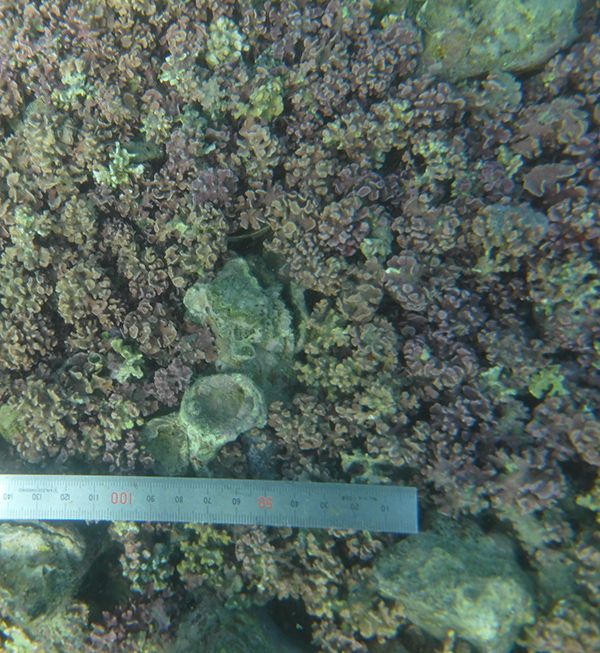
■Figure 1. Accumulated rhodoliths
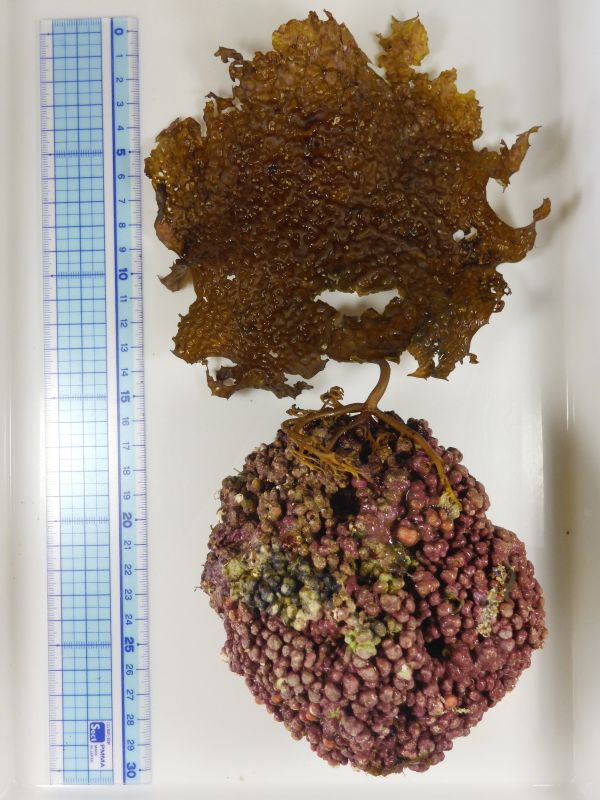
■Figure 2. Brown algae attached to a rhodolith
Efforts toward the conservation of coralline algae and their habitats
As the importance of coralline algae in coastal ecosystems has begun to be recognized, research on coralline algae and on their predominant habitats has rapidly increased. Compared with about 20 years ago, the number of peer‑reviewed papers published annually has more than tripled. At the same time, terminology describing the morphological forms of coralline algae and their habitats has also diversified, and, recently, efforts have been proposed to standardize the usage and definitions of these terms.
Although research on coralline algae has increased, information on their biodiversity, biogeographic characteristics, and the ecological and genetic relationships between rhodolith beds and other algal beds remains limited. With regard to species diversity, recent molecular phylogenetic studies estimate that the actual diversity of coralline algae is about 2 to 10 times greater than the number of species currently recognized taxonomically. Furthermore, the composition of polysaccharides associated with calcification differs among taxonomic groups of coralline algae, and it has also been shown that this composition changes in response to high temperatures and acidic conditions. Clarifying the species diversity of coralline algae is expected to deepen our understanding of their physiological characteristics and to provide clues to the factors that influence their distribution and the maintenance of their habitats.
Although research on coralline algae has increased, information on their biodiversity, biogeographic characteristics, and the ecological and genetic relationships between rhodolith beds and other algal beds remains limited. With regard to species diversity, recent molecular phylogenetic studies estimate that the actual diversity of coralline algae is about 2 to 10 times greater than the number of species currently recognized taxonomically. Furthermore, the composition of polysaccharides associated with calcification differs among taxonomic groups of coralline algae, and it has also been shown that this composition changes in response to high temperatures and acidic conditions. Clarifying the species diversity of coralline algae is expected to deepen our understanding of their physiological characteristics and to provide clues to the factors that influence their distribution and the maintenance of their habitats.
*1 SUZUKI Michio, “Mineralization and Decarbonization of Marine Organisms,”
No. 576 of this newsletter (August 5, 2024)
https://www.spf.org/opri/en/newsletter/576_1.html
*2 YAMAMORI Luna, “The Ecosystems of the Rocky Reef Created by Boring Sea Urchins,”
No. 555 of this newsletter (September 20, 2023)
https://www.spf.org/opri/en/newsletter/555_3.html
No. 576 of this newsletter (August 5, 2024)
https://www.spf.org/opri/en/newsletter/576_1.html
*2 YAMAMORI Luna, “The Ecosystems of the Rocky Reef Created by Boring Sea Urchins,”
No. 555 of this newsletter (September 20, 2023)
https://www.spf.org/opri/en/newsletter/555_3.html