Ocean Newsletter
No.598 October 20, 2025
-
The Future of the Ocean Begins with Knowledge — Linking the Diversity of Life from Deep-Sea Caves to the Next Generation
-
The Cutting Edge of Research on Coralline Algae: From Biodiversity to Blue Carbon
-
Aquariums Take on the Challenge of Creating Satoumi in Urban Areas
-
Challenges Facing Kesennuma, a Fisheries City, and Digitalization Efforts
-
Navigating “America First, but Not Alone” in the Pacific
Challenges Facing Kesennuma, a Fisheries City, and Digitalization Efforts
KEYWORDS
Challenging uncertainty / Enhancing profitability in fisheries / Value of fisheries
SAITO Tetsuo (President, Kesennuma Fisheries Cooperative Association)
Regional fisheries cities with sharply declining working-age populations have in recent years been battered by waves of change in the marine environment. In Kesennuma, initiatives are underway to achieve digitalization for improving the efficiency, labor-saving, and productivity of fisheries and aquaculture amid increasing uncertainty.
Overview of Kesennuma’s Fisheries and Seafood Cluster
Although fishing vessels, fish processing plants, and port facilities suffered devastating damage during the Great East Japan Earthquake, most have been rebuilt through the use of various reconstruction support systems. However, the path to full recovery has repeatedly been hindered by a series of challenges, including labor shortages caused by population outflow, reputational damage associated with the Fukushima nuclear accident and the discharge of ALPS-treated water, and the COVID‑19 pandemic. Moreover, the Pacific Ocean off Sanriku, once a bountiful sea that formed the foundation of the fishing and seafood-processing industries, has begun to exhibit conditions that can only be described as major oceanic changes, such as the emergence of extensive high‑temperature zones. As a result, a growing sense of uncertainty and confusion has spread throughout Kesennuma, a city whose way of life is closely tied to the sea.
In 2024, Kesennuma Fishing Port recorded landings totaling 67,526 tons and 22.578 billion yen in value, ranking first in the Tohoku and Hokkaido regions. Nationally, the port placed ninth in volume and fifth in value, underscoring its role as a major fisheries hub in northeastern Japan. Notably, Kesennuma has been Japan’s leading port for fresh skipjack tuna for 28 consecutive years, accounting for approximately 60% of the country’s total landings. Fresh swordfish and sharks are also characteristic species of Kesennuma Fishing Port, which holds an overwhelmingly dominant share and ranks first in Japan for these species. Although Kesennuma once boasted some of the highest Pacific saury landings in the country, drastic stock depletion pushed the port to fourth place nationwide in 2024. Regarding local fisheries, although coastal and pelagic tuna longline fisheries have declined markedly from their former scale, they remain among the largest in Japan. In the coastal tuna longline fishery, nine 100–150-ton vessels currently land swordfish and sharks, the main target species mentioned above, at Kesennuma throughout the year. In the pelagic tuna longline fishery, twenty-five 400–500-ton ultra-low-temperature tuna longliners primarily land frozen tuna species at Yaizu and Shimizu ports. In addition, offshore and pelagic fisheries operating out of Kesennuma include two distant‑water skipjack pole‑and‑line vessels and three Pacific saury stick-held dip net vessels. In coastal fisheries, operations include large‑mesh driftnet fishing, harpoon fishing, and an Isada krill boat seine fishery. Several coastal set‑net fisheries are also in place, including three large installations and multiple small‑ and medium‑scale ones.
Furthermore, supported by this diverse fishing industry, businesses such as fresh fish wholesalers and seafood processors have long been active in the area. Bonito, tuna, and other species are shipped nationwide, mainly to the Kanto region, and with the development of the Sanriku Coast Expressway the area is increasingly becoming a logistics hub for marine products along the entire Sanriku coastline. In the fish-processing industry, well-known products include seared bonito, processed shark fin—a notable success of the Kesennuma brand––and various canned goods made from locally landed fish. In addition, products such as salted squid guts and salmon roe—although they rely on raw fish imported from outside the region—are well known.
In this area, a fisheries cluster has developed around the fishing and seafood‑processing industries. It brings together technologies, production activities, and information related to fish, the sea, and vessels, including shipbuilding, ice manufacturing, fishing‑gear sales, and box‑making industries. Among these sectors, the shipbuilding industry, which plays an especially important role, also sustained devastating damage during the Great East Japan Earthquake. Reconstruction proved extremely difficult. Ultimately, however, the companies chose not to rebuild individually; instead, five rival firms joined to pursue a collective reconstruction effort, leading to the establishment of Miraiships Inc. With the completion of a skipjack pole-and-line vessel in 2025, the company became one of Japan’s leading fishing vessel shipyards, capable of building nearly all types of offshore and distant-water fishing vessels except for foreign purse seine vessels. In particular, the company holds an overwhelming market share in the construction of Pacific saury stick-held dip net fishing vessels. Its shipbuilding technology, capable of meeting the demanding structural and functional complexity of fishing vessels, remains unrivaled by other companies. This strength is rooted in Kesennuma’s unique environment, where numerous local fishing vessels are based and many others from across Japan regularly call. Within this setting, an integrated end-to-end fisheries business—stemming from the fishing industry itself—has developed through the organic integration of numerous related sectors.
In 2024, Kesennuma Fishing Port recorded landings totaling 67,526 tons and 22.578 billion yen in value, ranking first in the Tohoku and Hokkaido regions. Nationally, the port placed ninth in volume and fifth in value, underscoring its role as a major fisheries hub in northeastern Japan. Notably, Kesennuma has been Japan’s leading port for fresh skipjack tuna for 28 consecutive years, accounting for approximately 60% of the country’s total landings. Fresh swordfish and sharks are also characteristic species of Kesennuma Fishing Port, which holds an overwhelmingly dominant share and ranks first in Japan for these species. Although Kesennuma once boasted some of the highest Pacific saury landings in the country, drastic stock depletion pushed the port to fourth place nationwide in 2024. Regarding local fisheries, although coastal and pelagic tuna longline fisheries have declined markedly from their former scale, they remain among the largest in Japan. In the coastal tuna longline fishery, nine 100–150-ton vessels currently land swordfish and sharks, the main target species mentioned above, at Kesennuma throughout the year. In the pelagic tuna longline fishery, twenty-five 400–500-ton ultra-low-temperature tuna longliners primarily land frozen tuna species at Yaizu and Shimizu ports. In addition, offshore and pelagic fisheries operating out of Kesennuma include two distant‑water skipjack pole‑and‑line vessels and three Pacific saury stick-held dip net vessels. In coastal fisheries, operations include large‑mesh driftnet fishing, harpoon fishing, and an Isada krill boat seine fishery. Several coastal set‑net fisheries are also in place, including three large installations and multiple small‑ and medium‑scale ones.
Furthermore, supported by this diverse fishing industry, businesses such as fresh fish wholesalers and seafood processors have long been active in the area. Bonito, tuna, and other species are shipped nationwide, mainly to the Kanto region, and with the development of the Sanriku Coast Expressway the area is increasingly becoming a logistics hub for marine products along the entire Sanriku coastline. In the fish-processing industry, well-known products include seared bonito, processed shark fin—a notable success of the Kesennuma brand––and various canned goods made from locally landed fish. In addition, products such as salted squid guts and salmon roe—although they rely on raw fish imported from outside the region—are well known.
In this area, a fisheries cluster has developed around the fishing and seafood‑processing industries. It brings together technologies, production activities, and information related to fish, the sea, and vessels, including shipbuilding, ice manufacturing, fishing‑gear sales, and box‑making industries. Among these sectors, the shipbuilding industry, which plays an especially important role, also sustained devastating damage during the Great East Japan Earthquake. Reconstruction proved extremely difficult. Ultimately, however, the companies chose not to rebuild individually; instead, five rival firms joined to pursue a collective reconstruction effort, leading to the establishment of Miraiships Inc. With the completion of a skipjack pole-and-line vessel in 2025, the company became one of Japan’s leading fishing vessel shipyards, capable of building nearly all types of offshore and distant-water fishing vessels except for foreign purse seine vessels. In particular, the company holds an overwhelming market share in the construction of Pacific saury stick-held dip net fishing vessels. Its shipbuilding technology, capable of meeting the demanding structural and functional complexity of fishing vessels, remains unrivaled by other companies. This strength is rooted in Kesennuma’s unique environment, where numerous local fishing vessels are based and many others from across Japan regularly call. Within this setting, an integrated end-to-end fisheries business—stemming from the fishing industry itself—has developed through the organic integration of numerous related sectors.
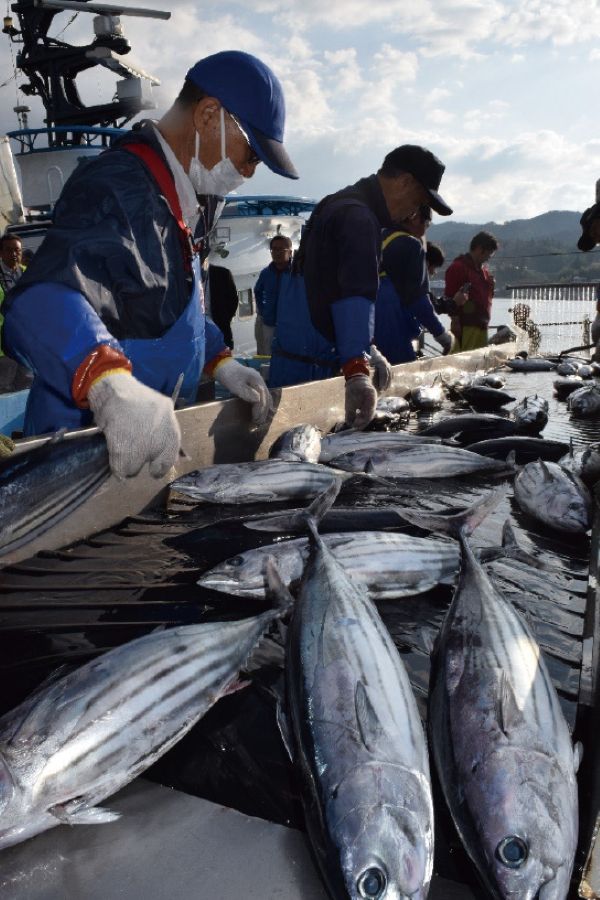
Bonito landings at the Kesennuma Fish Market (provided by the Sanriku Shimposya)
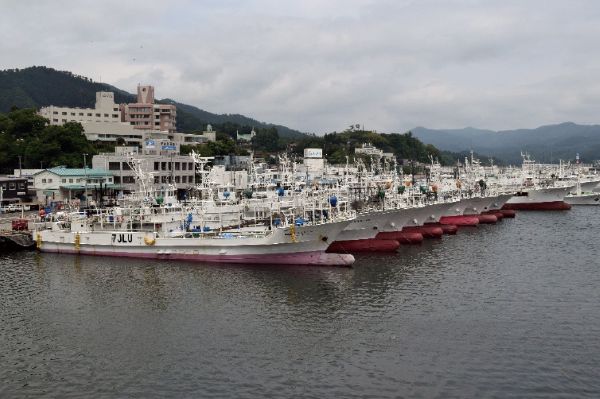
Tuna and saury fishing vessels moored at Kesennuma Fishing Port (provided by the Sanriku Shimposya)
Challenges Facing Kesennuma’s Fisheries and Seafood Industry and the Role of Digitalization
Fisheries, by their very nature, operate under the constraints of complex natural conditions such as weather and oceanographic environments. When fishers confront the immense power of the sea, they do so with humility and a deep sense of reverence. When the wind rises, they stay ashore, and they have long learned to live with periods of poor catches. Even so, today’s fishing industry is exposed to fierce market forces and cannot remain insulated from disruptions in the international economy, such as those triggered by the so-called “Trump tariffs.” Fishers continue to struggle with soaring fuel prices and rising costs of other supplies, yet they are unable to pass these increases on to fish prices. In addition, recent changes in the marine environment have caused significant disruptions to migration patterns of fish and the formation of fishing grounds. The Sanriku fishing grounds off Kesennuma are now exhibiting conditions so abnormal that even veteran fishers say they have never experienced anything like them. This instability in the fishing sector directly affects the operations of the seafood-processing industry, which is now forced to operate under considerable uncertainty.
Labor shortages have also become a severe issue. The population of Kesennuma City, which stood at 73,439 in 2010 (the year before the Great East Japan Earthquake), has declined to approximately 55,000 by 2025 due to disaster-related out-migration and decline driven by falling birth rates. The working-age population has likewise shrunk, resulting in a growing dependence on foreign workers in both fishing operations and seafood-processing facilities.
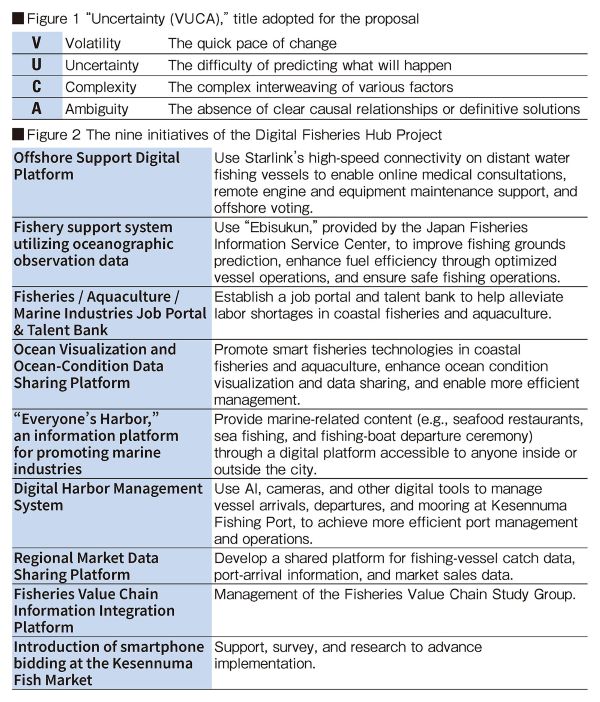
Amid these circumstances, Kesennuma City applied for the national program to designate “digital fisheries strategy centers” and was selected in August 2023 alongside Senshu, Osaka and Shimonoseki. The title of its proposal was “Challenging Uncertainty (VUCA)” (Figure 1).
The plan seeks to explore solutions to the many challenges facing Kesennuma’s fishing and seafood industries through the introduction of digital technologies. To formulate this plan, the Kesennuma City Council for the Promotion of Digital Fisheries was established, and it has been working to address these challenges. In its proposal, six key challenges were identified: (1) reducing uncertainty, (2) creating a sustainable working environment, (3) labor‑saving and improving productivity, (4) data integration, (5) further development of marine industries, and (6) digital transformation (DX) and the cultivation of digital talent. In addition, five specialized subcommittees were formed to advance nine initiatives under the Digital Fisheries Hub Project (Figure 2), organized into short-, medium-, and long-term phases.
Labor shortages have also become a severe issue. The population of Kesennuma City, which stood at 73,439 in 2010 (the year before the Great East Japan Earthquake), has declined to approximately 55,000 by 2025 due to disaster-related out-migration and decline driven by falling birth rates. The working-age population has likewise shrunk, resulting in a growing dependence on foreign workers in both fishing operations and seafood-processing facilities.
Amid these circumstances, Kesennuma City applied for the national program to designate “digital fisheries strategy centers” and was selected in August 2023 alongside Senshu, Osaka and Shimonoseki. The title of its proposal was “Challenging Uncertainty (VUCA)” (Figure 1).
The plan seeks to explore solutions to the many challenges facing Kesennuma’s fishing and seafood industries through the introduction of digital technologies. To formulate this plan, the Kesennuma City Council for the Promotion of Digital Fisheries was established, and it has been working to address these challenges. In its proposal, six key challenges were identified: (1) reducing uncertainty, (2) creating a sustainable working environment, (3) labor‑saving and improving productivity, (4) data integration, (5) further development of marine industries, and (6) digital transformation (DX) and the cultivation of digital talent. In addition, five specialized subcommittees were formed to advance nine initiatives under the Digital Fisheries Hub Project (Figure 2), organized into short-, medium-, and long-term phases.
Further challenges in advancing digitalization
At present, further research and study are required to ensure that digitalization can deliver efficiency gains and labor‑saving benefits in the fisheries and seafood-processing industries, where productivity remains low. In addition, regional areas face a shortage of digital talent, and efforts to cultivate it must also be advanced. Furthermore, while digital technologies continue to advance rapidly, the systems and legal frameworks governing fisheries and seafood-related industries are lagging behind, resulting in numerous issues that still need to be addressed.