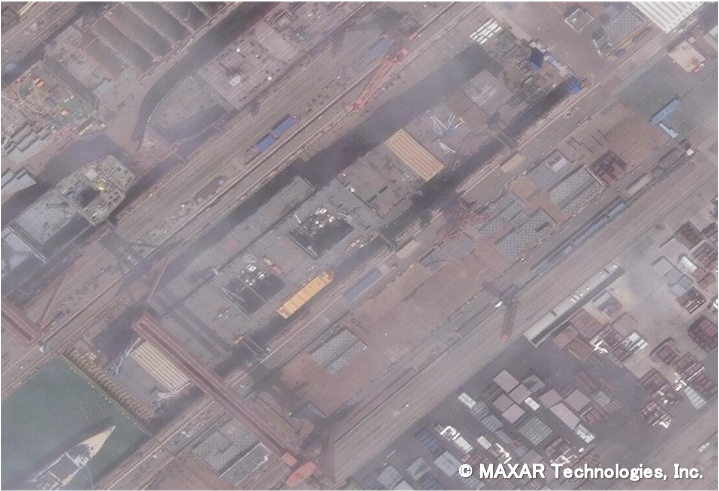
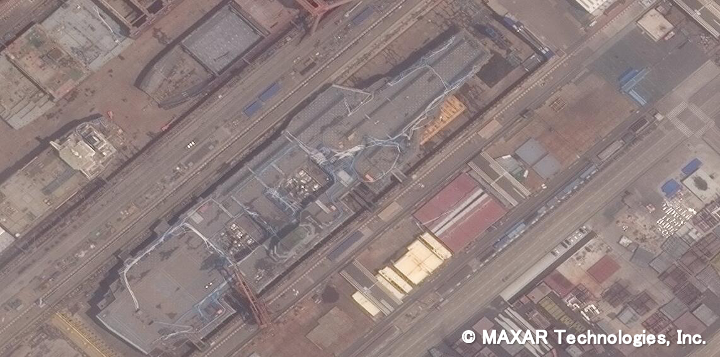
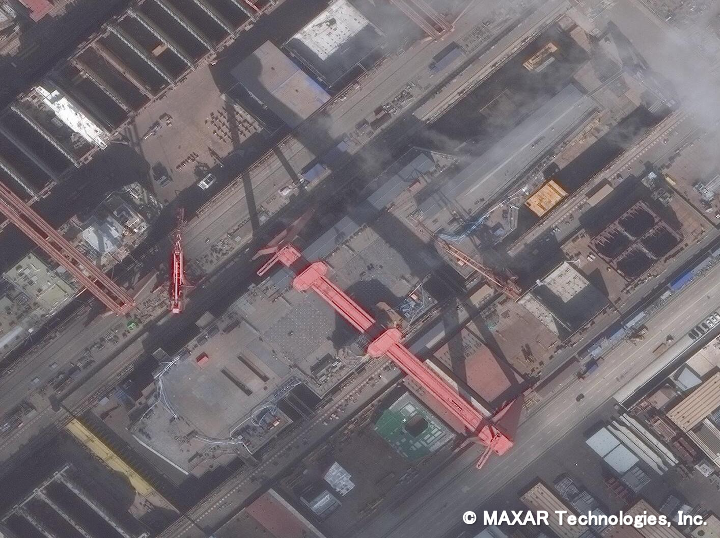
The Oct. 23 imagery reveals that the engine room was now covered and the deck in place. The engines must have been installed. In addition to the catapult equipment on portside of the front deck, an environment shelter had also been set up over another catapult on portside. Also, construction of the island on starboard had reached the upper part.
From the state of the construction work and the fact that blocks of another ship had been placed on the side of the dock, it is highly possible that the Type 003 carrier may be launched not later than early 2022.
Measurements from the Oct. 30 imagery of the nearly finished vessel show that the Type 003 is 318 meters long and 78 meters wide. While its length is some 20 meters shorter than the U.S. Navy's Gerald R. Ford-class carrier's 337 meters, it has the same width. There is analysis that the Type 003 will be capable of carrying aircraft comparable to the U.S. Navy's top-of-the-line carriers.
However, although the Type 003 was expected to be equipped with four catapults, only three catapults can be seen from satellite imagery. Furthermore, compared to the Gerald R. Ford-class carrier's three aircraft elevators (two on starboard and one on portside), Type 003 has only two, both on starboard. Since the difference in the number of catapults and elevators translates into difference in the efficiency of aircraft operations, it is reckoned that the Type 003's aircraft operational capability is inferior to the U.S. Navy's carriers.
There is also the question of carrier-based aircraft for Type 003. A media outlet affiliated with the U.S. Navy reported in 2016 the existence of the J-15 equipped with a catapult launch bar. [1] However, it has been reported that issues with the control system were found on the J-15s carried on “Liaoning” and “Shandong” so production of this aircraft had been terminated. There is an opinion that the J-15s currently owned by the Chinese navy do not even meet the requirements for operating on the “Liaoning” and “Shandong.” In which case, Type 003 will need new carrier-based aircraft.
The Chinese Aeronautical Establishment declared on its website in July 2020 that “a new generation of fighters will make maiden flight in 2021.” However, even before that, the Aviation Industry Corporation of China (AVIC) had posted the silhouette of a new carrier-based fighter on its website in 2019 and asked Internet users to guess what the aircraft was in a quiz. Therefore, it was thought that the new carrier-based aircraft would take flight in 2021. [2] There is an opinion that the silhouette posted by AVIC resembled the J-31. Although the People' Liberation Army has said that the J-31 would not be used because the order of R&D was wrong, there are reports that it is very likely that an upgraded version of the FC-31 for export will be used on the carrier. [3] On the other hand, the Central Military Commission is said to be keen on upgrading the J-20 for Type 003. As of now, the choice of carrier-based aircraft is still unclear. There had not been any report of new generation fighters being launched as of November 2021.
There are also problems with the training of the Chinese navy's carrier-based aircraft aviator. The capability of China's aircraft carriers cannot be gauged based only on the aircraft operational capability of the carrier itself; the capability of the carrier-based aircraft and their aviators must also be taken into account. Furthermore, it is not enough to evaluate China's military power based only on the performance of its weapons. An analysis of the capabilities for manufacturing and operating each weapon, including technical skills, and so forth is also necessary. Collaboration and balance with other weapons, their role in the overall strategy, and other factors must also be considered.
(Nov. 9, 2021)