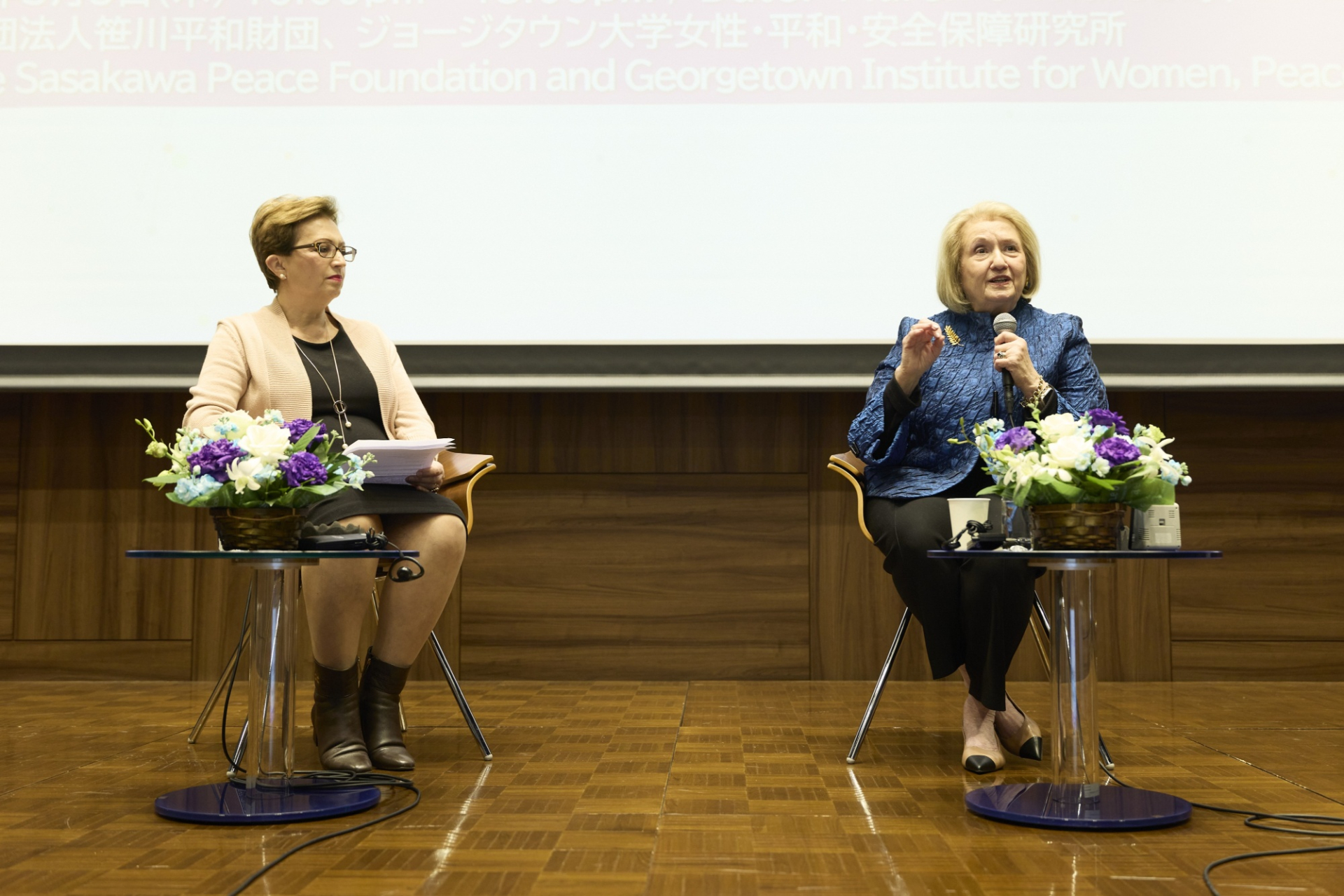
Dr. Akhavan: Hello everyone. It is my great honor to be here, especially to have this opportunity to have a conversation with Ambassador Verveer. And today we are basically going to raise questions that may not have, you know, answers, especially in the very short time that we have. But, we thought we would raise some questions that can become food for thought as we leave here to reflect more on.
So with that, I would like to ask Ambassador Verveer the first question, which is a very kind of a macro question, given the positions that you have held at the forefront of, advancing gender equality around the world, in your important positions that you have held, you have a unique vantage point for assessing progress in these, areas of both WPS and gender equality and women's issues in general.
And I would like to ask you, what have been the moments or the actions in your mind that have moved the discourse on gender equality forward? Have there been any paradigm shifts? Have there been any new conversations that, like since the women's liberation movement in the 1970s, that have given us a new vision for advancing gender equality, or have communicated this issue in a way that has been impactful in the discourse on the issue.
Amb. Verveer: Well, thank you, Roya, for the question. And it's good to be back here in Japan always. And with the Sasakawa Peace Foundation and so many of you who've done so much in this space, I think for me, one of those milestone, paradigm shifting moments was the Fourth U.N. World Conference on Women that took place in 1995 in Beijing.
And there were some 30,000 women from civil society who gathered in Huairou, not right in Beijing. They kept changing the site because I think all of a sudden the leaders didn't know what they had agreed to in terms of having all of these thousands of women coming to China.
And then there were another 17,000 in the official meeting, comprising the delegations from some 185 countries. And it built on previous UN gatherings of women — not just women in these gatherings, but men and women — with the aim to really close the gap between men and women, to recognize, men were equal to women, women were equal to men.
And in Beijing, I was involved because I was working in the white House at the time and Hillary Clinton was first lady, and she was invited by the secretary general to give a speech, one of the keynote speeches. Her speech centered around the phrases women's rights are human rights and human rights are women's rights.
And at the time that conference took place, hard to believe, there was a paradigm shift that was moving forward and that was chiseling women's rights into international human rights law. It had not been there. Domestic violence was not a crime. Many of the issues that we work on that we know today that are absolute issues of women's human rights, were not in human rights law.
And when she got up to speak, she went through a litany of violations against women that we are familiar with to this day. She said that human trafficking is a violation of human rights, that domestic violence, whether violence happening in your home or outside the home, in war for example, is a violation of human rights. Killing a girl baby just because she's born a girl, violation of human rights. And that was seared into everybody's understandings. This was a conference about women's rights as human rights.
And out of that conference came a platform for action. 185 countries signed the platform by consensus. I don't think that would happen today when we're experiencing such a pushback against women's rights.
But by consensus, what did they agree to? They agreed, for example, and there were about 12 articles, that women have a right to an education. They have a right to health care, to participate in the economies of their countries, to participate in the politics and decision making of their countries, to be free from violence, to engage in environmental issues, to safeguard the environment — climate change was not an issue then. It was the environment, but it was preparing the groundwork — to be free from discrimination, and to understand that women need to be protected in times of war, and they have a role to play in peace and security, five years before the 1325 resolution, the Security Council adopted.
And this blueprint for action, there were almost 50,000 people just there in Beijing. There were countless more who didn't get to go to Beijing. They were following everything that was happening and this movement was sparked, that created enormous change. It created a paradigm shift, truly
So many bills were passed. Laws were adopted to deal with domestic violence, for example, which had been viewed as a private matter, a cultural matter. No, it was a criminal matter. And this was a violation against human rights.
In my own government, in our State Department, for example, in the division that worked on human rights issues like female genital mutilation, for example, not considered a human rights violation, all of a sudden we were all working on that.
And so what these attendees did, whether they were NGOs or whether they were in the government, they went back to their countries and they worked on this agenda.
Now, 30 years later, how have we done? There have been extraordinary developments. Girls’ education, for example today, the problems are confined to a small number of places when back then it was hardly on the agenda of the international community.
As I said, laws against domestic violence, now problematically, they were adopted, but in some places not truly enforced or implemented. And that's where work still has to happen today. But there was a huge move forward.
Now, if you look at where we still have to go, there's a lot of place for us all to be working. One area, for example, where a whole lot of progress hasn't been made and you heard about from the first panel is women's political participation. Look at the state of affairs here in Japan. There is a long road to go.
The World Economic Forum — it’s this forum of businesspeople and government people, very high level people — many don't know they put out an annual gender gap report to look at the gap between men and women in a given country, and they have identified the areas of progress. But the report demonstrates political participation is the most difficult gap to close in terms of women's political participation.
Similarly, economic participation, another issue you and we all struggle with. Again, it's not where it needs to be. There hasn't been as much progress as should occur.
So there's work to be done clearly. But sadly, we are also experiencing a tremendous pushback against women's rights today. In many authoritarian countries in particular, pushing back on the progress women made, de-ratifying conventions that have been ratified, for example, to deal with gender-based violence. But I think it's happening because we did make so much progress, and there are many who didn't like what they were seeing because it somehow undermined their own desires for power and what they wanted to do.
And so while we recognize that, we have a lot of work to do to push back on what's happening, but also to accelerate. It's not enough just to push back. We aren't where we need to be, and so we have to really accelerate where we are. But that was one of those extraordinary moments, I think, in women's history.
Dr. Akhavan: Yes, absolutely. Thank you so much for that wonderful response. My next question is that during the last few decades, there has been extensive research, and great evidence that shows that men as well as women are harmed by the dominant patriarchal systems of power. This evidence is unmistakable if we only look at it. Unfortunately, it's not communicated very widely.
And the other side of it is that everyone, regardless of their gender, benefits from a gender equal world. This is also widely researched and demonstrated. So my question is, how can we use this evidence to try to perhaps reframe the entire discourse on gender inequality from the current adversarial conceptualization that somehow thinks about men versus women or women versus men, to a collaborative one, because everyone is harmed by gender inequality and everyone benefits from equality.
Amb. Verveer: Well, I think that's a really important point, and it's one that should help us today, actually, when there is this effort to turn back.
Men and women are beneficiaries of equality for women. There are co-beneficiaries, and some of the research that Roya has been alluding to, demonstrates that when women progress, men also progress and so do families, so do the children. Everybody progresses from that reality.
And unfortunately, there is this attitude that it's a zero sum game. If I succeed, he's diminished. That's not the case. We both succeed. It's a societal benefit when this happens.
I'll tell you, a couple of experiences that I had years ago when I was in the government, I was in India and I was asked to announce a grant from the United States aid agency, to deal with violence against women, and it was to go to a group of men who had organized themselves to do skits. A lot of the people were illiterate, and skits spoke the way language didn't speak, that was not understood.
And so the men on a stage like this perform this skit, and I could see that, you know, one of them — it was all men — one of them would lift his arm to hurt another, and somebody else in the group would push back that arm. And this was the kind of way they were going to go into their villages, to keep harm from happening to women, because the rate of violence against women was extremely high.
And sometime later, the NGO that was supporting this group of men who were providing these skits said to me, “when are you coming back to India?”
And I thought, well, that's peculiar. It's a long way. I said, “why are you asking?” And the response was, the men want to speak to you. And I thought, oh dear God, what is this about?
But I did find myself back at one point and I met with them and I said, “so, how is it going? Is the rate of violence in the village diminished?”
“Oh yes, yes, yes.”
I said, “well, don't you want to tell me about it?”
“Oh, we want to tell you something else.”
I said, “well, what do you want to tell me?” And they said, “we want to tell you we have changed. We realized that to demonstrate the fact that we are men did not require us to harm women. And we feel liberated from that, call it a norm, from that attitude, from that process that affected us.”
And I think in this there's a lesson about how people can change. It takes time, but it is so critical that we deal with these norms.
And then I was in Sweden, and Sweden has adopted a program so that when a woman gives birth, she takes time off, but also the fathers take time off and it's a parental leave with pay. And at first the men were afraid to take advantage of this program because they thought they'd be penalized somehow at work. And the government made some adjustments and basically said, if you don't take it, it's not going to your wife. It's lost and it's not going to help you.
Today, the men are saying, why didn't this happened a long time ago? Why were we deprived from benefiting from having that child from the very beginning being close to us? Why were we not having the same rights? And so the whole attitude has changed about men nurturing their babies from the start and being a part of their lives from the start.
So I think this co-beneficiary is true. We all benefit from the equality that each and every one of us should have to the other. So I think it's an important lesson that you raise in terms of norms because fundamentally, norms are an enormous problem. Attitudes, biases, discriminatory understandings, harm everybody.
Dr. Akhavan: Yeah, exactly. Wonderful, wonderful example. I think because we don't have much time and we would like to leave, time for questions. I would ask just one last question.
Leadership research in the last three decades has clearly shown that clear, that ideal leadership characteristics are very much the ones that generally the female of the species are brought up with and tend to exhibit. For example, care, compassion, emotional intelligence, communal orientation, and, the kind of soft approach to power.
And we have seen this reflected to some extent in today's presentations that these traits also seem to have characterized the traits of the leaders, who have been able to resolve such seemingly intractable conflicts across the world.
And my question is, would we be able to use these skills to really, again, bring men into the discussion, sort of a reach across the aisle type of approach, and basically engage, create spaces within which men and women can engage in addressing the fact that they are truly co-beneficiaries in a gender equal world.
Are there any attempts being made currently? And how can we do this better?
Amb. Verveer: You know, I think that the traits that you said that women are known to possess in terms of empathy and caring and collegiality and those kinds of traits are as important as some of the traits that men are described as having.
Dr. Akhavan: Absolutely.
Amb. Verveer: And it's that, that the compliment, you need both.
Dr. Akhavan: The balance.
Amb. Verveer: You need that balance, and it's often out of balance. So, for example, the Harvard Business School is taking a lot of the traits that women are known to possess or described to have, and saying it's important in the corporate sector. It's important — so for example, there is a real effort to put women on boards of corporations. And what they have found that when there's a critical mass — three, that's a critical mass — but it's enough to balance the other traits that men mostly are described as possessing, and it is affecting the bottom line.
So men in decision making bodies are now really working to try to balance this out in terms of the diversity, because diversity results in more innovation, it results in more creativity, it results in being able to create consensus, to cross against divisions. And so again, it's a very positive reality that is not always understood.
And, you know, I wrote a book with a partner several years ago now, about understanding your purpose, tapping your power, and really making a difference. And so many of the stories I put in the book are about men in decision-making positions — mostly in business, not so much in government — but they've made decisions to really diversify their workforce, diversify their decision making, etc.
And many of the programs were to help women globally. So, for example, a company like Coca-Cola had a big program called “5by20,” creating 5 million new women entrepreneurs by 2020 using their value chain. And what this did in terms of lifting up not just the realities for the women, but also for what was happening within those communities where both were again co beneficiaries.
There is something here that we should all be thinking about addressing in more significant ways. Instead of polarizing, instead of moving from each other, really coming together and understanding that whether it's at the peace table or it's in corporate decision making, or frankly in the family, that men and women both contribute in ways that can be tremendously impactful if we bring out the best in both and have a balance between the two.
Dr. Akhavan: Thank you so much for your wonderful response. And, with that, I would like to invite any questions or comments from the audience.
Question: Thank you, Ambassador Verveer. I’m Tomoko Matsuzawa from the Ministry of Defense. Thank you very much for your insightful input and sharing your experience.
I would like to ask about, developing capacity of a woman to become a leader. So there are opportunities for women joining some kind of a training system etc., but what is the best platform where we can develop women's capacity and also confidence to become a leader? And also, who are the most desirable profile as a trainer to train the candidate of the women to become a leader? Would that be male or would that be female? Or should we? Should it be a mixed trainer team? Thank you.
Amb. Verveer: Well, I think depending on what the characterization of the group of women is can be very instructive. For example, you have done so much work in the security sector. That is often not a sector viewed as one in which women can be successful or have the strengths that they need, for example, to perform.
But the reality is they do and it makes an enormous difference in the countries that have taken advantage of women's roles in the security sector. Even Ukraine today in the midst of a war, has realized a lot of what the women are bringing is not just the physical strength, but it's the intelligence that's needed in terms of the weaponry or the determinations that have to be made in the conduct of the war.
So I think that there is this knee jerk reaction in some places — and it's happening in my own country, regrettably — that anything that has to do with diversity or inclusion, somehow should be thrown out the window. And this is an example that is often provided for the military. And yet we have had top women, extraordinary admirals, generals, etc.
So one of the ways that, and in the ranks of our military, enormous numbers of women, who have done very well. And so I think they get there by learning from each other. When I think of Miriam and Monica, for example, to have their what they have been able to do working with women.
What we learned in women's coalitions is that kind of training almost like training the trainers, or bringing lessons from people who have had to undergo their own seeming lack of confidence or their own seeming lack of leadership. How were they able to get around it? How were they able to address it? And then being in a group is a very strengthening proposition.
So there are lots of manuals on leadership, leadership for in the defense sector, leadership in other areas, leadership in peacemaking. But we know that confidence matters. Believing in yourself matters. Knowing you can make a difference.
One of the things I've always tried to do is help everybody understand that each of us has power. We have different kinds of power depending on where we sit, but when we can put purpose to that power, let's say making a difference in building the security capacity or disaster risk reduction, there's enormous good we can bring to the outcome.
And that isn't self empowering. So I don't think there's one way, but there are lots of examples of how to do this. Well, depending what the group is that you're trying to help.
Question: Thank you very much for your talk, and I am International Christian University senior, and I am interested in, kind of radicalization or extremism.
What I have studied in Norway prior, I learned that these days, many people do radicalization on the online, especially people who are isolated, maybe who don't belong to a big company or not in the leading position.
So I really feel like when people are really living individually and isolated these days, especially in the developed world. I really wonder how we can spread this idea. And I can understand isolated people want to more focus on gaining their more position or more power. So I wonder what kind of message we can deliver through SNS and a more kind of pop or I can say mystical in Japanese like language.
Amb. Verveer: So you make a very good point about people in more isolated regions or isolated settings where they don't have the benefit of coming together with others who can support them and enable them to do what they have the capacity to do, if they have the right learnings that help them.
And I think today, we know that technology can be a plus and a minus. There is a lot of harm that's being transferred, through the internet today, particularly harmful in many ways to women because of the way women are being portrayed, and there's an attempt to bring them down to really get them out of politics. And AI is only going to exacerbate that.
But there are a lot of pluses, too. And I remember back when it was the simple phone that made the difference, that became the way you could teach people the most basic, educational tools or health care do's and don'ts. Or if you're a simple farmer, where's your market on a given day, you could walk miles and find out there is no market that day, but your phone could tell you. And so even you could do your banking on a phone today in many places.
And so the simple phone became a tool for development, and there are so many creative ways that that the phone and now the access to the internet have been used to break through this isolation in a very positive way. And I think there are lots of tools out there that you can find to enable, especially to lift up people in circumstances where there is tremendous isolation and enable them to come together and to really prosper.
Dr. Akhavan: Thank you very much for the questions. Wonderful questions. And, very comprehensive and thoughtful answers that we received from Ambassador Verveer. Thank you so much. It's been an honor.
Outro: That was the special dialogue with Ambassador Melanne Verveer, Executive Director of the Georgetown Institute of Women, Peace and Security. We have lots more in store for future episodes of SPF World Views, so stay tuned. Thanks for listening to this episode. We'll see you next time.