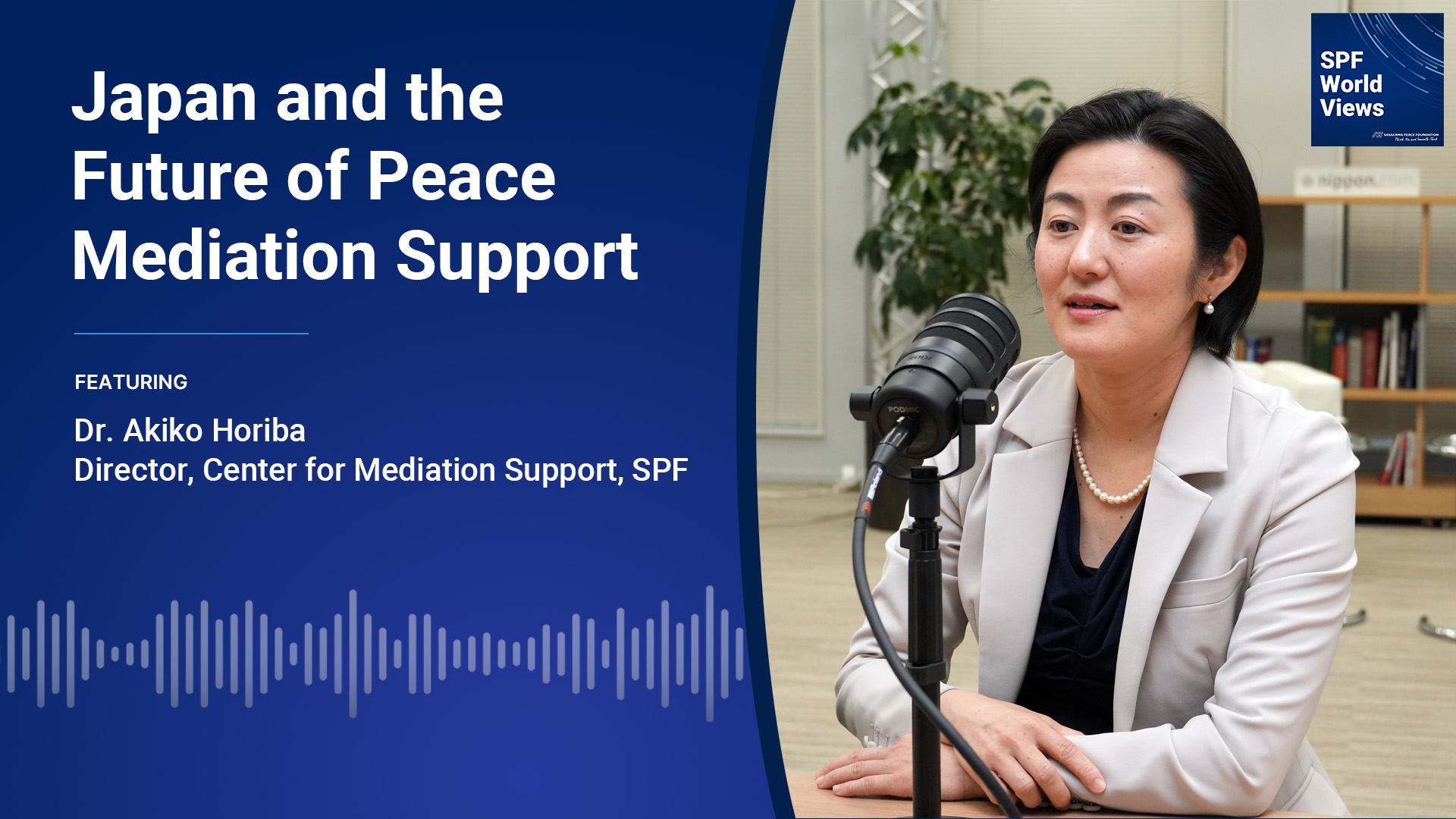
Today we'll be discussing a broad range of topics from the concepts of peacebuilding and peace mediation and peace mediation support. But before we get to that, I think we need to ground ourselves in terms of where we are in the world looking toward conflicts that are happening today. So, this is a bit of a big question, but I wanted to ask, from your perspective, how you would characterize the state of conflict today?
Dr. Horiba: Thank you very much. In this world right now, there are so many conflicts and people are still very much suffering all over the world, but no one in the media covered those conflicts.
For example, what I'm involved in Southern Thailand, there are a lot of bombings still, but on the local media even, it is not so much covered those issues, in the region, too.
And, for example Rohingya issues or Myanmar issues, there are still conflicts going, but because of the big conflict in Gaza, Russia, Ukraine, no one cares about those conflicts. But statistically, more than 50% of the conflicts in the world are related to self-determination conflict.
Can you quickly tell us what do you mean by self-determination conflict?
Self-determination conflict is the demand of the right of self-determination, but because of the strong government or authoritarian government, pressured the local people, especially using violence, and oppressed those people’s demand, so they cannot really fully get their right of self-determination.
So, they grab arms and fight back to the government, but the government also oppresses those people’s demands. So, it is a negative cycle of violence.
That kind of conflict still occurs in many countries, but because of the big wars – Russia, Ukraine, Gaza, Syria, Yemen, Libya – these self-determination conflicts are ignored. But that also leads to other conflicts, so I think it is very important to focus on and try to solve those problems in the self-determination conflict.
We'll be going into the concepts of peacebuilding and peace mediation. But to an untrained ear like mine, the words peacebuilding, peace mediation, and also peace mediation support, all sound vaguely similar to each other. I'm hoping you could explain what exactly is the distinction between these phrases.
Dr. Horiba: Yes. Actually, at the U.N. level, the definition of peacebuilding is a very broad definition of peacebuilding. And then there are four phases – preventive diplomacy, peacemaking, peacekeeping, and post-conflict peacebuilding.
And Japan, the Japanese government and Japanese NGOs, mainly focus on the post-conflict peacebuilding. This means that there is a peace agreement, then a Japanese entity comes in for the development, reconstruction, and so on.
Post-conflict reconstruction means that we are using ODA (Official Development Assistance) and then development aid, so building a school, hospital, infrastructure, that’s more the focus of the Japanese ODA development aid for reconstruction. And many Japanese NGOs also working post-conflict trauma healing, of course, development using ODA also, so mainly post-conflict peacebuilding phase.
Of course, many Japanese NGOs are working on humanitarian aid during the conflict time. But we are not really touching the political solutions for the conflict. So we are more focusing on the post-conflict peacebuilding, but not the whole range of peacebuilding.
What about with peacebuilding and peace mediation – how are those two distinct from each other?
Dr. Horiba: Peacebuilding itself is a very broad idea, but the peace mediation phase is during the peacemaking phase. So still there is a conflict, violent conflict, then the third party comes in and tries to solve this problem. That is the peacemaking phase.
So peace mediation, a third party comes in and acts as the mediator or facilitator to solve the problem, bringing two or three conflicting parties and then bringing them to the peace dialogue table to negotiate and try to compromise with each other, then reach an agreement, a peace agreement. That phase is very political, but this is a really important effort to do.
I also wanted to add one more thing on mediation and mediation support. If there is already a mediator and the peace process has started, but someone is supporting this peace process going forward, that we can call mediation support. Even behind the scenes, we can do some kind of collaboration to promote the peace process. So that's why peace mediation and peace mediation support is slightly different.
Can you think of any specific examples of the Japanese government doing these kinds of activities?
Dr. Horiba: Yes, Japan, actually we also had some experience doing peace mediation or peace mediation support.
For example, a long time ago, but in Cambodia, the Japanese government actually was doing a lot of mediation support role in Cambodia. Also in Indonesia, Aceh CoHA (Cessation of Hostilities Agreement) process 2001 to 2003. Also in Sri Lanka, we were involved in the peace process, peace dialogue.
And our big success is in the Philippines Mindanao. The Japanese government became the international contact group with observer status and then supporting the peace process, promoting the peace process itself.
So Japan also has some experience working in the peace-making phase for the mediation support, but not really emphasized and more focusing on the development.
Do you see that there are any sort of expectations that potentially the international community has of Japan in this area? Or how does Japan fit into the larger international picture?
Dr. Horiba: We are kind of seen as a very neutral actor, because we are not Muslim, we are not Christian, we are not Jewish. So, if it is related to the religious conflict, related to the religion in the conflict issue, then Japan maybe can be a neutral third party and we can discuss for many peoples, whoever that may still have a strong stereotype towards other religion. Japan is free to be in a free position from them.
Then also Japan, because of the Japanese government ODA support for a long time and development aid, there is a lot of trust with other countries, especially developing countries.
So what Japan, after the conflict WWII, for 80 years we are working a lot for the development aid. Through that support, Japan developed a lot of trust with the other countries.
That's why there are so many conflict areas, some of the actors are asking Japan to come to be a mediator, but the Japanese government, also many of the Japanese NGOs, are a little bit hesitant to be involved because this is very politically sensitive. But I think it is also very important, and there are a lot of space that Japan can play some role to contribute peace and stability.
You talk about Japan being called upon as this neutral party in the post-World War Two international order. But I think we're at a point in time where that international order is changing and international institutions are changing and evolving. So what do you see as the challenges and where further action is necessary, either by Japan or other parties as well?
Dr. Horiba: After WWII, human beings actually learned a lot from the tragedy that we need to protect human rights. We also have to have more rule of law, democracy. So those kind of values were developed for 80 years because we had a bad tragedy and lessons learned from WWII, I think.
But right now, many of the big powers start to forget about it. So Japan, through the development aid, not mediation but through the development aid, Japan tried to promote peace in the world and stability. So, Japan right now because of the disappearance of those important values in this world, Japan can play an important role to strengthen again those important values with other countries, like-minded countries.
It is a really difficult moment, a challenging time in the world, but Japan has to play a more proactive role for peace and stability in the world, and maybe Japan can play that kind of role through not only development aid, but through peacekeeping, and this means peace mediation support.
There's an important role also for private organizations in this discussion. We've been talking about the Japanese government and efforts that have happened on that end, but what do you see as the role for other organizations in this process?
Yes, actually peace mediation and peace mediation support is very politically sensitive because some of the countries who had a self-determination conflict, they don't want to internationalize those issues because of the – this is our internal affairs, so they don't want an international organization or other government to come in and do something.
So, there are a lot of limitations if the government comes in and does some activity, or international organizations like the U.N. coming in to do some peace mediation activities within the countries.
But, for a private organization it is much easier to come in and private organizations can make a lot of networks or do trust building activities with all conflicting parties. Then, we can find some opportunity to bring those two parties and sit down at the dialogue table and then find some solutions.
We can also say to all those actors that there are a lot of ways to solve the problem not using violence. So, we can try to convince them to sit down together and discuss for the future. But those kinds of initiatives are sometimes difficult if done by a government or U.N. agencies. There are a lot of roles that a private organization can play.
I want to turn our attention to the Center for Mediation Support, which was established within the Sasakawa Peace Foundation on April 1 of this year. So first, can you tell us what are the central goals that are guiding the work of the center?
Dr. Horiba: The Japanese government and Japanese private organizations didn’t focus on the peacemaking phase, so we didn't do so much on peace mediation and mediation support. But, as I told you, actually Japan can play a much bigger role for this phase.
The Sasakawa Peace Foundation and also The Nippon Foundation have been working in peace mediation support in Southeast Asia mainly for a long time. So we can establish this center and we can do more of this kind of activity with other countries.
That's why we can use this experience to share with other countries. Then maybe we can play more of a role for making peace and stability, not only just in Southeast Asia, but other regions, too.
What are some of the regions that will be covered by the work of this center?
Dr. Horiba: We are now thinking that we have been more focusing on Southeast Asia, but we wanted to work for the whole of Asia. But what does it mean, Asia?
Usually in the world we say Middle East. But this is still a very colonial perspective. Maybe from London, Paris, you see the Middle East, but from Japan, we see the Middle East is actually west.
So now we wanted to have a concept of a bigger idea of Asia. So we want to call it West Asia. We are saying that Asia is from east until west – all we call Asia. Those regions in West Asia, that's also where the center wants to try to do some activities.
I'm hoping you can talk a bit about what exactly those activities would be. So the center will be focusing on peace mediation support. What exactly does that mean in this case?
Dr. Horiba: So for example, what we are doing in Southeast Asia, especially working on the Deep South Thailand conflict. So, we are promoting the peace process. Currently Malaysia as the facilitator, the Thai government, and then the armed group called BRN (Barisan Revolusi Nasional, or National Revolutionary Front) is talking for the peace dialogue facilitated by the Malaysian government.
But sometimes it gets stuck, the peace process itself. So, we as a Japanese private organization, we are working already more than 15 years in those areas. So we have a lot of contact, and we have a lot of trust building with the armed group, the Thai government, and the Malaysian government, too. So, as a Japanese private organization, we can support from behind the scenes, we can support this peace process. That kind of activity we call peace mediation support.
We can do this not only just in the Deep South, but in other areas, too. For example, Libya. It is very far from Japan, but because we are not really involved and we don't have any interest in Libya, that's why as a third party, we can do some activities in promoting peace and stability in the region. We are still discussing what we can do, but we wanted to engage with all those actors because we need to understand what actually all the actors are thinking.
Usually, current situation, for example Trump, he says, he claims himself as a mediator. But what he's doing it's more deal or a transactional deal. It's not peace mediation or not conflict resolution, actually. This is more interest-based activities.
To solve the problem, solve the conflict, it’s really important to touch the cause of the conflict. So it means that we need to understand what the conflicting actor thinks. So that's why we need to engage with all actors and what they are actually thinking. It is very important to understand. That is the first basic activity, to understand what they are thinking and to have some good relationship and trust-building with all actors. That is a starting point. Then we can start to think together, what is the future?
But right now, there are so many mediators like Trump. They didn't touch the real cause of the conflict, only just the surface that only stopped the violence for a while. But that means that it will reoccur again, the violence, if we don't really touch the cause of the conflict.
And this is sometimes a very long process. And then the more structural causes of the conflict are everywhere. So we cannot solve all the problems, but still, we need to talk about it if we want to see the future.
And another interesting thing is many of the mediation support actors are doing lessons learned or sharing the experience. Each conflict is very unique, but at the same time, we can learn from other conflicts, too. That's why it is also very important to have more networking and then collaboration with many actors.
And at the Center for Mediation Support at the Sasakawa Peace Foundation, we want to focus also on becoming a hub of the area studies scholars. In Japan, there are so many Japanese scholars or researchers who can speak a foreign language, and they know what's really happening in those countries politically and economically, and socially, many perspectives. But in Japan, the Japanese government and Japanese organizations don't use this knowledge so far, so much.
So maybe this Center for Mediation Support can be the hub where all area studies come together and we analyze together about the conflict. And then we want to utilize their network, their knowledge, their experience for peace.
I also want to hear a bit about your story and how you got involved in this field in the first place, so I wanted to know, why did you become interested in the field of peacebuilding?
Dr. Horiba: Yes, because actually it is from the high school student.
Oh, really?
Dr. Horiba: At that time, it was the Yugoslavian conflict there. So many people say that ethnic cleansing or religious war, so fighting Muslims and Christians. So I saw that, when I was high school, I saw those conflicts and studied a little bit, and I thought that, well, I'm not a Christian. I'm not a Muslim. So maybe I can be the mediator to bring both people to talk and to solve some problem.
So I thought that Japan can be the connector, Japan can be the kind of mediator role for, making peace. That was only when I was a high school student –
So young, at such a young age.
Dr. Horiba: I was, you know, kind of got some inspiration that, maybe Japan can play that kind of role.
So since then, I thought that, well, Japan we don't have a kind of religion, institutional religion, but it's important to understand what is their belief. That's why I started to study theology first, and then I started to study about area studies, especially I studied in Italy, America. I went to Europe and America, so I thought that it is good to study about Asia, so I picked the Indonesia as a case study. But especially they called it religious conflict in Indonesia.
Then I started to do my PhD fieldwork in Ambon in Indonesia, the east part of Indonesia. There are some, Christian versus Muslim communal conflict happened since 1999.
So I started to live with the Christian community and the Muslim community as a homestay. But because I'm Japanese and they don't know what my religion is, that's why Muslim community also welcomed me to stay, and Christian community also.
So that is, kind of like a real experience, a concrete experience that Japan can really be accepted by both communities in the first stage. Of course, for whoever, it takes a long time, whoever can make trust with both parties. But for Japan, it’s very easy to, in the first stage we can go and talk with anyone.
After that, I also, start to work in Poso, Indonesia, also Aceh, and started to work in Southern Thailand because I can also speak Malay language. As Japanese in Southeast Asia countries, they really easy to accept me to talk what they actually think.
In this sense. I think that, from my real experience, maybe Japanese can play many roles for peacemaking and peace, especially peace mediation support, because it's a very politically sensitive. But, if we properly analyze the conflict and then actor mapping and networking, then we can have more access to anyone in the region, conflicting parties, and can hear their stories, and then can maybe bring some peace in the region. That is my experience, and then my idea. That's why I started to work on these issues.
What would you say is your vision for the field of peace building moving forward based on your experience on the ground?
Dr. Horiba: You know, this world is really having a lot of conflict all over the world. And then I think because many countries are focusing only on military expense increasing, and more military protection in all countries, then they forget about what happened outside, and still there are so many people suffering.
But still Japan maybe can play some role and then can support some of those who are suffering. And that is more Japan's soft power, and Japan can do more activity for peace.
Then, as a private foundation, we can play a more proactive role in this field. Then even this very challenging situation in the world, somehow we can bring some hope and collaborate with all like-minded countries and organizations together to promote those activities. So even if it’s a small step, I think it is very important to initiate this kind of activity.
Outro: That was our conversation with Dr. Akiko Horiba, Director of the Center for Mediation Support. To learn more about the center, head over to the show notes or visit the SPF website. Thanks for joining us for this episode of SPF World Views. We’ll see you next time.