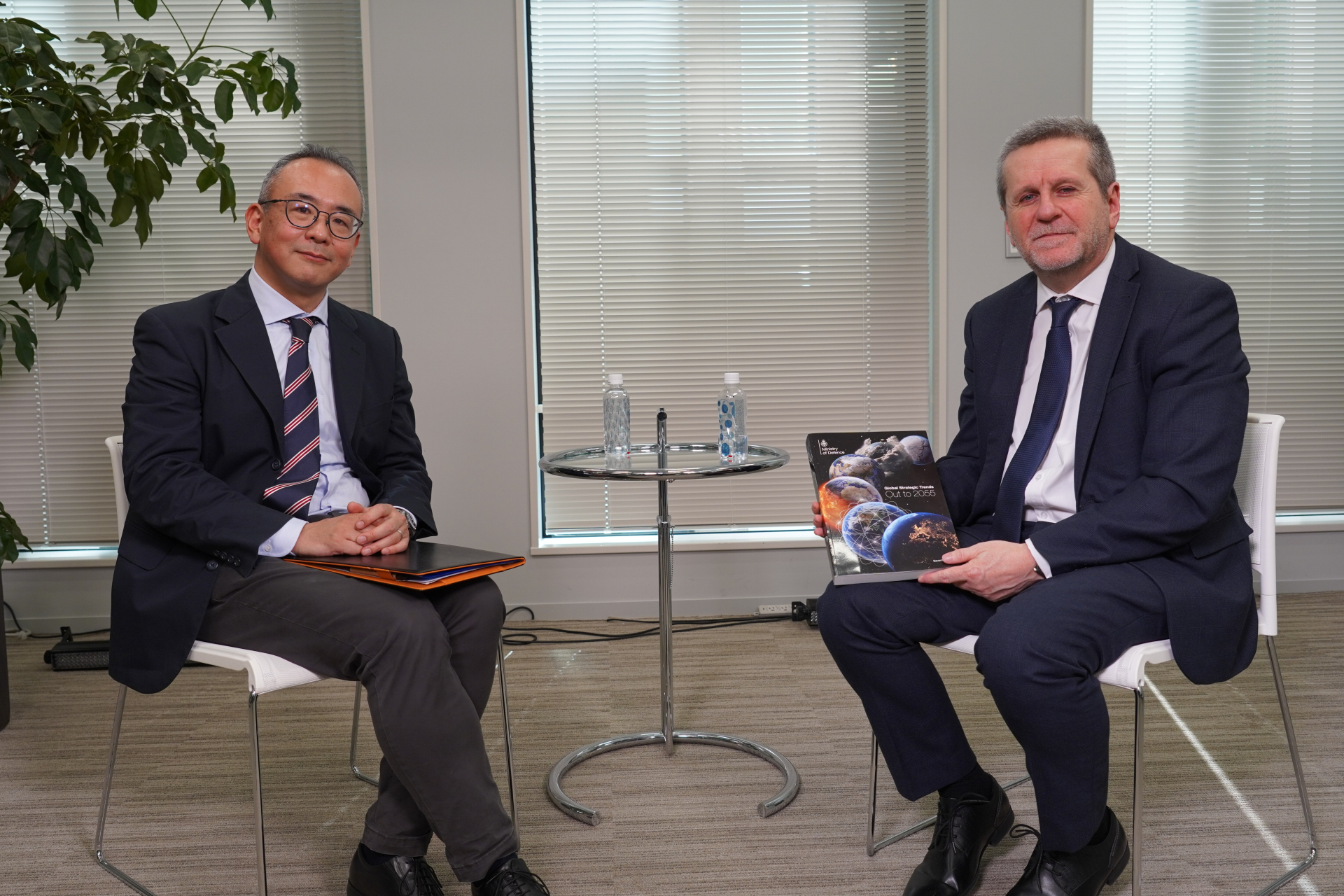
Mr. Nishida:
Richard, thank you very much for coming to the Sasakwa Peace Foundation. We are very much honored to have the Defence Futures team to our foundation to give us a third interview about strategic trends analysis.
I would like to ask you about the changes you have made in the
GST 7 from the last version GST 6, which was published in 2019. Do you have any new findings or update adjustments since then, and also any attempt to change the basic hypothesis or model or methodology based on what we have seen over the last five years?
Mr. Johnson:
Thank you, first of all, for hosting us and for this opportunity to chat today. It's a great opportunity for us.
As you said, it's the seventh edition. Central to the work, to the analysis, is our thoughts on six big drivers of change, so a lot of the analysis in there, a lot of the narrative is these six drivers, the impact we think they could have, some of the considerations that go with them.
The second thing I'd say is about the sort of regional and thematic perspective. So there is a big global view of this. There's a big global view of how these drivers impact. But what the analysis does is then take us to different parts of the world, different topics to try and understand those and some of the differences and nuances.
And then the third thing that I draw out from the book, which is new, is these five pathways to the future and these five futures – all fictitious, not predictions. We know we can't predict the future, but intended to be a useful tool for our strategists and our policymakers to think about different futures, different contexts that we might have out to 30 years, and to understand how those different futures might then impact on the choices that we make today.
Mr. Nishida:
Since the release of the GST 7 on September 2024, you have been in consultation with various stakeholders, including the U.K. and other government officials, academics, and civil societies.
I’m just curious, what are their major responses? Including Japan, many of the developed countries appear to be more pressed by the immediate issues such as Gaza, Ukraine, or own defense, while the so-called Global South countries – India, Turkey, Indonesia, or the Gulf countries – appear to be more optimistic about the future outlook, albeit most of them are also going to be affected by some of the strategic trends that you identify in your report.
Do you see any differences in the attitude or the perception or response to your analysis?
Mr. Johnson:
I think the first thing for me, starting close to home for me would be within U.K. defense. We currently have a Strategic Defense Review underway within the U.K. When we have these big strategic reviews, it is an opportunity across government and across defense for people just to think into a slightly different context, to think a little bit longer term, to have these strategic discussions.
From a national perspective, that's a real opportunity for us, so this work is something that the Strategic Defense Review team have had access to, and they've been briefed on it. And similarly across government in U.K., other departments doing their own similar longer term strategic refreshes and thinking, and to varying degrees, this can form part of those conversations.
What we've found over time is partnering with friends and allies around the world, that's helpful to us in terms of doing our work and having a broader perspective. But what we've seen over time is some of our allies and partners actually using this work themselves, using it as an input into their own defense planning, their own thinking.
We've seen Sweden, our partner nation, leading that. The last time we published this in 2018, the Swedes did something they called a Swedish synthesis to say "if this is the big global view, what does that mean for us in Sweden? What they've done this time, which is really exciting, is to lead some work with their Nordic neighbors and to look at the Nordic region and to say, okay, if this is a big global picture, what does it mean for the Nordic region? What are some of the issues that give rise for those nations?
And there are some other countries around the world doing similar things. Looking at taking the same approach to say if this is the big global view, what does this mean for us?
Mr. Nishida:
I hope our government also finds it interesting and useful to do this kind of work. At the same time, I think we are right now being challenged by a big neighbor, also a small neighbor as well. And I think we tend to look at the more immediate security environment.
Now, relating to that, it appears that our confidence in multilateralism is also fading or being challenged in many respects. While reading the GST 7, there are going to be more occasions that require international cooperation, whether it's migration, climate change, urbanization, conflicts, etc.
Now, how do you think about the utility of the post-World War Two multilateral institutions, notably the United Nations, especially for the Western countries, and for the nonpermanent members of the Security Council like Japan. How should we balance our diplomatic and also defense efforts to engage with bilateral partners or multilateral partners, and also the so-called “minilaterals”?
Mr. Johnson:
In terms of near-term/long-term, it's quite a challenge for us. I think when you're trying to look out to 30 years into the future at very broad trends and the potential for disruptive shocks, it’s particularly hard if something is happening today. So, if you want to think about the future of Russia out to 30 years, it's very hard to do that without thinking about what's going on right now in Ukraine.
In terms of multilateralism and institutions, we talk in the book about the idea of a very intense global competition. But when we've talked about these kinds of issues in the past, consciously or subconsciously, I think we've imagined that the system, the rules-based system, is a constant. There are these different technologies, there might be these different pandemics, there are these different challenges, but there's something that's very stable around the way the world is organized more generally. And what we've done this time is to think about the possibility that that's not the case, to think about the possibility that the world might be organized differently in future.
So we've got these five fictitious futures. And one of those is this world of multilateralism, of global cooperation and accommodation.
The second is, if you like, an evolution of what we have today. So the institutions that we can recognize today evolving, changing, still challenged in some cases. Probably central to that world is an idea that democracy is still seen as a significant, valuable approach to government by those more powerful players in this world.
The third world we describe sort of flips that on its head and says what if it's very different actors and different institutions that are helping drive the rules, the norms, the international institutions?
The fourth world is one in which we descend into conflict, perhaps because those institutions don't evolve, don't survive. We don't have the new norms of behavior, the new rules that that we need.
And then the fifth one is, I think for some, the most interesting world we describe, and if you're as old as me, one of the most challenging, because it describes a world in which whatever is happening, it's not states that are central to defining that world. It's perhaps a world in which states have struggled to cope with some of the challenges that they're presented with, and people have looked to others for security, for services, whether that's the private sector, whether it's a city that they identify more as being part of a city than as part of a part of an overall state.
So we have these different futures to provide that opportunity to consider different worlds and whether some of the choices that we might make today look like good choices depending on what the future might look like.
Mr. Nishida:
You are in the process of translating the summary report, the bite-sized version, into Japanese, which is going to be produced sometime within this year. I haven't seen the draft, but I think there might be some with the suggestion that you may want to make when reading this kind of analysis, because we are not so much used to reading the future descriptions.
Mr. Johnson:
So, I really hesitate to offer advice to anybody, because who are we to say to the Japanese government or anybody else this is what we think you should do.
I think from our perspective, the logic behind us starting to do this work 25 years ago, we still think is relevant. The report that recommended that we should be established in 1998 also announced the government's intention that the U.K. would have two new aircraft carriers. That's 1998.
We have those aircraft carriers now, and if they stay in service until they're due to go out of service, that's 2069. So that's 71 years from when we first said the government wants to have these aircraft carriers to them going out of service. Think how much can change over that period of time.
We are in this business of making long-term investments, some of them quite expensive. For us, we think it's important that we, as we say, we can't predict the future, but we think it's important that we try to have some insights into the context that we'll be operating in into the future to inform some of these decisions.
I think more generally, what comes out of this edition for me is this theme of global competition, and it is truly global. If you look at the competition for access to resources to energy to markets, it's going to take place on every continent and in every shared space and in new places – on and under the seabed, in space, increasingly in cyberspace.
There's a global dimension to this for everybody. Whichever actor it is, state or non-state, there's a global consideration. And given the way things are interconnected, that understanding of how our defense strategy fits within our wider view of security and how our view of security fits within our wider view of our national strategy, our place in the world.
These are big issues and big challenges, and we don't make recommendations, but we hope that through some of the insights in here and some of the models we have that we encourage people to ask some challenging questions of themselves.
It would be very easy to plan for a linear future. It would be very easy to imagine we just stay on this trajectory, and what we hope to do is stimulate people to say, what if? What if it's different? What if it's like that? What if it's like that? And for that to find a place, in and amongst all these other challenges, into the way we think about defense strategy.
Mr. Nishida:
We are very much looking forward to have the Japanese version translated and also to a higher level of the cooperation between the Japanese government and U.K. government and the thinking about the future security architecture.
Mr. Johnson:
It's hugely important to us. We try in this work to be dispassionate. We try not to describe a future that we would prefer. We try to look at the evidence and say, where do we think that might take us? And for all that we try to avoid this, there must be the risk that we bring bias to this work, that we look at the world through British eyes, through North European eyes.
Over the time that we've been doing this work, one of the ways we've tried to avoid that or reduce the risk of it is through our international engagement to bring different perspectives, different views of the world to bear. That's increasing. I hope it will increase still further.
Japan has been a really important part of that, and the partnerships that we've had, the engagements we've had, are a really, really valuable piece of this work. So long may it continue.
Mr. Nishida:
Excellent. Thank you very much, Richard.
Mr. Johnson:
Thank you very much.