Ocean Newsletter
No.606 June 20, 2026
-
Blue Natural Capital as a Vector to Rebuild Marine Life
-
Forging a New Ocean Economy through Impact Funds
-
Drawn into the Disappearing Seaweed Forest
Drawn into the Disappearing Seaweed Forest
KEYWORDS
Isoyake (denudation of seaweed beds) / Global Warming / Blue Carbon
HASEGAWA Yumi (Film Director)
Seaweed forests are quietly disappearing from coastlines around Japan. The film We Are Here and Here We live: Following the Disappearing Seaweed Forest documents people across the country, over the course of two years, who are confronting the phenomenon of “isoyake” (denudation of seaweed beds). Since its release in January 2025, the film has drawn a cumulative audience approaching 10,000 people. Through the "Umimori Baton"(Seaweed Forest) initiative, which provides a highlight version of the film to schools free of charge, I hope to pass the future of our oceans on to the next generation.
Diving Into the Sea, I Found a Forest
The first seaweed forest I ever saw was in the waters off Minamata, Kumamoto. Tiny juvenile fish wove their way among seaweed fronds shimmering in the sunlight. Filled with the presence of life, the scene was nothing less than the “sea in its natural state,” a sea I had never witnessed before. Amid the shifting underwater light, I stood transfixed, overwhelmed by the innate power of nature. At the same time, I still vividly remember the shock of learning that seaweed forests like this are quietly disappearing from much of Japan's coastline. If we do not know what a truly thriving state looks like, we cannot even know what it is we should be trying to protect. It was this conviction that set in motion the production of the documentary film We Are Here and Here We Live: Following the Disappearing Seaweed Forest. My desire to convey to as many people as possible that climate change is already having a profound impact on people's lives in Japan was the starting point for a long journey, from the film’s initial conception in 2021, to its production and, ultimately, to the “Umimori Baton” initiative described below.
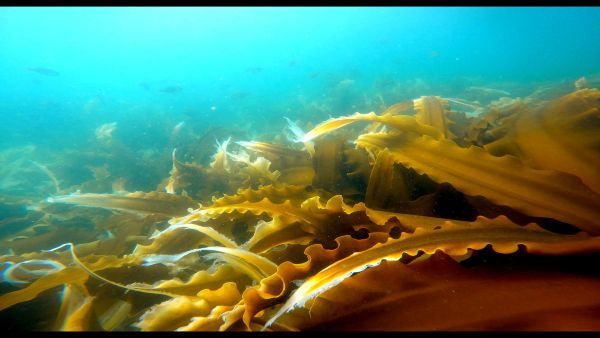
■A scene from the film: a seaweed forest
Walking Japan's Coastlines: The Silent Desertification of the Sea
Filming took two years, editing another. I traveled the length of Japan's coastline, from Hokkaido to Kyushu, and what confronted me there was the harsh reality that isoyake is becoming increasingly severe across the country. Records of isoyake date back to the Edo period, and historically, the loss and recovery of seaweed and seagrass have occurred in cycles. In recent years, however, the desertification of the sea has progressed quietly but steadily, with no recovery in sight. The same scenes recurred everywhere: barren seafloors with exposed rock dotted only with sea urchins, and seaweed reduced to its holdfast, drifting after being devoured by herbivorous fish. On the coast of Zushi in Kanagawa Prefecture, local residents were working up a sweat culling sea urchins. On Tsushima, off the coast of Kyushu, efforts were underway to turn the very fish responsible for grazing down seaweed beds into a valuable resource. Each region was confronting the challenges facing its sea, struggling in its own way to make a difference.
The Path Opened by Blue Carbon
When I decided to make a film about isoyake, I asked myself which type of seaweed people would most readily relate to as an issue that affected them personally. The answer that came to mind was kombu (kelp). A food that many of us eat on a regular basis, kombu has also served as currency and been used in religious rituals throughout history. Kombu has supported not only Japan's food culture but its culture as a whole. When I wanted to bring this issue to a wider audience, I thought kombu could play that role. Around that time, I learned about the current situation in the Minamikayabe district of Hakodate, Hokkaido, through the blog of Doi Junichi, owner of “KonbuDoi,”*1 a specialty shop in Osaka that had been introduced to me by Shogo Arai, Representative Director of Marine Algae Research Co., Ltd. Although Minamikayabe is renowned for producing high-quality natural makombu (Laminaria japonica), almost no kombu is harvested there today.
Having no connections of my own, I contacted the city of Hakodate and the local fishing cooperative directly. “Come and introduce yourself first,” they told me, and I still vividly remember the impact of setting foot in Minamikayabe for the first time. The sea and mountains seemed to coexist in quiet harmony, and the calm, gently stretching sea extended as far as the eye could see. I was completely captivated by its beauty. In Minamikayabe, the intertwined life of people and nature has continued unbroken since the Jomon period. When I opened a window, the scent of drying kombu drifted in, and I immediately sensed that this was a special place.
Minamikayabe is a region that has pioneered a number of innovative initiatives, including the world's first commercial kombu aquaculture operation. Yet the very fact that cultivated kombu brought stability to people's livelihoods also seems to have made it harder to take on new challenges. Fisherman Kaga Tomiichi reflected with a note of self-reproach, saying, “The condition our sea is in today is the result of resting on the laurels of the ‘Kenjo kombu’ brand.” Dive beneath the surface and you find sea urchins everywhere. At times, it is hard not to wonder whether any effort can truly make a difference. Yet despite these doubts, the people of Minamikayabe continue a wide range of efforts to protect their natural kombu. After introducing myself at the fishing cooperative, I was given a piece of what is locally known as “Hasegawa kombu,” named after the late Dr. Hasegawa Yoshio (former director of the Fisheries Agency's Hokkaido National Fisheries Research Institute), who contributed to the commercialization of kombu aquaculture. At that moment, I felt as though the god of seaweed itself were giving me a gentle push, telling me to make this film here.
When I encountered the concept of blue carbon during the filming process, the first image that came to mind was the landscape of Minamikayabe. I found myself wondering whether the kombu growing across those vast aquaculture grounds might be absorbing and storing enormous amounts of CO₂. In 2024, under the leadership of Takaya Daiki, a fisherman from Ofune-cho in Hakodate and vice chairman of the NPO Marine Network), Minamikayabe received certification for 1,462 tons of J-Blue Credits, one of the largest such certifications in Japan. The credits are expected to be used for seedling research and measures against isoyake and are available for purchase by business entities. In Minamikayabe, efforts to increase seaweed are beginning to be positioned within the flow of the economy. This is also a new mechanism for sharing, across society as a whole, a burden that until now has rested solely on the shoulders of fishermen and local residents. At the same time, even nearly two years after certification, only about 400 tons of CO₂ credits have been transferred. Challenges remain, including limited awareness of the system and the high price per ton, before it can gain broader acceptance and become a widely adopted initiative.
Having no connections of my own, I contacted the city of Hakodate and the local fishing cooperative directly. “Come and introduce yourself first,” they told me, and I still vividly remember the impact of setting foot in Minamikayabe for the first time. The sea and mountains seemed to coexist in quiet harmony, and the calm, gently stretching sea extended as far as the eye could see. I was completely captivated by its beauty. In Minamikayabe, the intertwined life of people and nature has continued unbroken since the Jomon period. When I opened a window, the scent of drying kombu drifted in, and I immediately sensed that this was a special place.
Minamikayabe is a region that has pioneered a number of innovative initiatives, including the world's first commercial kombu aquaculture operation. Yet the very fact that cultivated kombu brought stability to people's livelihoods also seems to have made it harder to take on new challenges. Fisherman Kaga Tomiichi reflected with a note of self-reproach, saying, “The condition our sea is in today is the result of resting on the laurels of the ‘Kenjo kombu’ brand.” Dive beneath the surface and you find sea urchins everywhere. At times, it is hard not to wonder whether any effort can truly make a difference. Yet despite these doubts, the people of Minamikayabe continue a wide range of efforts to protect their natural kombu. After introducing myself at the fishing cooperative, I was given a piece of what is locally known as “Hasegawa kombu,” named after the late Dr. Hasegawa Yoshio (former director of the Fisheries Agency's Hokkaido National Fisheries Research Institute), who contributed to the commercialization of kombu aquaculture. At that moment, I felt as though the god of seaweed itself were giving me a gentle push, telling me to make this film here.
When I encountered the concept of blue carbon during the filming process, the first image that came to mind was the landscape of Minamikayabe. I found myself wondering whether the kombu growing across those vast aquaculture grounds might be absorbing and storing enormous amounts of CO₂. In 2024, under the leadership of Takaya Daiki, a fisherman from Ofune-cho in Hakodate and vice chairman of the NPO Marine Network), Minamikayabe received certification for 1,462 tons of J-Blue Credits, one of the largest such certifications in Japan. The credits are expected to be used for seedling research and measures against isoyake and are available for purchase by business entities. In Minamikayabe, efforts to increase seaweed are beginning to be positioned within the flow of the economy. This is also a new mechanism for sharing, across society as a whole, a burden that until now has rested solely on the shoulders of fishermen and local residents. At the same time, even nearly two years after certification, only about 400 tons of CO₂ credits have been transferred. Challenges remain, including limited awareness of the system and the high price per ton, before it can gain broader acceptance and become a widely adopted initiative.
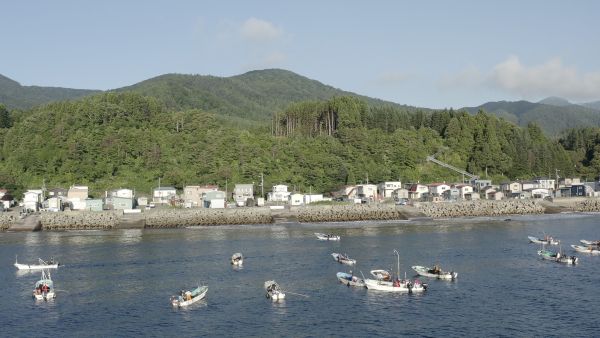
■Natural kombu harvesting in Minamikayabe
Umimori Baton: What I Want to Pass on to the Next Generation
More than a year has passed since the film's release on January 10, 2025, yet independently organized screenings continue unabated. The cumulative audience is expected to surpass 10,000 before long. The themes of these screenings are diverse, ranging from food education and initiatives to learn about local marine environments to blue carbon. Their formats have also expanded to include events for general audiences, families, and corporate audiences. New connections continue to emerge, including post-screening discussions, collaborations involving food, and collaborations with diving activities, among others. There are, without a doubt, people across the country who share the same aspirations.
Another effort that we, the film's creators, are particularly committed to is “Umimori Baton.” *2 Through this initiative, we provide a 28-minute highlight version re-edited from the main film, free of charge to elementary, junior high, and senior high schools, as well as other educational institutions across Japan. We ask that it be used on a school-wide or grade-wide basis. Movie theaters and independent screenings attract only adults who are interested in the issue, along with the children they bring with them. But the problems facing the ocean are a matter of the future that concerns every child. At the heart of this initiative lies our conviction that this film should reach even children who would not otherwise have the opportunity to attend one of our screenings. In the school setting, students watch the film together with their classmates, reflect on what they have seen, and discuss it with one another. That experience can have a reach that is difficult to achieve within the home alone. If it reaches even one child's heart, I believe it will surely become the next baton passed on. After all, it is today's children who will undoubtedly determine the future of our oceans. I want to pass on to the next generation both the belief that this world is still a profoundly beautiful place and a commitment to continuing to grapple with environmental challenges that have no easy answers. The name “Umimori Baton” embodies that heartfelt wish.
Those of us living in the present are being called upon to consider how we should relate to nature. No one person can change the world alone. Yet there are kindred spirits across the country who care deeply about the sea. That is something I have come to feel strongly through both the making and screening of this film. We may never be able to return to a way of life like that of the Jomon period, but there must be ways of engaging with the sea and nature that are possible precisely because we live in the modern age. Carrying forward the aspirations of those who came before us and leaving a somewhat better future for the next generation is our mission as people living in the present.
Another effort that we, the film's creators, are particularly committed to is “Umimori Baton.” *2 Through this initiative, we provide a 28-minute highlight version re-edited from the main film, free of charge to elementary, junior high, and senior high schools, as well as other educational institutions across Japan. We ask that it be used on a school-wide or grade-wide basis. Movie theaters and independent screenings attract only adults who are interested in the issue, along with the children they bring with them. But the problems facing the ocean are a matter of the future that concerns every child. At the heart of this initiative lies our conviction that this film should reach even children who would not otherwise have the opportunity to attend one of our screenings. In the school setting, students watch the film together with their classmates, reflect on what they have seen, and discuss it with one another. That experience can have a reach that is difficult to achieve within the home alone. If it reaches even one child's heart, I believe it will surely become the next baton passed on. After all, it is today's children who will undoubtedly determine the future of our oceans. I want to pass on to the next generation both the belief that this world is still a profoundly beautiful place and a commitment to continuing to grapple with environmental challenges that have no easy answers. The name “Umimori Baton” embodies that heartfelt wish.
Those of us living in the present are being called upon to consider how we should relate to nature. No one person can change the world alone. Yet there are kindred spirits across the country who care deeply about the sea. That is something I have come to feel strongly through both the making and screening of this film. We may never be able to return to a way of life like that of the Jomon period, but there must be ways of engaging with the sea and nature that are possible precisely because we live in the modern age. Carrying forward the aspirations of those who came before us and leaving a somewhat better future for the next generation is our mission as people living in the present.
*1 https://www.konbudoi.jp/home-en
*2 Applications for both independent screenings and the Umimori Baton initiative are accepted on an ongoing basis through the official website of the film “We Are Here and Here We live: Following The Disappearing Seaweed Forest”: https://umi-mori.com
*2 Applications for both independent screenings and the Umimori Baton initiative are accepted on an ongoing basis through the official website of the film “We Are Here and Here We live: Following The Disappearing Seaweed Forest”: https://umi-mori.com