Ocean Newsletter
No.606 June 20, 2026
-
Blue Natural Capital as a Vector to Rebuild Marine Life
-
Forging a New Ocean Economy through Impact Funds
-
Drawn into the Disappearing Seaweed Forest
Blue Natural Capital as a Vector to Rebuild Marine Life
KEYWORDS
Blue carbon/Nature-based solution/climate change mitigation
Carlos M. Duarte (Distinguished Professor, King Abdullah University of Science and Technology (KAUST))
Since the industrial revolution, we have lost significant shares of the abundance of marine life, and we have lost about 50% of blue natural capital. However, in recent years, there has been growing attention to nature-based solutions that integrate biodiversity conservation and climate change mitigation. In particular, blue carbon habitats such as mangroves and seaweed contribute both to climate change mitigation and to the restoration of coastal ecosystems. Blue carbon is an important strategy that redefines the ocean as a reproductive common and supports the transition to a sustainable society.
Blue natural capital
The world has lost about two of thirds of the abundance of animals and plants comprising the foundations of its natural capital, which through ecosystems delivers essential processes and supports human well-being as an important source of the economy and ecosystem services (WWF, 2024).
In the oceans, too, we have lost significant shares of the abundance of marine life across multiple different components, habitats, and species. Roughly, we have lost about 50% of blue natural capital (Duarte et al., 2020), the abundance of marine life that supports the essential benefits that we receive from the ocean (Lovelock and Duarte, 2025).
The drivers of these losses of blue natural capital have been multiple. The earliest one was hunting, followed by deforestation that led to impacts on shorelines, from excess sediment and habitat loss to the destruction of coastal habitats due to the building of human infrastructure and cities, chemical pollution and climate change (Duarte et al., 2020). Whereas hunting and fishing were already mitigated through different conventions that stop, for instance, whaling, the moratorium of whale hunting by the International Whaling Commission, or the CITES (Convention on International Trade in Endangered Species of Wild Fauna and Flora) on the trade of endangered species, chemical pollution and climate change continue to rise in intensity, as we have not been able to mitigate these impacts.
In the oceans, too, we have lost significant shares of the abundance of marine life across multiple different components, habitats, and species. Roughly, we have lost about 50% of blue natural capital (Duarte et al., 2020), the abundance of marine life that supports the essential benefits that we receive from the ocean (Lovelock and Duarte, 2025).
The drivers of these losses of blue natural capital have been multiple. The earliest one was hunting, followed by deforestation that led to impacts on shorelines, from excess sediment and habitat loss to the destruction of coastal habitats due to the building of human infrastructure and cities, chemical pollution and climate change (Duarte et al., 2020). Whereas hunting and fishing were already mitigated through different conventions that stop, for instance, whaling, the moratorium of whale hunting by the International Whaling Commission, or the CITES (Convention on International Trade in Endangered Species of Wild Fauna and Flora) on the trade of endangered species, chemical pollution and climate change continue to rise in intensity, as we have not been able to mitigate these impacts.
Nature-based solution
The fact that we have successfully mitigated some impacts has allowed partial recovery of some species (Duarte et al., 2020). Hence, we can differentiate three phases in the way humans have impacted the ocean since the industrial revolution: (1) the first phase saw a sharp increase in pressures and declining marine life from the industrial revolution until the beginning of this century; (2) the second saw efforts to slow down pressures starting in the 1980’s, aware of the impacts of these pressures on blue natural capital; and, (3) since 2020, there has been an ambition to rebuild marine life (Duarte et al., 2020).
Rebuilding the abundance of marine life to approach that of the 1950’s is an ambitious, but doable grand challenge, which will require three decades of sustained efforts along six vectors: (1) protect species; (2) harvest wisely; (3) protect spaces; (4) restore habitats; (5) mitigate climate change to meet the goals of the Paris Agreement; and (6) mitigate all forms of pollution. These efforts must be underpinned by a tenacity to maintain the course of efforts and not give up hope that the oceans can be returned to a state of abundance (Duarte et al., 2020). Indeed, hundreds of documented cases of marine conservation success provide examples that can inform actions to avoid failure and increase the likelihood of success (Rossbach et al., 2023).
This roadmap was subsequently embraced by the Kunming-Montreal Global Biodiversity Framework, which was adopted in 2022 as part the 15th convention of the parties of the UN Convention of Biological Diversity, which, among other actions, aims at stopping further biodiversity losses, protecting 30% of land and ocean and restoring 30% of degraded habitats by 2030, which is indeed a very ambitious regenerative goal (https://www.cbd.int/gbf). The Kunming-Montreal Global Biodiversity Framework also calls on the signatories of the CBD to activate nature-based solutions in order to minimize the negative impacts of climate change while contributing both to climate and biodiversity goals. Indeed, both climate and biodiversity crises are connected, because blue natural capital, and natural capital in general, is an essential component of the carbon cycle and climate stability. So, by rebuilding natural capital, we can contribute to achieving both our climate and biodiversity goals. Nature-based solutions (NbS) are defined as a pathway to de-carbonize the atmosphere, removing fugitive CO2 that has been released into the atmosphere and re-carbonizing the biosphere. The outcome of nature-based solutions is an increase in the abundance of life on land and oceans, therefore rebuilding natural capital.
Rebuilding the abundance of marine life to approach that of the 1950’s is an ambitious, but doable grand challenge, which will require three decades of sustained efforts along six vectors: (1) protect species; (2) harvest wisely; (3) protect spaces; (4) restore habitats; (5) mitigate climate change to meet the goals of the Paris Agreement; and (6) mitigate all forms of pollution. These efforts must be underpinned by a tenacity to maintain the course of efforts and not give up hope that the oceans can be returned to a state of abundance (Duarte et al., 2020). Indeed, hundreds of documented cases of marine conservation success provide examples that can inform actions to avoid failure and increase the likelihood of success (Rossbach et al., 2023).
This roadmap was subsequently embraced by the Kunming-Montreal Global Biodiversity Framework, which was adopted in 2022 as part the 15th convention of the parties of the UN Convention of Biological Diversity, which, among other actions, aims at stopping further biodiversity losses, protecting 30% of land and ocean and restoring 30% of degraded habitats by 2030, which is indeed a very ambitious regenerative goal (https://www.cbd.int/gbf). The Kunming-Montreal Global Biodiversity Framework also calls on the signatories of the CBD to activate nature-based solutions in order to minimize the negative impacts of climate change while contributing both to climate and biodiversity goals. Indeed, both climate and biodiversity crises are connected, because blue natural capital, and natural capital in general, is an essential component of the carbon cycle and climate stability. So, by rebuilding natural capital, we can contribute to achieving both our climate and biodiversity goals. Nature-based solutions (NbS) are defined as a pathway to de-carbonize the atmosphere, removing fugitive CO2 that has been released into the atmosphere and re-carbonizing the biosphere. The outcome of nature-based solutions is an increase in the abundance of life on land and oceans, therefore rebuilding natural capital.
Blue carbon strategy and seaweed
In this context, marine forests, the vegetated coastal habitats that thrive along the shorelines of continents, are the most intense carbon sinks in the biosphere (Duarte et al., 2013). The long-term carbon burial in vegetated soils in marine forests is more than ten-fold higher per unit area than that in terrestrial ones. Additionally, there are no fires underwater, so carbon accumulation proceeds safely for thousands of years without that carbon being released back to the atmosphere during forest fires, as happens on land. Hence, vegetated coastal habitats account for more than half of all the carbon buried in the seafloor despite these habitats occupying only 0.2% of the seafloor (Duarte et al., 2005). For this reason, these habitats have been termed “blue carbon habitats” (Nellemann et al., 2009).
And yet we have lost about half of the marine forest across different domains, from mangroves to seagrass, to salt marshes and kelp forests. While these losses have reduced the capacity of these ecosystems to remove atmospheric CO2, they offer an opportunity to contribute to climate mitigation by avoiding further losses and restoring these ecosystems.
Blue carbon projects also represent a flow of finance from developed nations, which are the ultimate buyers of carbon crates, to developing nations, which are the places where these projects are rooted. Under blue carbon projects, the finances delivered against blue carbon credits are contributing to the repair of damaged ecosystems in these developing nations.
Whereas blue carbon projects are already active in the case of mangroves, and to a lesser extent in seagrasses and salt marshes, seaweed remains largely ignored, to the extent that we recently referred to carbon sequestration by macroalgae as the elephant in the Blue Carbon room (Krause-Jensen et al., 2018). Macroalgal Forest represents a marine Amazonia that, rather than being compact, is distributed as a ribbon around the shorelines of continents and islands and seamounts to reach a global area of 7.2 million km2 and a contribution to global productivity of 1.3 Pg C per year, comparable to that of the Amazonia (Duarte et al., 2022). Algal forest contributes to carbon in coastal sediments and the deep sea, which receive both dissolved and particular organic carbon of macroalgal origin (Krause-Jensen and Duarte, 2016). Combined, macroalgal carbon removes about 0.17 Pg C per year, more than seagrass, mangroves and saltmarshes combined (Krause-Jensen and Duarte, 2016).
Seaweed, both wild and cultured are now rising to be important components of the blue carbon strategy, with Japan leading the way as the first nation to include seaweed in their national blue carbon program, through the J-Blue credits (Kuwae et al., 2022), and also in their national greenhouse inventories submitted to the UN Framework Climate Change Convention. As we focus on seaweed agriculture, we need to realize that seaweed agriculture produces a wealth of benefits beyond climate action, as they produce regulating services like carbon uptake, but also modulate ocean pH, release oxygen in seawater and remove excess nutrients (Duarte et al., 2022).
And yet we have lost about half of the marine forest across different domains, from mangroves to seagrass, to salt marshes and kelp forests. While these losses have reduced the capacity of these ecosystems to remove atmospheric CO2, they offer an opportunity to contribute to climate mitigation by avoiding further losses and restoring these ecosystems.
Blue carbon projects also represent a flow of finance from developed nations, which are the ultimate buyers of carbon crates, to developing nations, which are the places where these projects are rooted. Under blue carbon projects, the finances delivered against blue carbon credits are contributing to the repair of damaged ecosystems in these developing nations.
Whereas blue carbon projects are already active in the case of mangroves, and to a lesser extent in seagrasses and salt marshes, seaweed remains largely ignored, to the extent that we recently referred to carbon sequestration by macroalgae as the elephant in the Blue Carbon room (Krause-Jensen et al., 2018). Macroalgal Forest represents a marine Amazonia that, rather than being compact, is distributed as a ribbon around the shorelines of continents and islands and seamounts to reach a global area of 7.2 million km2 and a contribution to global productivity of 1.3 Pg C per year, comparable to that of the Amazonia (Duarte et al., 2022). Algal forest contributes to carbon in coastal sediments and the deep sea, which receive both dissolved and particular organic carbon of macroalgal origin (Krause-Jensen and Duarte, 2016). Combined, macroalgal carbon removes about 0.17 Pg C per year, more than seagrass, mangroves and saltmarshes combined (Krause-Jensen and Duarte, 2016).
Seaweed, both wild and cultured are now rising to be important components of the blue carbon strategy, with Japan leading the way as the first nation to include seaweed in their national blue carbon program, through the J-Blue credits (Kuwae et al., 2022), and also in their national greenhouse inventories submitted to the UN Framework Climate Change Convention. As we focus on seaweed agriculture, we need to realize that seaweed agriculture produces a wealth of benefits beyond climate action, as they produce regulating services like carbon uptake, but also modulate ocean pH, release oxygen in seawater and remove excess nutrients (Duarte et al., 2022).
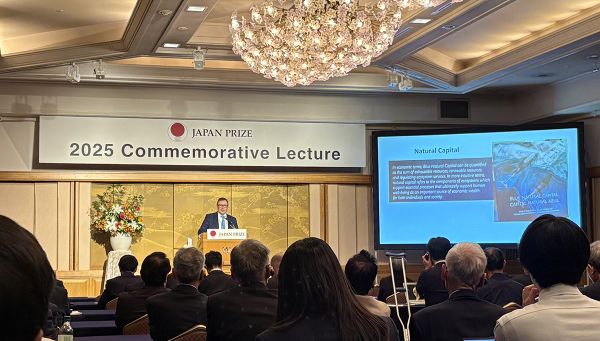
■The author at the Japan Prize Commemorative Lecture on April 17, 2025(photo by Dr. Atsushi Watanabe, OPRI-SPF)
For the ocean as the commons
Blue carbon strategies provide the first opportunity for marine ecosystems to generate income by protecting and rebuilding rather than by extracting from them (Lovelock and Duarte, 2025). This development breaks through the tragedy of the commons and moves the conversation from one focused on terra nulis, a concept enshrined in western legal codes that asserts that the ocean belongs to no one, to one of terra omnis, which means that the ocean belongs to everyone, and everyone can invest in healthy oceans.
Western nations need to learn practices from other cultures, such as the Japanese ‘Satoumi’ tradition, where humans do not dominate but live in harmony with nature. Adopting these principles will provide an opportunity to stop extractive approaches to the ocean and develop blue natural capital as an investable asset that can produce social, economic, and cultural benefits, maintained over generations, while returning the oceans to a state of abundance.
Western nations need to learn practices from other cultures, such as the Japanese ‘Satoumi’ tradition, where humans do not dominate but live in harmony with nature. Adopting these principles will provide an opportunity to stop extractive approaches to the ocean and develop blue natural capital as an investable asset that can produce social, economic, and cultural benefits, maintained over generations, while returning the oceans to a state of abundance.
References
※Duarte, C.M., Agusti, S., Barbier, E., Britten, G.L., Castilla, J.C., Gattuso, J.P., Fulweiler, R.W., Hughes, T.P., Knowlton, N., Lovelock, C.E. and Lotze, H.K., 2020. Rebuilding marine life. Nature, 580(7801), pp.39-51.
※Duarte, C.M., Gattuso, J.P., Hancke, K., Gundersen, H., Filbee‐Dexter, K., Pedersen, M.F., Middelburg, J.J., Burrows, M.T., Krumhansl, K.A., Wernberg, T. and Moore, P., 2022. Global estimates of the extent and production of macroalgal forests. Global Ecology and Biogeography, 31(7), pp.1422-1439.
※Duarte, C.M., Losada, I.J., Hendriks, I.E., Mazarrasa, I. and Marbà, N., 2013. The role of coastal plant communities for climate change mitigation and adaptation. Nature climate change, 3(11), pp.961-968.
※Duarte, C.M., Middelburg, J.J. and Caraco, N., 2005. Major role of marine vegetation on the oceanic carbon cycle. Biogeosciences, 2(1), pp.1-8.
※Krause-Jensen, D. and Duarte, C.M., 2016. Substantial role of macroalgae in marine carbon sequestration. Nature Geoscience, 9(10), pp.737-742.
※Krause-Jensen, D., Lavery, P., Serrano, O., Marbà, N., Masque, P. and Duarte, C.M., 2018. Sequestration of macroalgal carbon: the elephant in the Blue Carbon room. Biology letters, 14(6).
※Kuwae, T., Watanabe, A., Yoshihara, S., Suehiro, F. and Sugimura, Y., 2022. Implementation of blue carbon offset crediting for seagrass meadows, macroalgal beds, and macroalgae farming in Japan. Marine Policy, 138, p.104996.
※Lovelock, C.E. and Duarte, C.M., 2025. Out of the blue carbon box: toward investable blue natural capital. Biology Letters, 21(4), pp.20240648-20240648.
※Nelleman, C., Corcoran, E., Duarte, C.M., Valdes, L., DeYoung, C., Fonseca, L. and Grimsditch, G. 2009. Blue carbon: the role of healthy oceans in binding carbon: a rapid response assessment. UNEP/Earthprint.
※Rossbach, S., Steckbauer, A., Klein, S.G., Arossa, S., Geraldi, N.R., Lim, K.K., Martin, C., Rossbach, F.I., Shellard, M.J., Valluzzi, L. and Duarte, C.M., 2023. A tide of change: What we can learn from stories of marine conservation success. One Earth, 6(5), pp.505-518.
※WWF (2024) Living Planet Report 2024 – A System in Peril. WWF, Gland, Switzerland.
※Duarte, C.M., Agusti, S., Barbier, E., Britten, G.L., Castilla, J.C., Gattuso, J.P., Fulweiler, R.W., Hughes, T.P., Knowlton, N., Lovelock, C.E. and Lotze, H.K., 2020. Rebuilding marine life. Nature, 580(7801), pp.39-51.
※Duarte, C.M., Gattuso, J.P., Hancke, K., Gundersen, H., Filbee‐Dexter, K., Pedersen, M.F., Middelburg, J.J., Burrows, M.T., Krumhansl, K.A., Wernberg, T. and Moore, P., 2022. Global estimates of the extent and production of macroalgal forests. Global Ecology and Biogeography, 31(7), pp.1422-1439.
※Duarte, C.M., Losada, I.J., Hendriks, I.E., Mazarrasa, I. and Marbà, N., 2013. The role of coastal plant communities for climate change mitigation and adaptation. Nature climate change, 3(11), pp.961-968.
※Duarte, C.M., Middelburg, J.J. and Caraco, N., 2005. Major role of marine vegetation on the oceanic carbon cycle. Biogeosciences, 2(1), pp.1-8.
※Krause-Jensen, D. and Duarte, C.M., 2016. Substantial role of macroalgae in marine carbon sequestration. Nature Geoscience, 9(10), pp.737-742.
※Krause-Jensen, D., Lavery, P., Serrano, O., Marbà, N., Masque, P. and Duarte, C.M., 2018. Sequestration of macroalgal carbon: the elephant in the Blue Carbon room. Biology letters, 14(6).
※Kuwae, T., Watanabe, A., Yoshihara, S., Suehiro, F. and Sugimura, Y., 2022. Implementation of blue carbon offset crediting for seagrass meadows, macroalgal beds, and macroalgae farming in Japan. Marine Policy, 138, p.104996.
※Lovelock, C.E. and Duarte, C.M., 2025. Out of the blue carbon box: toward investable blue natural capital. Biology Letters, 21(4), pp.20240648-20240648.
※Nelleman, C., Corcoran, E., Duarte, C.M., Valdes, L., DeYoung, C., Fonseca, L. and Grimsditch, G. 2009. Blue carbon: the role of healthy oceans in binding carbon: a rapid response assessment. UNEP/Earthprint.
※Rossbach, S., Steckbauer, A., Klein, S.G., Arossa, S., Geraldi, N.R., Lim, K.K., Martin, C., Rossbach, F.I., Shellard, M.J., Valluzzi, L. and Duarte, C.M., 2023. A tide of change: What we can learn from stories of marine conservation success. One Earth, 6(5), pp.505-518.
※WWF (2024) Living Planet Report 2024 – A System in Peril. WWF, Gland, Switzerland.