Ocean Newsletter
No.603 March 20, 2026
-
The Future Ocean Sleeping Beneath the Ice: A New World Opened Up by Antarctic RINGS
-
Carbon Cycle Study in the Southern Ocean and a Long-Standing Challenge
-
Arctic Challenge for Sustainability III (ArCS III)
-
The Northern Sea Route: Is the economic model viable?
Arctic Challenge for Sustainability III (ArCS III)
KEYWORDS
Environment and Society of the Arctic Region / Sustainability / Interdisciplinary Research
HASUMI Hiroyasu (Professor, Atmosphere and Ocean Research Institute, The University of Tokyo; Visiting Professor, National Institute of Polar Research; ArCS III Project Director)
ArCS III, Japan's flagship project for Arctic research, began in April 2025. This paper provides an overview of the history and characteristics of previous Arctic research projects in Japan and introduces how these will be developed in ArCS III and what initiatives will be implemented to achieve this.
Japan’s Arctic Research
In April 2025, the Arctic Challenge for Sustainability III (ArCS III) was initiated. This project was publicly solicited by the Ministry of Education, Culture, Sports, Science and Technology (MEXT) as part of the Subsidy Program for Promoting Environmental Technology and Other Accelerated Development, and a proposal led by the National Institute of Polar Research (NIPR) was selected for funding.
Arctic research in Japan dates back to the 1950s. However, whereas Antarctic research was institutionalized as a national undertaking during the same period, Arctic research in Japan long remained largely driven by individual researchers. A major turning point came in 2011, with the launch of the Arctic Climate Change Research Project under MEXT’s Green Network of Excellence (GRENE) initiative.
This program aimed to advance understanding of the rapidly changing Arctic climate and its global impacts and involved more than 300 researchers from the natural sciences and engineering. With the initiation of this project, the Japan Consortium for Arctic Environmental Research (JCAR) was founded, providing a clear framework for Japan’s Arctic research community. The subsequent Arctic Challenge for Sustainability (ArCS), launched in 2015, advanced interdisciplinary research with stakeholders related to the Arctic environment in mind. In particular, the humanities and social sciences were incorporated into the project, strengthening collaboration with the natural sciences and engineering. Under the Arctic Challenge for Sustainability II (ArCS II), which began in 2020, such interdisciplinary research efforts were further expanded, and tangible outcomes related to the sustainability of the Arctic region began to emerge.
It should also be noted that Japan’s interdisciplinary approach to Arctic research has been internationally pioneering. Similar initiatives were subsequently launched in Europe and North America, and while these efforts are greater in scale than those in Japan, Japan continues to remain at the forefront in terms of achieving integrated and organic collaboration.
Arctic research in Japan dates back to the 1950s. However, whereas Antarctic research was institutionalized as a national undertaking during the same period, Arctic research in Japan long remained largely driven by individual researchers. A major turning point came in 2011, with the launch of the Arctic Climate Change Research Project under MEXT’s Green Network of Excellence (GRENE) initiative.
This program aimed to advance understanding of the rapidly changing Arctic climate and its global impacts and involved more than 300 researchers from the natural sciences and engineering. With the initiation of this project, the Japan Consortium for Arctic Environmental Research (JCAR) was founded, providing a clear framework for Japan’s Arctic research community. The subsequent Arctic Challenge for Sustainability (ArCS), launched in 2015, advanced interdisciplinary research with stakeholders related to the Arctic environment in mind. In particular, the humanities and social sciences were incorporated into the project, strengthening collaboration with the natural sciences and engineering. Under the Arctic Challenge for Sustainability II (ArCS II), which began in 2020, such interdisciplinary research efforts were further expanded, and tangible outcomes related to the sustainability of the Arctic region began to emerge.
It should also be noted that Japan’s interdisciplinary approach to Arctic research has been internationally pioneering. Similar initiatives were subsequently launched in Europe and North America, and while these efforts are greater in scale than those in Japan, Japan continues to remain at the forefront in terms of achieving integrated and organic collaboration.
Objectives of ArCS III
In conceptualizing ArCS III, two key considerations were kept in mind: building on the trajectory established through ArCS II to further develop interdisciplinary research, and clearly emphasizing the resolution of societal challenges as its concrete future direction. Based on this perspective, the project goal of ArCS III was defined as:
“To create integrated knowledge that contributes to solving the social challenges arising from environmental and societal changes in the Arctic.”
Awareness of societal challenges had also existed in previous projects; however, it was largely limited to the impacts of environmental changes associated with global warming on society. By the time ArCS III was being conceptualized, the Russian invasion of Ukraine had already occurred, and the resulting political and social changes were beginning to have impacts on societies both within and beyond the Arctic that were greater than those arising from environmental change alone. If the resolution of societal challenges related to the Arctic is to be properly considered, societal challenges arising from social changes not directly linked to environmental change must also be regarded as an indispensable element of research projects that aim to address the Arctic region in an integrated manner.
While the resolution of societal challenges represents an important direction, it is also a fact that many unknowns remain regarding the natural environment of the Arctic region. Advancing our understanding of the natural environment and linking that understanding to highly reliable predictions is another perspective that must not be overlooked. There is a sense that Japan’s Arctic research enjoys a high degree of international trust and expectations. This can be attributed to the fact that, even prior to the launch of large-scale research projects, Japan has continuously engaged in international research collaboration and steadily pursued the acquisition and open dissemination of data and knowledge. Losing this continuity would represent a loss for Japan that extends beyond academic research alone. Furthermore, during the ArCS III period, the Arctic research vessel Mirai II, Japan’s first research icebreaker vessel dedicated to the Arctic, will begin operating, significantly expanding the means available to elucidate the unknown natural environment of the Arctic. Mirai II is considered an international research platform, with operations planned in consideration of international research needs. Seizing this opportunity to significantly advance Japan’s long-standing efforts to understand the Arctic’s natural environment and to strengthen its research presence is an important objective of ArCS III. In addition, exploring ways to contribute, through research, to the international community, particularly in and around the Arctic, can also be regarded as a key mission entrusted to the project.
“To create integrated knowledge that contributes to solving the social challenges arising from environmental and societal changes in the Arctic.”
Awareness of societal challenges had also existed in previous projects; however, it was largely limited to the impacts of environmental changes associated with global warming on society. By the time ArCS III was being conceptualized, the Russian invasion of Ukraine had already occurred, and the resulting political and social changes were beginning to have impacts on societies both within and beyond the Arctic that were greater than those arising from environmental change alone. If the resolution of societal challenges related to the Arctic is to be properly considered, societal challenges arising from social changes not directly linked to environmental change must also be regarded as an indispensable element of research projects that aim to address the Arctic region in an integrated manner.
While the resolution of societal challenges represents an important direction, it is also a fact that many unknowns remain regarding the natural environment of the Arctic region. Advancing our understanding of the natural environment and linking that understanding to highly reliable predictions is another perspective that must not be overlooked. There is a sense that Japan’s Arctic research enjoys a high degree of international trust and expectations. This can be attributed to the fact that, even prior to the launch of large-scale research projects, Japan has continuously engaged in international research collaboration and steadily pursued the acquisition and open dissemination of data and knowledge. Losing this continuity would represent a loss for Japan that extends beyond academic research alone. Furthermore, during the ArCS III period, the Arctic research vessel Mirai II, Japan’s first research icebreaker vessel dedicated to the Arctic, will begin operating, significantly expanding the means available to elucidate the unknown natural environment of the Arctic. Mirai II is considered an international research platform, with operations planned in consideration of international research needs. Seizing this opportunity to significantly advance Japan’s long-standing efforts to understand the Arctic’s natural environment and to strengthen its research presence is an important objective of ArCS III. In addition, exploring ways to contribute, through research, to the international community, particularly in and around the Arctic, can also be regarded as a key mission entrusted to the project.
ArCS III Initiatives
As concrete measures toward achieving the project goal outlined above, ArCS III has established three strategic goals. In addition, ten research themes have been defined to achieve these strategic goals, along with seven research platforms designed to support the generation of outcomes from these research themes (see figure). This section focuses on providing an overview of each strategic goal.
Strategic objective 1 is to be achieved primarily through research in the natural sciences. Here, the term “information creation” refers not only to the generation of research-based scientific data, but also to the added value given to such data in response to societal needs. By way of analogy, rather than presenting weather forecasts solely in terms of temperature or wind speed, this approach corresponds to processing such information into practical indicators, such as a laundry index. In this sense, the configuration of the research themes is also based on the perspective of information that is directly relevant to societal challenges. In previous projects, research themes were organized according to traditional disciplinary categories, such as the atmosphere and the ocean. In ArCS III, they are organized based on informational outputs, such as greenhouse gases.
Strategic objective 3 is to be achieved through research themes grounded in the humanities and social sciences. In particular, ArCS III newly incorporates the perspective of history. Social changes and the societal challenges arising from them—such as those illustrated by the Russian invasion of Ukraine—are strongly influenced by geopolitical factors, and at a more fundamental level are rooted in the historical processes through which Arctic societies have been formed. Understanding social changes related to governance and indigenous peoples while taking into account the formative process of Arctic societies is expected to be useful when considering Japan’s international contributions to Arctic societies as well as its Arctic-related policies.
Strategic objective 2 is to be achieved through interdisciplinary research conducted in close coordination with the initiatives under strategic objectives 1 and 3. The target domains are broadly divided into terrestrial, oceanic, and coastal areas. In the terrestrial domain, the impacts of changes in the land environment—such as permafrost thaw—on living environments and social infrastructure are visualized over wide areas, and geographic information directly relevant to adaptation is provided. In the oceanic domain, knowledge contributing to the conservation and sustainable use of the Arctic Ocean is generated, with a focus on the prediction of ocean conditions, including sea ice. In the coastal domain, sustainable social systems are explored for coastal communities that are strongly influenced by both terrestrial and oceanic environments.
While carrying out these research activities, ArCS III also views the dissemination of information on the current state and significance of environmental and societal changes in the Arctic region, as well as the development of researchers and other personnel who will lead the next generation of Arctic research, as important missions of the project. Although details are omitted here, one distinctive initiative related to human resource development is the provision of career pathways for promising early-career researchers as Project Assistant Professors at NIPR, through which next-generation leaders in Arctic research are strategically trained under the guidance of mentors.
Over the five-year period until ArCS III concludes at the end of FY2029, the project will aim to achieve its overall goal by organically integrating these diverse initiatives.
Strategic objective 1 is to be achieved primarily through research in the natural sciences. Here, the term “information creation” refers not only to the generation of research-based scientific data, but also to the added value given to such data in response to societal needs. By way of analogy, rather than presenting weather forecasts solely in terms of temperature or wind speed, this approach corresponds to processing such information into practical indicators, such as a laundry index. In this sense, the configuration of the research themes is also based on the perspective of information that is directly relevant to societal challenges. In previous projects, research themes were organized according to traditional disciplinary categories, such as the atmosphere and the ocean. In ArCS III, they are organized based on informational outputs, such as greenhouse gases.
Strategic objective 3 is to be achieved through research themes grounded in the humanities and social sciences. In particular, ArCS III newly incorporates the perspective of history. Social changes and the societal challenges arising from them—such as those illustrated by the Russian invasion of Ukraine—are strongly influenced by geopolitical factors, and at a more fundamental level are rooted in the historical processes through which Arctic societies have been formed. Understanding social changes related to governance and indigenous peoples while taking into account the formative process of Arctic societies is expected to be useful when considering Japan’s international contributions to Arctic societies as well as its Arctic-related policies.
Strategic objective 2 is to be achieved through interdisciplinary research conducted in close coordination with the initiatives under strategic objectives 1 and 3. The target domains are broadly divided into terrestrial, oceanic, and coastal areas. In the terrestrial domain, the impacts of changes in the land environment—such as permafrost thaw—on living environments and social infrastructure are visualized over wide areas, and geographic information directly relevant to adaptation is provided. In the oceanic domain, knowledge contributing to the conservation and sustainable use of the Arctic Ocean is generated, with a focus on the prediction of ocean conditions, including sea ice. In the coastal domain, sustainable social systems are explored for coastal communities that are strongly influenced by both terrestrial and oceanic environments.
While carrying out these research activities, ArCS III also views the dissemination of information on the current state and significance of environmental and societal changes in the Arctic region, as well as the development of researchers and other personnel who will lead the next generation of Arctic research, as important missions of the project. Although details are omitted here, one distinctive initiative related to human resource development is the provision of career pathways for promising early-career researchers as Project Assistant Professors at NIPR, through which next-generation leaders in Arctic research are strategically trained under the guidance of mentors.
Over the five-year period until ArCS III concludes at the end of FY2029, the project will aim to achieve its overall goal by organically integrating these diverse initiatives.
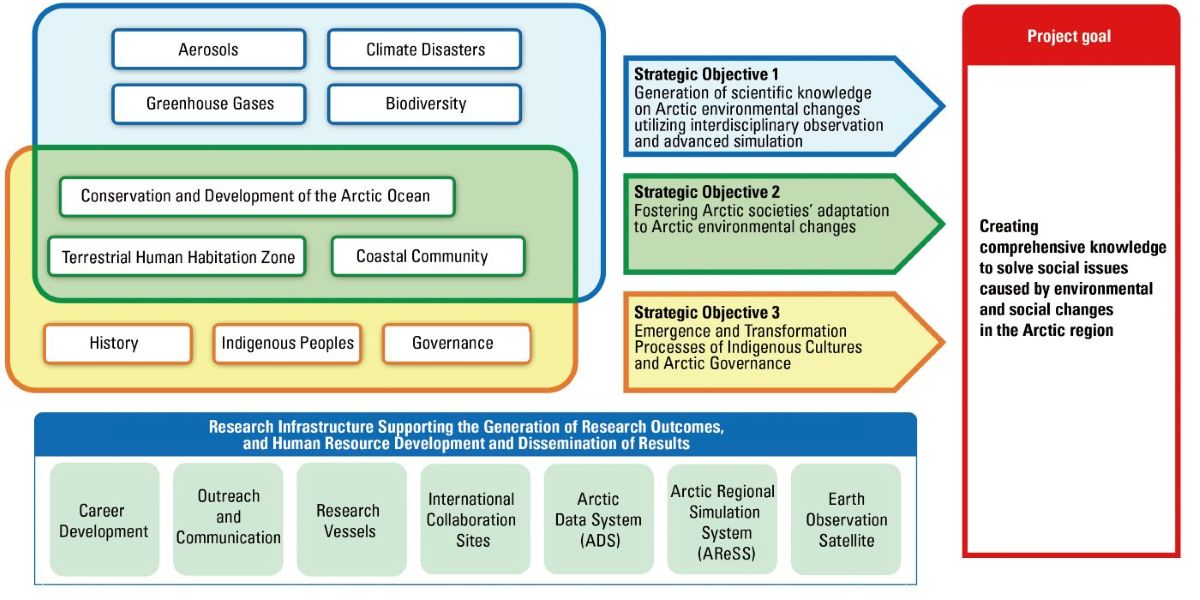
■ An overview of ArCS III, consisting of the project goal, three strategic goals, ten research themes, and seven research platforms.
For details on the implementation of individual research themes and research platforms, please refer to the ArCS III website (www.arcs3.nipr.ac.jp/en/).