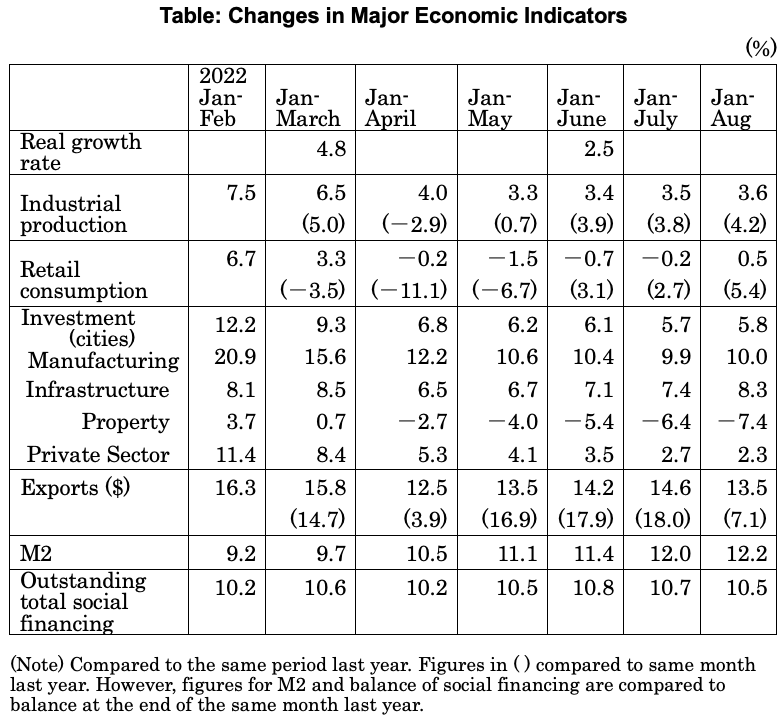
The above looked at the timeline of China’s macroeconomic policies. Below are a number of distinguishing features observed in the policies for 2022.
First, there has been no change in the basic macroeconomic policy of maintaining fiscal sustainability and the basic stability of macro leverage ratio.
Premier Li asserted repeatedly that “there will be no excessive money supply or sacrifice of future interests.” He stated clearly at the WEF Special Virtual Dialogue with Global Business Leaders on July 19: “We will not introduce supersize stimulus measures, issue excessive money supply, or sacrifice future interests to go after an excessively high growth speed.” He further claimed at the Sept. 28 meeting that with the economic policies introduced so far “all the policy tools accumulated over the past years were deployed, and these policies are effective and of a reasonable scale.”
These policies were introduced in stages, in May, August, and September. They also do not consist of additional issuance of government and local bonds or a major increase in money supply. China is trying to deal with the situation through such measures as VAT refunds, policy-based tax cuts, drastic frontloading of the issuance and use of local government special bonds, frontloading the local government special bonds quota for 2023, supplementary funding by the policy banks, special reloans by the People’s Bank of China, and using government funds to subsidize interest payments.
While this has been criticized by some as “piecemeal attack,” this must have been based on the lessons learned from the outcomes of the large-scale economic measures adopted at the time of the Lehman Shock, which later resulted in such side effects as excess production capacity of the state-owned enterprises, skyrocketing housing prices, increase in local government debts, expansion of shadow banking, and inflation.
Second, efforts to buoy up the economy were focused on the July-September quarter.
At each State Council Executive Meeting, Premier Li came up with a continuous series of specific policies to expand investment, strengthen consumption, alleviate the difficulties of MSMEs and self-employed individuals, give assistance to business sectors affected by Covid-19 and the poor, and stabilize employment and commodity prices, logistics and transportation, trade, and foreign investment. He announced comprehensive and follow-up policies to stabilize the “economic fundamentals” twice in May and August.
According to the National Bureau of Statistics, the GDP growth rate was originally scheduled to be announced on Oct. 18, which was in the middle of the 20th CPC National Congress. However, the announcement was postponed suddenly. Since the announcement of a low growth rate in the middle of this important meeting deliberating on a third term for General Secretary Xi Jinping might develop into a question of the leadership’s responsibility, it was probably absolutely necessary to avoid making the announcement.
Third, the role of the major economically developed provinces as pillars is being emphasized.
Premier Li has held several meetings with leading provincial officials this year. The major ones are as follows:
April 11: Meeting with certain leading local officials held in Jiangxi Province. The provinces of Jiangxi, Liaoning, Zhejiang, Guangdong, and Sichuan participated.
May 18: Meeting with leading provincial officials in Yunnan Province. Yunnan, Liaoning, Jiangsu, Zhejiang, Anhui, Fujian, Shandong, Henan, Hubei, Hunan, Guangdong, and Sichuan participated.
July 7: Meeting with leading officials of the coastal provinces in the southeast held in Fujian. Fujian, Shanghai, Jiangsu, Zhejiang, and Guangdong participated.
Aug. 16: Meeting with leading officials of the economic powerhouses in Guangdong. Guangdong, Jiangsu, Zhejiang, Shandong, Henan, and Sichuan participated.
The State Council sent working teams to these provinces to supervise and support the full implementation of the comprehensive and follow-up policies. Provinces with a large economic scale which were relatively unaffected by Covid-19 are strongly urged to achieve their annual economic targets in order to help buoy up the overall economy.
Fourth, the State Council’s Premier Li is taking the lead in these economic policies.
On Feb. 23, 2020, at the time the Covid-19 epidemic was spreading rapidly, a “meeting on coordinating Covid-19 prevention and control with economic and social development” was held to discuss economic policies with the full membership of the Standing Committee of the Political Bureau of the CPC Central Committee attending. Later, a meeting of the Political Bureau on March 27 decided on comprehensive economic measures. Another meeting of the Political Bureau on April 17 adopted specific measures for the comprehensive economic policies. All the economic policies were led by the CPC.
Even before this, after the Great Sichuan Earthquake occurred in May 2008 amid a slowdown in economic growth, a major meeting of leading central government and local officials was convened on June 13 to discuss reconstruction policies for the Sichuan earthquake and review macroeconomic policies. This meeting was organized jointly by the CPC Central Committee and the State Council. Even today, the annual Central Economic Work Conference determining basic economic policy for the next year is jointly convened by the CPC Central Committee and the State Council.
However, this time, since the lockdown in Shanghai started in late March, the State Council’s Premier Li has consistently taken the lead in economic policies for six months. Li announced successive economic stimulation policies at the State Council Executive Meetings and has actively convened other economic-related meetings. The State Council Executive Meeting on May 23 decided on comprehensive economic policies, and on May 25, the State Council alone held a videoconference involving 100,000 local leaders. Furthermore, follow-up measures and policies for the fourth quarter were decided at State Council Executive Meetings on Aug. 24 and Sept. 28, respectively.
On the other hand, the CPC Central Committee Political Bureau meetings reported in the media discussed only Covid-19 policies. It would seem that a clear line has been drawn for the State Council to lead economic policies and the Party to take leadership in Covid-19 measures. Moreover, at their respective meetings, the CPC Central Committee seems to have focused on the dynamic zero-Covid policy, while the State Council prioritized stable economic recovery and improvement. It is not clear if this is simply a practical demarcation or if the two sides have differences in policy priorities.
Therefore, it is necessary to pay close attention to whether leadership and priorities in economic policies will change after the 20th Party Congress.