① Fiscal policies
Regarding proactive fiscal policies, the Meeting emphasized the need to “increase oits power and improve its efficiency and to continue implementing tax cut and cost reduction policies in detail.”
As for what “in detail” implies here, according to a report delivered by Liu Kun, Minister of Finance, at the Standing Committee of the National People’s Congress on August 23rd, it means to pay close attention to changes in the tax burden of each industry and “to ensure that the tax burden of major industries, such as manufacturing, will go down significantly, to ensure that the tax burden will go down to a certain extent in the construction and the transport/haulage industries, to ensure that the tax burden on other industries will not increase and, instead, only decrease, and to effectively lower social security contributions by businesses, in particular, small and very small businesses.” In addition, the report stated that, if local governments modified the policy by changing the forms of cost in order to cancel the tax cut effects, they would be investigated and punished as soon as such instances come to light.
In other words, the tax cut and cost reduction policies, as seen in the VAT cut in April and the cut in employers’ contributions to urban employees’ basic pensions in May, are still being implemented, and their effects are yet to be determined. Because the cost reduction policies will lead to a reduction in the local government’s revenue, passive resistance is being expected, and strict monitoring of the central government’s implementation is necessary.
② Monetary policies
Regarding moderate monetary policies, the Meeting used the conventional wording that “monetary policies should be appropriately eased and tightened in order to maintain a rational sufficiency of liquidity.”
In addition, the Meeting stated that “we will promote structural reform for the monetary supply side, guide financial institutions to increase mid- and long-term loans to manufacturing and private businesses, achieve a firm grasp on the speed and degree of risk handling, and ensure that financial institutions, the local government, and financial supervisory authorities take responsibility.”
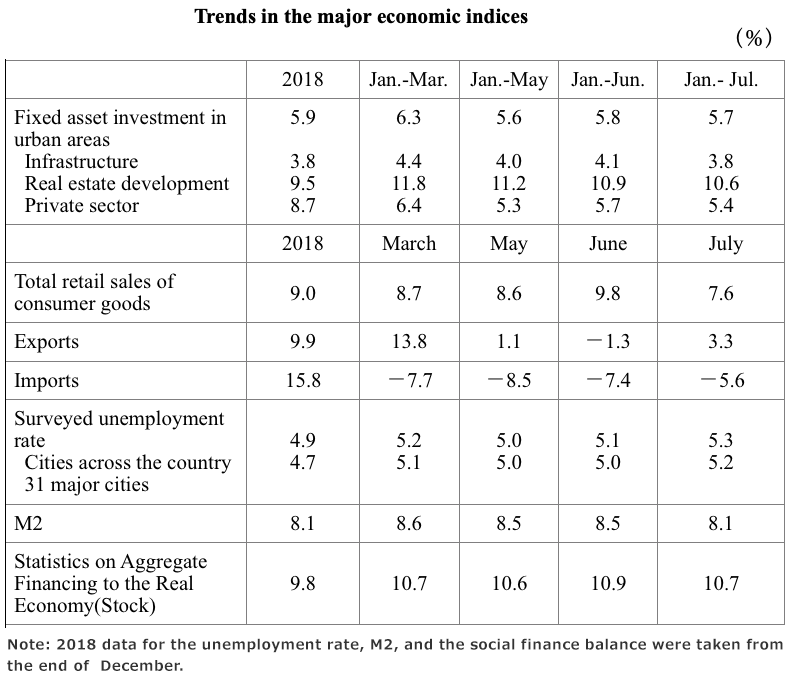
The special mention of manufacturing suggests that securing capital investment in manufacturing, especially with regard to private manufacturing businesses, is becoming difficult. This is likely to be linked to the decline in investments in the private sector. In addition, at the “video conference on second half-yearly policies” held by the People’s Bank on August 2nd, it was suggested that the serious credit risk of Baoshang Bank and liquidity risks of some medium and small financial institutions were being handled appropriately. The reference to risk handling therefore reflects this.
③ Employment policies
Regarding employment policies, the Meeting continued to use conventional wording: “we are carrying out solid employment policies for the focus groups, such as university graduates, migrant workers from rural areas, and retired military personnel.”
However, at the aforementioned “round table on policies to stabilize employment in some province ” held on August 19th, Premier Li Keqiang emphasized that “we need to strengthen the stability of business management and employees’ posts, and we need to support, in particular, labor intensive firms and businesses that are facing temporary management difficulties so that they can overcome the difficulties.”
Furthermore, it was stated that skills improvement for employees and training for job and industry changes would be implemented using 100 billion yuan from the unemployment insurance fund, that the number of places in the higher job training schools would be increased by a million, and that the number of places in technical worker training schools located in 200 places across the country would be increased in order to strengthen policies to prevent the emergence of unemployment.
④ Housing policies
The area of focus indicates a clear rejection of economic boosting policies based on real estate, as seen in “we firmly maintain the position that ‘housing is for living in and not for speculation,’ implement a management mechanism of real estate, which is effective in the long term, and disavow real estate as a means of creating temporary economic stimulus.”
As the active real estate market expands the industrial production of steel, cement, aluminum, and glass; construction consumption, interior decoration, furniture, household electrical appliances, and acoustic products; and investments in real estate development, it is often used as an economic stimulus, and minor overheating of the market has been ignored. However, because appreciation in housing prices increases the household’s mortgage burden and increases debt risks and constraints on consumption, this time, the long-term, healthy development of the real estate market has been prioritized.
⑤ Consumption and investment
It was stated that consumption should reflect actions “to dig deep for latent domestic demand, to develop and expand final demand, to kick start the rural market effectively, and to increase consumption by using many of the reform measures.” According to the National Development and Reform Commission’s report to the Standing Committee of the National People’s Congress, which was delivered on August 23rd, emphasis was placed on promoting the discarding and replacing of old vehicles as well as the development of the rural market and new fields, including elderly care, infant education, and household chores support.
As for investment, the Meeting narrowed down the objectives as follows: “to stabilize investment in manufacturing, to implement the redevelopment of old collective housing in urban areas and projects that reinforce weak parts, such as parking space, in urban areas and cold chain distribution facilities between cities and rural areas, and to urgently promote the construction of new types of infrastructure such as the information network.”