The novel coronavirus has already brought about a global crisis. It is even changing world history in the sense that the Great Depression brought about a comparable crisis. The impact that it has had on China is significant. The time divisions that have become familiar until now, such as the “reform and open period,” may no longer be valid after 2020.
It is uncertain whether the Chinese economic growth trajectory that has been sustained in the past will continue in the future. Even in terms of economic impact, the economic index announced in March 2020 for January–February of the same year was shocking[1]. The growth rate for the first quarter of 2020 announced in April was -6.8%, and this is a situation that has not been experienced since the reform and open period[2]. On the other hand, economic recovery has progressed since March and some indicators have improved. However, the possibility of the second wave of infection cannot be ruled out, and it is difficult to foresee the future when the European and U.S. economies are expected to undergo a significant negative growth in the second quarter[3]. A World Bank report released at the end of March predicted that the growth rate of the Chinese economy in 2020 would be 2.3% at baseline and 0.1% in a more severe, low-level scenario[4]. At the World Bank online seminar held on April 23, Aaditya Mattoo, Chief Economist of the East Asia and Pacific Region, pointed out that the likelihood of low-level scenarios are increasing[5].
Regarding the Chinese government's response, opinions are divided on how to evaluate its vulnerability and resilience. While the delay of its initial move until the first half of January has been pointed out, after January 23, the government has shifted to a strong policy enforcement, including city lockdowns. When the main epidemic areas were contained in China, many argued that the outbreak of the novel coronavirus indicated the vulnerability of China’s political system[6]. However, the virus containment by the subsequent lockdown control suppressed new infections. As a result, as early as the second half of February, production recovery has been promoted in regions other than Hubei Province and Beijing[7].
Since the lockdown of Wuhan and surrounding cities on January 23, the Chinese government had moved swiftly. Needless to say, in view of the series of actions taken by the Chinese government, the following policies are significant: the Central Leading Group on Responding to the Novel Coronavirus Disease Outbreak (leading group below), whose establishment was decided at the assembly of the Standing Committee of the Central Political Bureau of the Communist Party, the highest decision-making body in China, and the same meeting on January 25; and on a more practical level, the Executive Committee of the State Council[8].For example, the contents of the leading group meeting held on January 26 were varied. Among major policies, some of its main contents included the following: (1) request party committees and governments in each region to acknowledge and agree that the current virus outbreak is serious, (2) preferentially provide medical supplies such as protective equipment and masks to Hubei province and Wuhan, and renovate hotels as quarantine areas, (3) request to establish a coronavirus response leading group in each area, (4) demand strict isolation of patients who tested positive, (5) postpone or reduce meetings and large events, and conduct tests in public transportation, (6) reduce the flow of people by extending the Lunar New Year period and adjusting the school reopening period, (7) strengthen the training of doctors and nurses with the aim of maximally reducing the mortality rate, and promote scientific research and vaccine research, and (8) disclose quarantine information as appropriate[9].
A policy would not be effective without a system that further specifies the policy decided by the top layers of the government and the Communist Party and transmits it to the local level through the command system of each department. To clarify both the vulnerabilities of delayed initial response to the novel coronavirus, and resilience of the rapid first wave containment, we must pay attention to the function (and malfunction) of the bureaucracy.
In observing the policy enforcement process of Chinese bureaucracy, the author believes that the present novel coronavirus case has important implications. The crisis of the spreading virus was sudden, and prompt policy enforcement was required. An immediate application of power, so to speak, was necessary. In addition, it was common for the title of the policy document called “Novel Coronavirus Measures.” In other words, the policy response was made visible. The US–China trade war that had intensified since 2018 also exerted a significant burden on the Chinese economy. As such, measures have been taken in terms of trade policy, employment policy, and economic measures. However, even a policy that could be interpreted as a measure against the US–China trade war, a description like this is not usually made: “This tax reduction policy will be implemented in order to respond to the US–China trade war.” Because of this, it is necessary to position the policy from its planning period and situational evidence. In other words, understanding the response of the Chinese government bureaucracy to US–China trade measures involves certain difficulties because it has neither been concentrated over time nor visualized. On the other hand, China’s huge bureaucratic response to the crisis caused by coronavirus was concentrated as to time period, and it can be observed through tabulating policy documents.
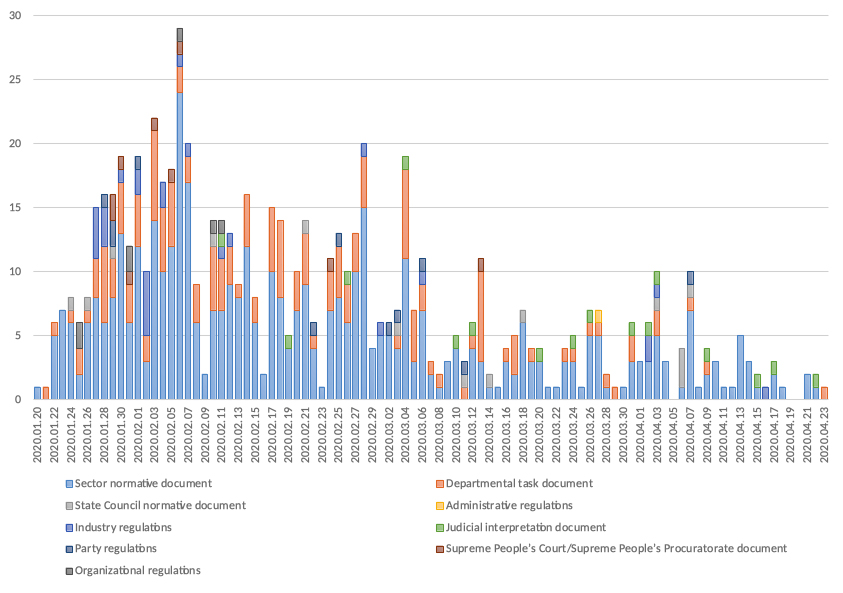
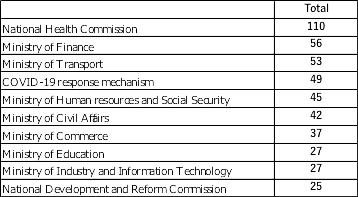
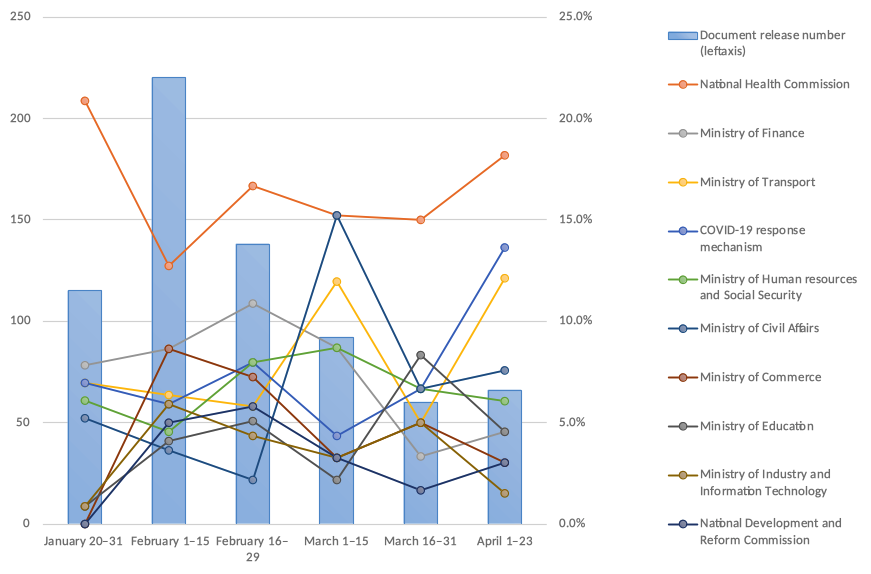
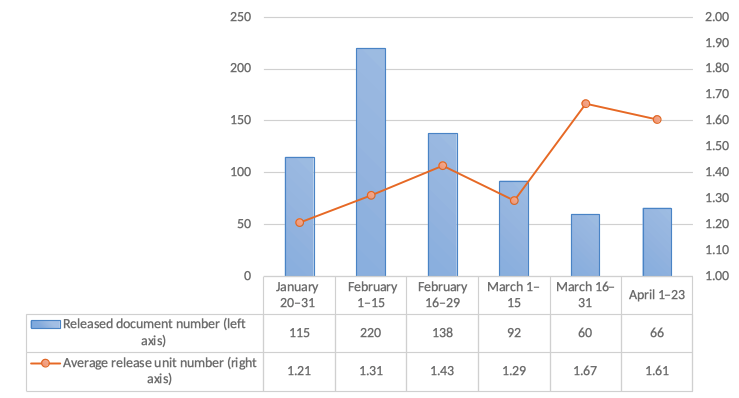
Therefore, this paper aims to understand the trends and changes in the composition of countermeasures of each section of the Chinese government and related organizations from January to April 2020 in a sequential and quantitative manner[10]. The policy document database of the Chinese government,“北大法宝 (Beida Fabao)” (https://www.pkulaw.com/), was used. As we will see, this database is not a complete complement of policy documents, but it is still useful. It should be noted that the results shown here are tentative, as further confirmation will be made in the future to increase the capture rate of documents in the database.