Ocean Newsletter
No.605 May 20, 2026
-
Making the Most of the Bounty of the Sea: The Fate of Fishery Waste
-
SDGs Starting from Sea Urchins: Sea Urchin Propagation and Blue Carbon Creation Using the "Shakotan Method"
-
Integration of Land-Based Salmon Farming and Regional Resources: Toward a New Ocean Governance from the Land
Making the Most of the Bounty of the Sea: The Fate of Fishery Waste
KEYWORDS
Fish Scraps / Shells / Seafood Processing Residue
YAMASHITA Haruko (Professor, Special Appointment, Faculty of Economics, Daito Bunka University)
In Japan, the residue left after consuming seafood is properly processed by the private sector. Over 70% of fish scraps in Japan and 100% of oyster shells in Hiroshima Prefecture are collected and reused. While the main uses of fish scraps are fish oil and fish meal, they are also used for various purposes such as food and medicine. Similarly, seashells are used not only as soil conditioners and construction materials, but also in supplements, chicken feed, and aquaculture materials. Japan's self-sustaining recycling of seafood processing residues should be promoted to the world.
Over 90% of Fish Scraps are Reused
Of Japan's domestically produced seafood, the volume supplied for the domestic market comes to 2.56 million tons a year, of which seafood excluding mollusks and seaweed accounts for 1.62 million tons (2024 statistics, used throughout this article). Because the yield rate (the proportion of the edible portion out of the total volume of supply) is 54%, the non-edible portion of fish, meaning the heads, bones, skin, fins, and viscera collectively known as fish scraps, comes to 750,000 tons. The yield rate for shellfish is even lower, at 50% for scallops and 20% for oysters, and in the case of scallops, the shells left over after the meat is removed for export also remain in Japan, bringing the estimated volume of discarded shells to 360,000 tons. Taken together, one might worry about what happens to the resulting 1.11 million tons a year, but there is little cause for concern. There are a number of private companies that collect and reuse fishery processing residues such as fish scraps and shells.
Fishery waste also includes artificial materials such as aquaculture ropes and equipments, but this article focuses on fish and shellfish, i.e., seafood processing residues. Let us begin with fish scraps. According to the author's estimates shown in the figure, the total volume of fish scraps is 750,000 tons, of which 74% is delivered to fish meal companies.
Fish scraps fall broadly into three categories: “On-site scraps” discharged from neighboring seafood processing plants, “urban scraps” from wholesale markets, supermarkets, and restaurants, and “household waste” from homes. “On-site scraps” consist of a single fish species—salmon scraps from the Sanriku area, or bonito scraps from Yaizu and Makurazaki, for example—, are still fresh when they are discharged, which is why fish meal companies, for-profit and non-profit, have set up near processing plants to produce fish meal and fish oil. Fresh on-site scraps have many other uses as well. Deep-fried salmon skin is sold as a snack food, and collagen is extracted from the skin and calcium from the bones for advanced use as raw materials in pharmaceuticals, health foods, and cosmetics.
“Urban scraps,” generated at a stage closer to the consumer, contain a jumbled mix of fish of varying freshness and are of lower quality than on-site scraps. Even so, the industry's largest company based in the greater Tokyo area buys fish scraps from as many as 10,000 stores every day and processes them into fish meal and fish oil.
In descending order of quality, fish meal is used as fish feed, then chicken feed, then pig feed, and finally agricultural fertilizer, while fish oil goes from pharmaceuticals and health foods, to a feed additive, and to fuel oil for the fish meal plants themselves. The liquid left over after fish meal and oil have been extracted, known as fish solubles, is also sold as a product.
Fish scraps from households (15%) are disposed of as “household waste.” The remaining 12%, or 88,000 tons are either reused or discarded. Data is not yet available to break this down in detail, but some reuse is taking place, and there is potential to raise the reuse rate further. For example, a processor of green eye fish in Toyohashi makes fish sauce from its own scraps, but because sales channels remain underdeveloped, only about 20% of the scraps can currently be put to use, with the rest discarded as waste. A dried bonito-flake manufacturer in Yaizu makes neribushi—a processed bonito paste—from bonito scraps, and while sales channels are sufficient, the company has not been able to increase the supply of raw material from some cutting plants that are reluctant to sort their waste.
Although fish meal made from fish scraps are not comparable tothe products made from whole fish such as sardines in terms of their quality, demand remains solid, supported by the worldwide expansion of fish farming and the resulting rise in fish meal prices in recent years. Nevertheless, the supply of raw material for fish scraps has been declining year by year. There are three reasons for this: first, consumption is falling over the years as the Japanese steadily eat less fish; second, domestic production is declining continuously due to the aging of fishers and climate change; and third, an increasing share of imported seafood is now processed overseas before being exported to Japan, so the resulting fish scraps are generated abroad rather than in Japan. If the volume generated within Japan continues to dwindle, the country's self-sustaining, profit-based system for processing fish scraps will become impossible to maintain.
Fishery waste also includes artificial materials such as aquaculture ropes and equipments, but this article focuses on fish and shellfish, i.e., seafood processing residues. Let us begin with fish scraps. According to the author's estimates shown in the figure, the total volume of fish scraps is 750,000 tons, of which 74% is delivered to fish meal companies.
Fish scraps fall broadly into three categories: “On-site scraps” discharged from neighboring seafood processing plants, “urban scraps” from wholesale markets, supermarkets, and restaurants, and “household waste” from homes. “On-site scraps” consist of a single fish species—salmon scraps from the Sanriku area, or bonito scraps from Yaizu and Makurazaki, for example—, are still fresh when they are discharged, which is why fish meal companies, for-profit and non-profit, have set up near processing plants to produce fish meal and fish oil. Fresh on-site scraps have many other uses as well. Deep-fried salmon skin is sold as a snack food, and collagen is extracted from the skin and calcium from the bones for advanced use as raw materials in pharmaceuticals, health foods, and cosmetics.
“Urban scraps,” generated at a stage closer to the consumer, contain a jumbled mix of fish of varying freshness and are of lower quality than on-site scraps. Even so, the industry's largest company based in the greater Tokyo area buys fish scraps from as many as 10,000 stores every day and processes them into fish meal and fish oil.
In descending order of quality, fish meal is used as fish feed, then chicken feed, then pig feed, and finally agricultural fertilizer, while fish oil goes from pharmaceuticals and health foods, to a feed additive, and to fuel oil for the fish meal plants themselves. The liquid left over after fish meal and oil have been extracted, known as fish solubles, is also sold as a product.
Fish scraps from households (15%) are disposed of as “household waste.” The remaining 12%, or 88,000 tons are either reused or discarded. Data is not yet available to break this down in detail, but some reuse is taking place, and there is potential to raise the reuse rate further. For example, a processor of green eye fish in Toyohashi makes fish sauce from its own scraps, but because sales channels remain underdeveloped, only about 20% of the scraps can currently be put to use, with the rest discarded as waste. A dried bonito-flake manufacturer in Yaizu makes neribushi—a processed bonito paste—from bonito scraps, and while sales channels are sufficient, the company has not been able to increase the supply of raw material from some cutting plants that are reluctant to sort their waste.
Although fish meal made from fish scraps are not comparable tothe products made from whole fish such as sardines in terms of their quality, demand remains solid, supported by the worldwide expansion of fish farming and the resulting rise in fish meal prices in recent years. Nevertheless, the supply of raw material for fish scraps has been declining year by year. There are three reasons for this: first, consumption is falling over the years as the Japanese steadily eat less fish; second, domestic production is declining continuously due to the aging of fishers and climate change; and third, an increasing share of imported seafood is now processed overseas before being exported to Japan, so the resulting fish scraps are generated abroad rather than in Japan. If the volume generated within Japan continues to dwindle, the country's self-sustaining, profit-based system for processing fish scraps will become impossible to maintain.
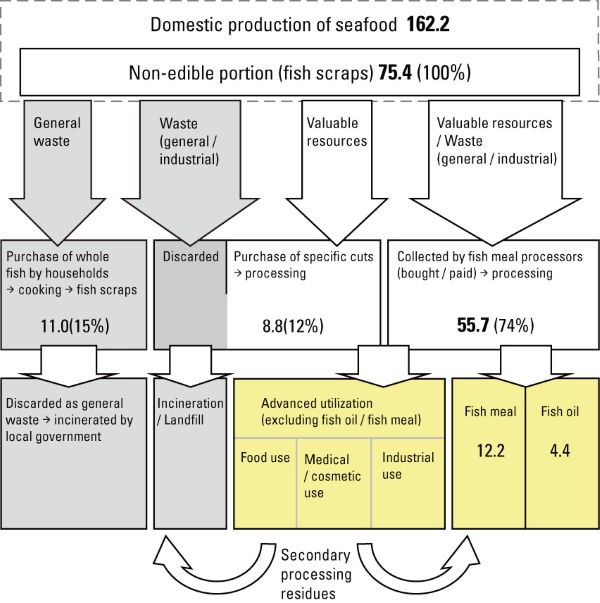
■Figure: The Treatment of Fish Scraps (2024, unit: 10,000 tons)
Source: Data (in bold) from the Fisheries and Aquaculture Production Statistics, Food Balance Sheet, Family Income and Expenditure Survey, Trade Statistics, and the Yearbook of Fisheries Oil and Fat Industry (all 2024), together with estimates based on assumptions made by the author
Hiroshima Prefecture's Oyster Shell Collection Rate: 100%
Next, let’s look at the actual state of shell processing by focusing on scallops and oysters, which together account for 95% of Japan's shellfish production. Companies that handle shells are not the same as those that handle fish scraps. Because shellfish meats in Japan are typically peeled before distribution, remained shells accumulate at the production sites is overwelming, which has led to the development of centralized shell processing systems on the ground. In Hiroshima Prefecture, which accounts for 60% of Japan's oyster production, two companies collect oyster shells from the production sites, and according to prefectural data, the collection rate stands at 100%.
Because shells are made almost entirely of the simple compound calcium carbonate, one might assume that their reuse is limited to a narrow range of applications. However beyond high-volume uses such as soil conditioners for farmland and construction materials, they are in fact put to a remarkably wide variety of uses. Both scallop and oyster shells are turned into calcium supplements for human consumption and mixed into chicken feed to support egg production; in addition, scallop shells are hung in the sea to give oyster larvae something to attach to, and oyster shells are hung to give nori (seaweed) spores something to attach to, eventually crumbling and sinking to the seafloor. The wall artwork shown in the photograph is the work of washi (Japanese paper) craft artist Hatano Wataru, who depicted the islands of the Seto Inland Sea by piecing together fragments of washi paper embedded with oyster shell powder in various colors, supplied by the oyster shell processor mentioned above.
Because shells are made almost entirely of the simple compound calcium carbonate, one might assume that their reuse is limited to a narrow range of applications. However beyond high-volume uses such as soil conditioners for farmland and construction materials, they are in fact put to a remarkably wide variety of uses. Both scallop and oyster shells are turned into calcium supplements for human consumption and mixed into chicken feed to support egg production; in addition, scallop shells are hung in the sea to give oyster larvae something to attach to, and oyster shells are hung to give nori (seaweed) spores something to attach to, eventually crumbling and sinking to the seafloor. The wall artwork shown in the photograph is the work of washi (Japanese paper) craft artist Hatano Wataru, who depicted the islands of the Seto Inland Sea by piecing together fragments of washi paper embedded with oyster shell powder in various colors, supplied by the oyster shell processor mentioned above.
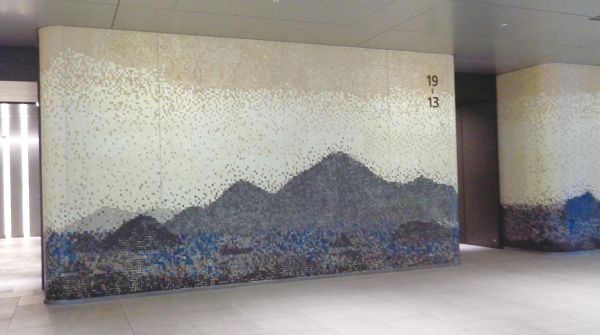
■Wall of the second-floor foyer, Hiroshima JP Building (photo by the author)
Bringing Japan's Model to the World
People from other countries often ask, “has processing advanced this far in Japan been sustained byof the government subsidies?” or “is it because of strict regulation and inspection?” The answer to both is no. The government does not subsidize the processing of fishery waste. Japan does, of course, have a Waste Management Act, and once something is classified as waste, it falls under this law, while material used as a “valuable resource” is exempt from the regulation. In practice, both the largest urban food-waste processor in the Tokyo metropolitan area and a neribushi producer in Yaizu pays to take these materials. This legal circumvention appears to have been a key driver of reuse. In addition, by the Edo period at the latest, commoners in Japan had developed a habit of not wasting food and were already accustomed to sorting and reusing any kind of waste. This historical and cultural background likely laid the groundwork for the thorough utilization of fish scraps and shells.
Technologies for developing even more advanced applications, along with the researchers who support them, are found throughout the public and private sectors across Japan. Even so, no matter how far such advanced use progresses, it is impossible to make use of the entire volume, and secondary processing residue is inevitably generated in the course of further processing. Overall optimization is achieved as a result of the function of processors that serve as a final destination for fish scraps and shells of every kind. If Japan's self-sustaining, circular model for the processing of fish scraps and shells were identified and promoted overseas, fishery processing residues, which account for nearly half of the world's fisheries production of 210 million tons (2024) could likewise be transformed into the bounty of the sea.
Technologies for developing even more advanced applications, along with the researchers who support them, are found throughout the public and private sectors across Japan. Even so, no matter how far such advanced use progresses, it is impossible to make use of the entire volume, and secondary processing residue is inevitably generated in the course of further processing. Overall optimization is achieved as a result of the function of processors that serve as a final destination for fish scraps and shells of every kind. If Japan's self-sustaining, circular model for the processing of fish scraps and shells were identified and promoted overseas, fishery processing residues, which account for nearly half of the world's fisheries production of 210 million tons (2024) could likewise be transformed into the bounty of the sea.