Ocean Newsletter
No.602 February 20, 2026
-
Pacific Island Countries: The Future of the Pacific Islands Forum (PIF) Regional Solidarity Organization
-
The Okinotorishima and Small Island States Program of The University of Tokyo Ocean Alliance
-
Current Status and Challenges of Remote Island Shipping Routes
-
From Ryukyu to Southeast China: The Fascination of Island Archaeology
The Okinotorishima and Small Island States Program of The University of Tokyo Ocean Alliance
KEYWORDS
Okinotorishima / Small Island States / sea-level rise
KAYANNE Hajime (Project Researcher, Department of Civil Engineering, Graduate School of Engineering, The University of Tokyo)
Okinotorishima and the atoll small island states of the Pacific share a common foundation in that their territories have been formed by biological processes and are now facing the shared threat of submergence due to sea-level rise. Sustainable territorial maintenance requires eco-engineering approaches that harness the functional roles of corals, foraminifera, and other organisms. The Okinotorishima and Small Island States Program of the University of Tokyo Ocean Alliance operates as a cross-sectoral platform linking academia, government, and industry, promoting reciprocal interaction between research and policy. It aims to develop and socially implement a territorial maintenance model that anticipates and advances Nature-based Solutions (NbS).
Okinotorishima and Small Island States
Okinotorishima is a table reef located at Japan’s southernmost point, spanning approximately 4.5 km east–west and 1.7 km north–south. It lies isolated in the Philippine Sea and is surrounded by an exclusive economic zone of about 400,000 square km. The outer rim is encircled by a reef crest that emerges at low tide, but at high tide, most of the reef lies below sea level, except for Kita-kojima (North Islet) and Higashi-kojima (East Islet). These two islets meet the United Nations Convention on the Law of the Sea definition of an island: “naturally formed area of land, surrounded by water, which is above water at high tide.” However, they face the risk of submergence due to sea-level rise in the present century.
Besides Okinotorishima, 14 small island states are distributed across the Pacific Ocean. Among them, three countries—the Republic of the Marshall Islands, the Republic of Kiribati, and Tuvalu—are composed exclusively of atolls. The Federated States of Micronesia and French Polynesia are also home to several atolls. In atolls, islands that remain above high tide (atoll islets) have an average elevation of only around two meters and, like Okinotorishima, face the risk of inundation. Atoll islets are formed from biogenic debris deposited atop a foundation created by coral reefs. Adaptation to sea-level rise therefore requires not only hard engineering measures such as seawalls and land reclamation, but also eco-engineering approaches that harness the natural processes that form and sustain islands, such as those involving corals and foraminifera.*¹ However, protecting the entire perimeter of atoll countries with hard infrastructure is unrealistic. Moreover, when ecosystems are damaged by seawalls or land reclamation and sediment transport and deposition processes are disrupted, the islands’ natural resilience is undermined.
Okinotorishima and Pacific atoll countries share a common vulnerability: their territory is created by biological processes, yet that territory may be lost in the future. For this reason, enabling the constant exchange of knowledge between the two is critically important for developing a new model of territorial maintenance that benefits both Japan’s remote border islands and small island states.
Besides Okinotorishima, 14 small island states are distributed across the Pacific Ocean. Among them, three countries—the Republic of the Marshall Islands, the Republic of Kiribati, and Tuvalu—are composed exclusively of atolls. The Federated States of Micronesia and French Polynesia are also home to several atolls. In atolls, islands that remain above high tide (atoll islets) have an average elevation of only around two meters and, like Okinotorishima, face the risk of inundation. Atoll islets are formed from biogenic debris deposited atop a foundation created by coral reefs. Adaptation to sea-level rise therefore requires not only hard engineering measures such as seawalls and land reclamation, but also eco-engineering approaches that harness the natural processes that form and sustain islands, such as those involving corals and foraminifera.*¹ However, protecting the entire perimeter of atoll countries with hard infrastructure is unrealistic. Moreover, when ecosystems are damaged by seawalls or land reclamation and sediment transport and deposition processes are disrupted, the islands’ natural resilience is undermined.
Okinotorishima and Pacific atoll countries share a common vulnerability: their territory is created by biological processes, yet that territory may be lost in the future. For this reason, enabling the constant exchange of knowledge between the two is critically important for developing a new model of territorial maintenance that benefits both Japan’s remote border islands and small island states.
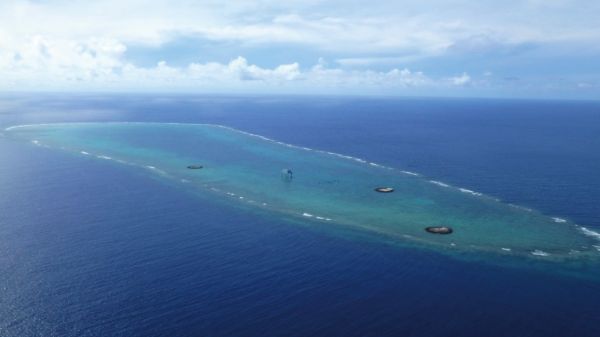
■Okinotorishima (Provided by the Ministry of Land, Infrastructure, Transport and Tourism, Keihin River Office)
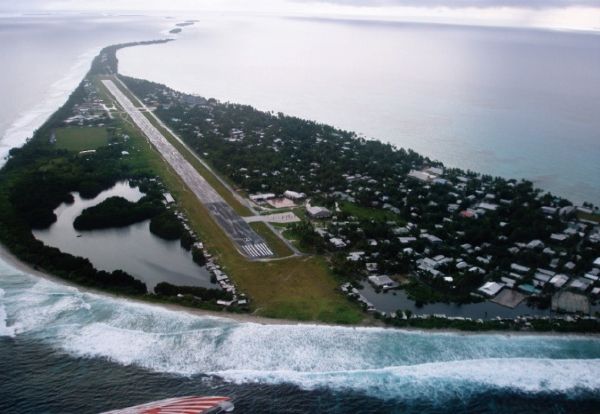
■Fongafale Island on Funafuti Atoll, the capital of Tuvalu, which consists of nine atolls (Photo by the author)
Okinotorishima and Small Island States Program
The Okinotorishima and Small Island States Program is one of the initiatives of the Ocean Alliance, a cross-disciplinary organization of marine researchers at the University of Tokyo. The program comprises approximately 200 members from industry, government, and academia, spanning multiple disciplines and sectors. It provides a nationally rare framework in which researchers in fields such as coral reef science, coastal engineering, and ecology engage in integrated discussions together with government agencies and private companies, functioning as a “platform” that bridges scientific knowledge and society. Okinotorishima and atoll countries share a common challenge, in that their territory is formed through biological processes and is subject to submergence due to sea-level rise. The program is built around an eco-engineering approach that links Okinotorishima and atoll countries, while also addressing a broad range of issues, including international law, the history of territorial recognition, and seabed resources.
Public interest in Okinotorishima was sparked by a survey expedition organized by the Nippon Foundation in 2004. I participated in the expedition and subsequently proposed the maintenance of the island through the activities of corals and foraminifera at a study group of the Ocean Policy Research Institute.*² I also personally launched a study group that evolved alongside the establishment of the Ocean Alliance in 2007 and which was eventually formalized as an official program in 2019.
At Okinotorishima, the Ministry of Land, Infrastructure, Transport and Tourism is responsible for territorial conservation and port development, the Fisheries Agency oversees coral reef restoration, and the Tokyo Metropolitan Government handles public outreach and awareness. However, because government administration is vertically segmented, it is difficult to share information and develop a coherent master plan. In addition, issues related to Okinotorishima’s status under international law have also hindered information disclosure. Connecting these administrative silos should be led by political leadership from the top down and by universities from the bottom up. In this context, the program has served as a “bottom-up hub” connecting disciplines and sectors.
Meanwhile, in small island states, we have conducted survey research on eco-engineering–based island maintenance in the Republic of the Marshall Islands and Tuvalu since 2002 through initiatives led by the Ministry of the Environment and the JICA–JST SATREPS program. These efforts have accumulated knowledge directly related to territorial maintenance, including coral reef geomorphology, biological processes, and sediment transport and coastal currents. The research has also been closely linked with government-implemented projects, such as the development of permeable revetments and artificial beach rock under technical development programs of the Ministry of Land, Infrastructure, Transport and Tourism, as well as seeding production technologies for corals using sexual reproduction developed by the Fisheries Agency, by fostering ongoing two-way interaction between research and government‑implemented projects. I have also participated almost every year as a speaker in the Tokyo Metropolitan Government’s Okinotorishima Forum. Since 2022, a literature and map database on Okinotorishima and Minamitorishima has been made publicly available,*³ and field surveys of both islands are underway. Integrating Okinotorishima and small island states from the perspective of “the sustainability of biologically formed islands” represents the program’s most distinctive feature.
Public interest in Okinotorishima was sparked by a survey expedition organized by the Nippon Foundation in 2004. I participated in the expedition and subsequently proposed the maintenance of the island through the activities of corals and foraminifera at a study group of the Ocean Policy Research Institute.*² I also personally launched a study group that evolved alongside the establishment of the Ocean Alliance in 2007 and which was eventually formalized as an official program in 2019.
At Okinotorishima, the Ministry of Land, Infrastructure, Transport and Tourism is responsible for territorial conservation and port development, the Fisheries Agency oversees coral reef restoration, and the Tokyo Metropolitan Government handles public outreach and awareness. However, because government administration is vertically segmented, it is difficult to share information and develop a coherent master plan. In addition, issues related to Okinotorishima’s status under international law have also hindered information disclosure. Connecting these administrative silos should be led by political leadership from the top down and by universities from the bottom up. In this context, the program has served as a “bottom-up hub” connecting disciplines and sectors.
Meanwhile, in small island states, we have conducted survey research on eco-engineering–based island maintenance in the Republic of the Marshall Islands and Tuvalu since 2002 through initiatives led by the Ministry of the Environment and the JICA–JST SATREPS program. These efforts have accumulated knowledge directly related to territorial maintenance, including coral reef geomorphology, biological processes, and sediment transport and coastal currents. The research has also been closely linked with government-implemented projects, such as the development of permeable revetments and artificial beach rock under technical development programs of the Ministry of Land, Infrastructure, Transport and Tourism, as well as seeding production technologies for corals using sexual reproduction developed by the Fisheries Agency, by fostering ongoing two-way interaction between research and government‑implemented projects. I have also participated almost every year as a speaker in the Tokyo Metropolitan Government’s Okinotorishima Forum. Since 2022, a literature and map database on Okinotorishima and Minamitorishima has been made publicly available,*³ and field surveys of both islands are underway. Integrating Okinotorishima and small island states from the perspective of “the sustainability of biologically formed islands” represents the program’s most distinctive feature.
Future Prospects
Eco-engineering approaches that enhance island resilience through coral reef restoration received little attention in the 2000s, when our study group was first established. At the time, coral reef restoration was even criticized as merely providing justification for development. In recent years, however, international support has increasingly focused on adaptation measures for small island states, which are among the first to be affected by sea-level rise. At the same time, adaptation strategies based solely on hard measures such as revetment and land reclamation have come to be recognized as forms of maladaptation that damage ecosystems and exacerbate erosion. As a result, NbS, which harness the power of natural processes, have gained growing international emphasis.
Both Okinotorishima and Pacific atoll countries share a common foundation in that their islands are formed by biological processes, and their maintenance depends critically on ecosystem health and restoration. This perspective has been cultivated through the program’s parallel advancement of surveys and research in both contexts. The eco-engineering–based coastal protection approaches we have proposed anticipate the concept of NbS.
While global trends are only now beginning to turn toward ecosystem-based adaptation, Japan has proposed and explored this direction for more than 20 years. To make such approaches function effectively on the ground, reciprocal interaction between government and research is essential domestically, while overseas it is crucial to build consensus with local governments and communities. In addition, there is a need to integrate individual technologies into a comprehensive system for territorial maintenance and to evaluate their effectiveness on the century-long timescale of sea-level rise. By overcoming these challenges and bridging eco-engineering concepts into policy and practice, this program aims to advance their societal implementation so that “territory created by living organisms” can be passed on to future generations.
Both Okinotorishima and Pacific atoll countries share a common foundation in that their islands are formed by biological processes, and their maintenance depends critically on ecosystem health and restoration. This perspective has been cultivated through the program’s parallel advancement of surveys and research in both contexts. The eco-engineering–based coastal protection approaches we have proposed anticipate the concept of NbS.
While global trends are only now beginning to turn toward ecosystem-based adaptation, Japan has proposed and explored this direction for more than 20 years. To make such approaches function effectively on the ground, reciprocal interaction between government and research is essential domestically, while overseas it is crucial to build consensus with local governments and communities. In addition, there is a need to integrate individual technologies into a comprehensive system for territorial maintenance and to evaluate their effectiveness on the century-long timescale of sea-level rise. By overcoming these challenges and bridging eco-engineering concepts into policy and practice, this program aims to advance their societal implementation so that “territory created by living organisms” can be passed on to future generations.
*1 Hajime Kayane, “Submerged atolls and their regeneration - Territorial preservation of island states in the Pacific Ocean and islands along the Japanese border” No. 99 of this newsletter (September 20, 2004)
https://www.spf.org/opri/en/newsletter/99_1.html
*2 Hajime Kayane, “Regenerating Okinotori-shima Island” No. 174 of this newsletter (November 5, 2007)
https://www.spf.org/opri/en/newsletter/174_1.html
*3 Okinotorishima and Minamitorishima Database
https://umdb.um.u-tokyo.ac.jp/DChiri/okinotorishima_minamitorishima/index.php
https://www.spf.org/opri/en/newsletter/99_1.html
*2 Hajime Kayane, “Regenerating Okinotori-shima Island” No. 174 of this newsletter (November 5, 2007)
https://www.spf.org/opri/en/newsletter/174_1.html
*3 Okinotorishima and Minamitorishima Database
https://umdb.um.u-tokyo.ac.jp/DChiri/okinotorishima_minamitorishima/index.php