Ocean Newsletter
No.602 February 20, 2026
-
Pacific Island Countries: The Future of the Pacific Islands Forum (PIF) Regional Solidarity Organization
-
The Okinotorishima and Small Island States Program of The University of Tokyo Ocean Alliance
-
Current Status and Challenges of Remote Island Shipping Routes
-
From Ryukyu to Southeast China: The Fascination of Island Archaeology
Pacific Island Countries: The Future of the Pacific Islands Forum (PIF) Regional Solidarity Organization
KEYWORDS
Pacific Islands Forum (PIF)/ consultative body/ diversity of island nations
KOBAYASHI Izumi (Professor, Faculty of International Studies, Osaka Gakuin University; President, Pacific Islands Studies Association)
Over the last few years, the Pacific Islands Forum (PIF) has been experiencing significant instability regarding its organizational management and relations with non-regional countries. Originally established as a forum for island nations to discuss regional issues and communicate with the international community, "regional integration" has been emphasized in recent years under the leadership of Australia and New Zealand. However, given the diversity of island nations, it is more realistic for the PIF to remain a consultative body rather than pursue integration.
Instability within the PIF
Since 1989, the Pacific Islands Forum (PIF), an organization uniting the Pacific island states, has conducted dialogues with partners outside the region by inviting neighboring donor countries and international organizations. In recent years, these dialogues have grown increasingly active, with participation from over 20 countries and international organizations. Nevertheless, at the 54th PIF Annual Meeting held in September 2025, the dialogue partners meeting was deferred.
Although the Solomon Islands’ Prime Minister Manele, serving as chair that year, denied such claims, it is evident that China exerted considerable influence on the cancellation of the event. This assessment recalls the incident at the 2024 PIF Leaders’ Meeting, when the joint declaration was revised overnight. The wording referring to Taiwan as “an important partner” was removed following vehement objections from Qian Bo, China’s Special Envoy for Pacific Island Countries Affairs. Such post‑publication alterations of a leaders’ declaration under external pressure are without precedent. However, the decision likely stemmed from concerns that continued deterioration of China–Taiwan relations could undermine the unity of the PIF, a key symbol of regional solidarity and inter-island cooperation. At present, 11 member states maintain diplomatic relations with China, compared to three with Taiwan. Ignoring the China–Taiwan issue ahead of the next summit would therefore marginalize Palau, the Marshall Islands, and Tuvalu, all of which recognize Taiwan.
President Surangel Whipps Jr. of the Republic of Palau, the chair country for the 2026 PIF Leaders’ Meeting, stated clearly during a meeting with the author in October 2025, during his visit to Japan, that Palau intends to resume the traditional dialogue with external partners. However, reconciling the diverse interests of island nations and finding a solution acceptable to China within a single year will not be easy. For this reason, the dialogue event may be revived through a degree of deliberate ambiguity characteristic of Pacific diplomacy.
Although the Solomon Islands’ Prime Minister Manele, serving as chair that year, denied such claims, it is evident that China exerted considerable influence on the cancellation of the event. This assessment recalls the incident at the 2024 PIF Leaders’ Meeting, when the joint declaration was revised overnight. The wording referring to Taiwan as “an important partner” was removed following vehement objections from Qian Bo, China’s Special Envoy for Pacific Island Countries Affairs. Such post‑publication alterations of a leaders’ declaration under external pressure are without precedent. However, the decision likely stemmed from concerns that continued deterioration of China–Taiwan relations could undermine the unity of the PIF, a key symbol of regional solidarity and inter-island cooperation. At present, 11 member states maintain diplomatic relations with China, compared to three with Taiwan. Ignoring the China–Taiwan issue ahead of the next summit would therefore marginalize Palau, the Marshall Islands, and Tuvalu, all of which recognize Taiwan.
President Surangel Whipps Jr. of the Republic of Palau, the chair country for the 2026 PIF Leaders’ Meeting, stated clearly during a meeting with the author in October 2025, during his visit to Japan, that Palau intends to resume the traditional dialogue with external partners. However, reconciling the diverse interests of island nations and finding a solution acceptable to China within a single year will not be easy. For this reason, the dialogue event may be revived through a degree of deliberate ambiguity characteristic of Pacific diplomacy.
PIF as a platform for the collective voice of Pacific Island Countries
At this point, it is worth reconsidering what kind of organization the PIF actually is. Article 2 of the PIF Agreement states that its purpose is to “strengthen regional cooperation and integration.” This provision has led the Forum to be widely understood as an institution aimed at promoting regional integration. However, the founding agreement was not codified until 2005, more than 30 years after the Forum was established in 1971 as the South Pacific Forum (SPF), at which time no formal charter existed. The original membership consisted of only seven countries and territories, including Australia and New Zealand, leaving little scope at the time for regional integration.
After the Second World War, the region was administered through the South Pacific Commission (SPC), established by the colonial powers. As Western Samoa (now the Independent State of Samoa) and Nauru gained independence in the 1960s, Pacific island countries were admitted to the SPC as independent regional members. The organization, however, functioned primarily as a forum for social and economic issues and operated under an unwritten rule that political matters would not be discussed. For newly independent island countries, however, a forum that excluded political discussion was meaningless. Accordingly, following the independence of Fiji and Tonga, the SPF was established to provide a venue in which the island nations could freely discuss issues of regional concern.
The SPF subsequently admitted newly independent Pacific island countries as members and was renamed the Pacific Islands Forum (PIF) in 2000. In this way, the consultative organization of Pacific island countries has continued to develop, until it now comprises 16 countries and two territories, while fulfilling its founding purpose of making the existence of small independent island states known to the international community and promoting their claims globally.
After the Second World War, the region was administered through the South Pacific Commission (SPC), established by the colonial powers. As Western Samoa (now the Independent State of Samoa) and Nauru gained independence in the 1960s, Pacific island countries were admitted to the SPC as independent regional members. The organization, however, functioned primarily as a forum for social and economic issues and operated under an unwritten rule that political matters would not be discussed. For newly independent island countries, however, a forum that excluded political discussion was meaningless. Accordingly, following the independence of Fiji and Tonga, the SPF was established to provide a venue in which the island nations could freely discuss issues of regional concern.
The SPF subsequently admitted newly independent Pacific island countries as members and was renamed the Pacific Islands Forum (PIF) in 2000. In this way, the consultative organization of Pacific island countries has continued to develop, until it now comprises 16 countries and two territories, while fulfilling its founding purpose of making the existence of small independent island states known to the international community and promoting their claims globally.
Regional Integration as an Australian and New Zealand Initiative
Thus, the PIF was originally conceived as a consultative body rather than an organization dedicated to regional integration. Why, then, has it increasingly been discussed in recent years in terms of a “crisis of integration” or “integration or fragmentation”? The author argues that this shift stems from the inclusion of Australia and New Zealand, former colonial powers, among the Forum’s founding members, despite the PIF’s origins as a consultative body of island nations. Initially, they supported newly independent island countries through institutional and financial assistance, presenting themselves as fellow regional states. Over time, however, they increasingly asserted their own preferences and steered the islands toward regional integration. This trajectory culminated in the 2005 Agreement, which identified regional integration as a core objective. As integration in the Pacific island region has advanced, it has served the interests of Australia and New Zealand by facilitating development assistance, cooperation with former colonial territories, and regional security in Oceania. In short, PIF unity and integration reflect the priorities of Australia and New Zealand rather than those of the island nations.
While Pacific island countries share common paths to independence and geography, they also display considerable diversity. Being grouped together under the single label of “Pacific island countries,” from Papua New Guinea with a population exceeding ten million to Nauru with only around ten thousand, is an unwelcome characterization. Once the realities and sentiments of the islands are considered, regional integration or unity appears to be little more than an idealized vision by Australia and New Zealand. In short, island nations, Australia, and New Zealand participate in the PIF under different expectations regarding regional solidarity and cooperation.
While Pacific island countries share common paths to independence and geography, they also display considerable diversity. Being grouped together under the single label of “Pacific island countries,” from Papua New Guinea with a population exceeding ten million to Nauru with only around ten thousand, is an unwelcome characterization. Once the realities and sentiments of the islands are considered, regional integration or unity appears to be little more than an idealized vision by Australia and New Zealand. In short, island nations, Australia, and New Zealand participate in the PIF under different expectations regarding regional solidarity and cooperation.
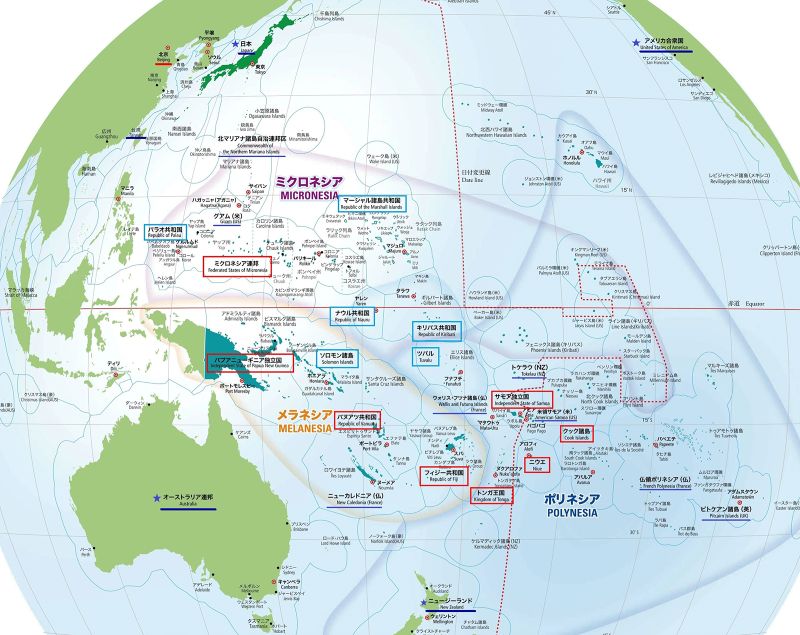
Map of the Pacific Prepared by the Pacific Island Nations Program, Sasakawa Peace Foundation
Why the PIF Remains Essential for Pacific Island Countries
That said, the PIF remains an essential organization even for the island nations. The outcomes of the following two incidents illustrate this point clearly.
First, there is the case of Fiji’s suspension from the PIF in September 2009. Despite the prevailing view among many island nations that they should refrain from intervening in the domestic affairs of other Pacific islands, Australia and New Zealand played a decisive role in pushing through the decision to suspend Fiji following the coup. In response, Prime Minister Frank Bainimarama of Fiji countered that meaningful discussions of regional solidarity and cooperation required a forum without Australia and New Zealand. Accordingly, in 2013, he launched the Pacific Islands Development Forum (PIDF) and called on Pacific island countries to participate. The island members of the PIF responded immediately by joining, a development that reveals underlying sentiments toward Australia and New Zealand among the island nations. However, after Fiji returned to democratic rule, it was readmitted to the PIF in 2015, restoring the status quo. As a result, the activities of the PIDF have since lost momentum.
Second, there was the 2021 dispute over the withdrawal of five Micronesian states from the PIF. In the selection of the PIF Secretary General, a Polynesian candidate was elected by vote, instead of the expected Micronesian. Australia and New Zealand were again deeply involved in the election, prompting Micronesian states to condemn the outcome as a breach of trust and announce their intention to withdraw from the Forum. Subsequently, recognizing the seriousness of the situation, Australia and New Zealand engaged in approximately eighteen months of negotiations, ultimately averting a split by appointing a Micronesian Secretary General.
In this way, despite being members of the same organization, a significant gap exists between the island nations and Australia/New Zealand. The PIF is likely to continue facing challenges in its governance, yet islands nations are unlikely to seek its fragmentation or dissolution. This is because they recognize the Forum as a crucial platform for projecting their presence to the international community. Accordingly, rather than pressing ahead with further integration or unity, the PIF is likely to endure as a consultative body by embracing greater diversity among its members.
First, there is the case of Fiji’s suspension from the PIF in September 2009. Despite the prevailing view among many island nations that they should refrain from intervening in the domestic affairs of other Pacific islands, Australia and New Zealand played a decisive role in pushing through the decision to suspend Fiji following the coup. In response, Prime Minister Frank Bainimarama of Fiji countered that meaningful discussions of regional solidarity and cooperation required a forum without Australia and New Zealand. Accordingly, in 2013, he launched the Pacific Islands Development Forum (PIDF) and called on Pacific island countries to participate. The island members of the PIF responded immediately by joining, a development that reveals underlying sentiments toward Australia and New Zealand among the island nations. However, after Fiji returned to democratic rule, it was readmitted to the PIF in 2015, restoring the status quo. As a result, the activities of the PIDF have since lost momentum.
Second, there was the 2021 dispute over the withdrawal of five Micronesian states from the PIF. In the selection of the PIF Secretary General, a Polynesian candidate was elected by vote, instead of the expected Micronesian. Australia and New Zealand were again deeply involved in the election, prompting Micronesian states to condemn the outcome as a breach of trust and announce their intention to withdraw from the Forum. Subsequently, recognizing the seriousness of the situation, Australia and New Zealand engaged in approximately eighteen months of negotiations, ultimately averting a split by appointing a Micronesian Secretary General.
In this way, despite being members of the same organization, a significant gap exists between the island nations and Australia/New Zealand. The PIF is likely to continue facing challenges in its governance, yet islands nations are unlikely to seek its fragmentation or dissolution. This is because they recognize the Forum as a crucial platform for projecting their presence to the international community. Accordingly, rather than pressing ahead with further integration or unity, the PIF is likely to endure as a consultative body by embracing greater diversity among its members.