Ocean Newsletter
No.597 September 20, 2025
-
The Tokyo International Conference on African Development and the Sustainable Blue Economy
-
Decarbonisation Efforts to Mitigate Climate Change Impacts in Southern Africa
-
Calling for concerted actions to avert the impending climate-driven marine food security crisis in the Western Indian Ocean (WIO)
-
The History and Future of JICA's Fisheries Project in Senegal
-
Increasing Environmental Awareness in Madagascar
The Tokyo International Conference on African Development and the Sustainable Blue Economy
KEYWORDS
TICAD / Fisheries industry / Eminent Persons Meeting
KOBAYASHI Masanori (Senior Research Fellow, Sasakawa Peace Foundation)
With the cooperation of the Nippon Foundation and the Sasakawa Africa Association, the Sasakawa Peace Foundation held four high-level expert meetings since the summer of 2024, bringing together executives from Japanese government agencies and private companies. Following consultations with the African Diplomatic Corps in Tokyo, we have compiled a set of recommendations that were submitted to the Japanese Foreign Minister. We advanced discussions at the eminent persons’ meeting in July and the summit meeting in August. Based on the discussions, we intend to promote effective collaboration and advance Japan-Africa cooperation in the field of the sustainable blue economy.
The Current Status and Challenges Surrounding Africa's Blue Economy
“Why do many coastal regions in African countries face poverty, despite being surrounded by seas that are said to be rich in resources?” When I attended the International Conference on the Sustainable Blue Economy in the Gulf of Guinea, held in Yaoundé, the capital of Cameroon in Central West Africa, from July 9 to 10, 2025, I was asked this question by a local stakeholder. His argument was that although Africa’s coasts are believed to be rich in fish, coastal communities are not benefiting from these resources. Indeed, it was a stark contrast to the lively gathering of many people overlooking the Mediterranean in Nice, France, where the Third United Nations Ocean Conference had been held just one month earlier. With the cooperation of The Nippon Foundation and the Sasakawa Africa Association, the Sasakawa Peace Foundation held four high-level expert meetings since the summer of 2024, bringing together executives from Japanese government agencies and private companies. Following consultations with the African Diplomatic Corps in Tokyo, the Foundation produced the recommendation document “Toward the Promotion of Sustainable Development in Africa: Strengthening the Japan-Africa Partnership and Enhancing the Effectiveness of the Tokyo International Conference on African Development (TICAD) Process” (July 11, 2025)*.
Trends and Characteristics of African Fisheries
The total marine fish catch by African countries increased by 16.3% over 10 years, from 5.9 million tons in 2014 to 6.9 million tons in 2023. It was noted that not all countries have uniformly increased their fish catch; rather, the trend varies significantly by country, with some even showing a decline in catch volumes. For example, Mauritania has increased its fish catch by 114.8%, expanding it to 2.1 times the previous volume, but South Africa, which ranked sixth in catch volume, has seen a 29.8% decrease, and Namibia, ranking seventh, has experienced a 16.0% decline. The same pattern applies to aquaculture production, including both marine and inland waters. Across Africa as a whole, aquaculture production increased by 37.6% over the 10 years through 2023. While South Africa saw a 19.9% increase, Namibia experienced a 47.5% decrease. In fisheries product trade, Namibia’s fishery imports increased by 49.0% between 2013 and 2022, and South Africa also saw an 82.3% increase, indicating that both countries have shifted from being seafood exporters to seafood importers. Even in Mozambique, which has been increasing its catches, seafood imports exceed exports. Field surveys we have conducted to date have identified factors such as increased catches by foreign fishing vessels, degradation of coastal ecosystems, and changes in the marine environment due to rising sea water temperatures. It was also pointed out that high-quality local fish are procured by foreign operators, leaving only smaller fish to circulate in the domestic market. While further analysis is needed, such statistics and interviews reveal a reality where coastal residents, who should be benefiting from the ocean’s resources, are not able to take full advantage of their position.
Eminent Persons’ Meeting and Blue Economy
The Sasakawa Peace Foundation, in collaboration with the Nippon Foundation and the Sasakawa Africa Association, held the Japan-Africa Partnership Eminent Person’s Meeting on Africa's Sustainable Development: Towards Enhancing Food Security and Promoting Sustainable Blue Economies, in Hakone, Kanagawa Prefecture, from July 22 to 24, 2025. The meeting was attended by former heads of state from Nigeria, Tanzania, Niger, and Cape Verde, as well as the former President of the African Development Bank and the former Chairperson of the African Union Commission. The participants discussed strategies, approaches, and concrete actions to effectively implement the previously mentioned policy proposal, “Toward the Promotion of Sustainable Development in Africa: Strengthening the Japan-Africa Partnership and Enhancing the Effectiveness of the TICAD Process,” which was developed based on discussions among Japanese stakeholders and experts.
At the meeting, various issues were pointed out and proposals were made. For example, Africa’s fisheries sector is predominantly small-scale fishing by small boats, and the development of infrastructure to enable cold-chain distribution with refrigeration and freezing facilities was identified as a key challenge. In Tanzania, it was noted that coastal aquaculture is expanding, particularly seaweed farming in the Zanzibar archipelago, which has shown socioeconomic effects such as women's participation and income generation. The utilization of marine products remains largely underdeveloped in Africa, and high expectations were expressed for collaboration with Japan, which has a tradition of seafood utilization and a fish-eating culture, as well as advanced technologies including biotechnology. Proposals were also made to expand marine education for children and young people in Africa, and to implement leadership development programs aimed at training young professionals in launching and leading businesses in fisheries, processing, and distribution sectors. In addition, a proposal was made to establish and operate a Blue Innovation Fund, in collaboration with institutions such as the African Development Bank, to support startups in the blue economy. The outcomes of these discussions were compiled into the Eminent Persons’ Statement, which, along with the recommendations from the preceding High-Level Expert Meeting, was formally presented to Minister for Foreign Affairs Takeshi Iwaya on July 25, 2025, by Yohei Sasakawa, Honorary Chair of The Nippon Foundation and the Sasakawa Peace Foundation, Shuichi Suzuki, President of the Sasakawa Africa Association, and Atsushi Sunami, President of the Sasakawa Peace Foundation.
At the meeting, various issues were pointed out and proposals were made. For example, Africa’s fisheries sector is predominantly small-scale fishing by small boats, and the development of infrastructure to enable cold-chain distribution with refrigeration and freezing facilities was identified as a key challenge. In Tanzania, it was noted that coastal aquaculture is expanding, particularly seaweed farming in the Zanzibar archipelago, which has shown socioeconomic effects such as women's participation and income generation. The utilization of marine products remains largely underdeveloped in Africa, and high expectations were expressed for collaboration with Japan, which has a tradition of seafood utilization and a fish-eating culture, as well as advanced technologies including biotechnology. Proposals were also made to expand marine education for children and young people in Africa, and to implement leadership development programs aimed at training young professionals in launching and leading businesses in fisheries, processing, and distribution sectors. In addition, a proposal was made to establish and operate a Blue Innovation Fund, in collaboration with institutions such as the African Development Bank, to support startups in the blue economy. The outcomes of these discussions were compiled into the Eminent Persons’ Statement, which, along with the recommendations from the preceding High-Level Expert Meeting, was formally presented to Minister for Foreign Affairs Takeshi Iwaya on July 25, 2025, by Yohei Sasakawa, Honorary Chair of The Nippon Foundation and the Sasakawa Peace Foundation, Shuichi Suzuki, President of the Sasakawa Africa Association, and Atsushi Sunami, President of the Sasakawa Peace Foundation.

■Figure 1: Marine fish catch volumes and their trends across Africa as a whole and the top seven African countries (1990-2023)
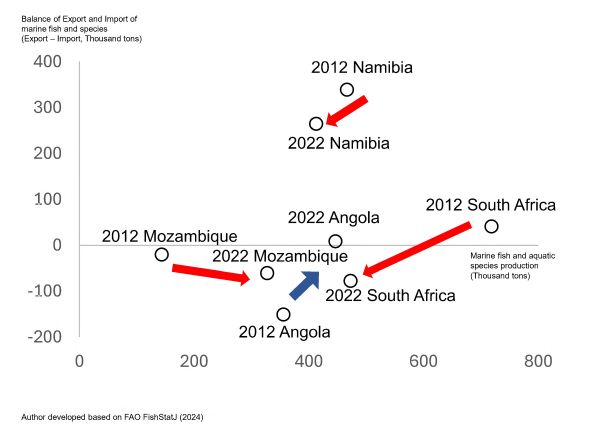
■Figure 2: Changes in Fishery Production and Trade Balance of Southern African Countries (2012-2022)
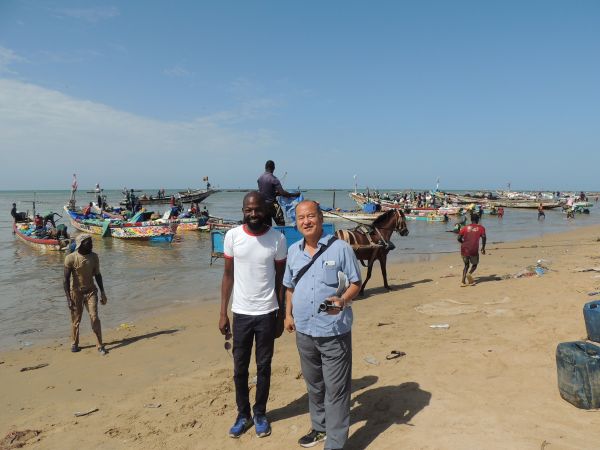
Mbour (Senegal)
Collaboration with Africa toward Promoting the Blue Economy
The six heads of state and regional organizations who attended the Eminent Persons’ Meeting also participated in the “Special International Symposium: Forging a Sustainable Future through Africa–Japan Collaboration Towards Enhancing Food Security and Promoting Sustainable Blue Economies,” held at the Sasakawa Peace Foundation International Conference Hall on July 25, 2025. The symposium was held in a hybrid format combining in-person and online participation. Following opening remarks by Deputy Minister for Foreign Affairs Hisayuki Fujii, constructive discussions were further developed focusing on education, research, technology, human resource development, investment promotion, and other topics. At the Ninth Tokyo International Conference on African Development (TICAD9), held from August 20 to 22, 2025 in Yokohama City, a policy dialogue on this theme was conducted with African leaders and heads of regional organizations. How can Africa’s rich marine resources be harnessed to improve the lives of local communities? Building on the discussions from the summit in summer, we aim to identify the ideal form of collaboration and advance Japan-Africa cooperation in the field of the blue economy.