Ocean Newsletter
No.601 January 20, 2026
-
Research on the Dynamics of Marine Plastics on a Global Scale
-
From the Seto Inland Sea to the World: "Setouchi Oceans X" as a Compass for Marine Debris Countermeasures
-
Approaches to Reducing Plastic Pollution
From the Seto Inland Sea to the World: "Setouchi Oceans X" as a Compass for Marine Debris Countermeasures
KEYWORDS
Marine debris/ Enclosed coastal seas/ Seto Inland Sea
SHIOIRI Tomo (Senior Research Fellow at the Ocean Policy Research Institute, Sasakawa Peace Foundation; Former Project Leader, Setouchi Oceans X, Nippon Foundation)
"Setouchi Oceans X," a project between the Nippon Foundation and the four Setouchi prefectures, has developed practical, evidence-based marine debris countermeasures and accumulated knowledge in one of Japan's largest enclosed coastal seas. This process transcends administrative silos and overcomes physical, economic, and institutional challenges through technical expertise and local collaboration, and offers effective solutions to marine and coastal issues that require comprehensive management. It is expected to provide a clear path toward resolving the challenges facing the world's oceans.
Trends in Marine Debris Countermeasures
The issue of marine plastic debris is an urgent global challenge. Enclosed coastal seas, which are also the homes of large coastal cities, are areas where the problem is particularly visible. For this reason, they are often assumed to be easier to address than the open ocean; however, even in such seas, a widely applicable and systematic solution model has yet to be established. Enclosed coastal seas have long supported social and economic activities through the concentration of major cities and industries along their coasts. A defining characteristic of these seas is that waste generated by such activities becomes a source of pollution in locations relatively close to where it is produced. Once debris enters rivers or the ocean, it crosses administrative and national boundaries, obscuring responsibility and hindering solutions. As a result, cooperation among governments, citizens, and businesses is essential. Developing, testing, and horizontally scaling effective regional measures in enclosed coastal seas therefore represents a promising approach to systemic solutions.
Looking globally, large-scale multinational projects covering vast marine areas are being implemented in regions such as the Baltic Sea*¹ and the Mediterranean Sea*². However, in the Baltic Sea, the difficulty of building consensus among multiple countries has resulted in the absence of numerical targets, with the primary focus instead placed on the development and standardization of monitoring methodologies. In the Mediterranean, priority has been given to establishing an implementation framework, and the regulatory effects of land-based waste management are assessed only indirectly using a simple indicator: the count of individual pieces of stranded debris. The current reality remains that effective countermeasures have yet to be implemented, and practical solution models have yet to be presented.
Looking globally, large-scale multinational projects covering vast marine areas are being implemented in regions such as the Baltic Sea*¹ and the Mediterranean Sea*². However, in the Baltic Sea, the difficulty of building consensus among multiple countries has resulted in the absence of numerical targets, with the primary focus instead placed on the development and standardization of monitoring methodologies. In the Mediterranean, priority has been given to establishing an implementation framework, and the regulatory effects of land-based waste management are assessed only indirectly using a simple indicator: the count of individual pieces of stranded debris. The current reality remains that effective countermeasures have yet to be implemented, and practical solution models have yet to be presented.
Setouchi Oceans X
Against the backdrop of the lack of established solution models for enclosed coastal seas, Setouchi Oceans X*³ was launched in 2020 with the Seto Inland Sea as its focal area, with the aim of presenting a practice-based solution model from Japan. The Chair of The Nippon Foundation and the governors of four Seto Inland prefectures—Okayama, Hiroshima, Kagawa, and Ehime—entered into a collaboration agreement. Through evidence-based practical actions, the initiative seeks to reverse the trend and put the growth of marine debris on a downward trajectory by March 2028, and to present its outcomes as a solution model to the world.
The first major innovation of this project lies in its original governance design. Marine debris countermeasures have long faced challenges stemming from over-compartmentalized administrative structures and the absence of actors responsible for wide-area coordination. To overcome these challenges, Setouchi Oceans X established a promotion council through a formal agreement between The Nippon Foundation, which brings financial resources and communication capacity, and the four prefectural governments, which hold administrative authority. This framework transcends conventional administrative boundaries and implements flexible, bottom-up initiatives that engage citizens and businesses. The second innovation is its evidence-based approach. Large-scale surveys were conducted at the outset of the project as a first step in establishing a foundation for quantification and evaluation. These included comprehensive river debris surveys across 280 rivers in the four prefectures (with a total length of approximately 1,200 km), as well as seabed debris recovery surveys and related research, in order to identify debris types, sources, and hotspots. These efforts made it possible to calculate the marine debris balance of the four Seto Inland prefectures, visualizing a concrete gap—namely, an annual shortfall of 86 tons in debris recovery—as a shared quantitative target (Figure). This clearly defined numerical target provides a common reference point that underpins and drives all countermeasure activities.
With this innovative framework and clear targets working in tandem, the Nippon Foundation committed a total budget of more than 1.5 billion yen and established an additional ¥500 million fund. The project is structured around four core pillars:
(1) research and investigation, (2) collaboration with businesses and local communities, (3) awareness, education, and action, and (4) policy development.
Through these pillars, the initiative accelerates the development and networking of regional actors and, drawing on concrete achievements and practical knowledge gained through its implementation framework, advances the construction of a viable solution model.
The first major innovation of this project lies in its original governance design. Marine debris countermeasures have long faced challenges stemming from over-compartmentalized administrative structures and the absence of actors responsible for wide-area coordination. To overcome these challenges, Setouchi Oceans X established a promotion council through a formal agreement between The Nippon Foundation, which brings financial resources and communication capacity, and the four prefectural governments, which hold administrative authority. This framework transcends conventional administrative boundaries and implements flexible, bottom-up initiatives that engage citizens and businesses. The second innovation is its evidence-based approach. Large-scale surveys were conducted at the outset of the project as a first step in establishing a foundation for quantification and evaluation. These included comprehensive river debris surveys across 280 rivers in the four prefectures (with a total length of approximately 1,200 km), as well as seabed debris recovery surveys and related research, in order to identify debris types, sources, and hotspots. These efforts made it possible to calculate the marine debris balance of the four Seto Inland prefectures, visualizing a concrete gap—namely, an annual shortfall of 86 tons in debris recovery—as a shared quantitative target (Figure). This clearly defined numerical target provides a common reference point that underpins and drives all countermeasure activities.
With this innovative framework and clear targets working in tandem, the Nippon Foundation committed a total budget of more than 1.5 billion yen and established an additional ¥500 million fund. The project is structured around four core pillars:
(1) research and investigation, (2) collaboration with businesses and local communities, (3) awareness, education, and action, and (4) policy development.
Through these pillars, the initiative accelerates the development and networking of regional actors and, drawing on concrete achievements and practical knowledge gained through its implementation framework, advances the construction of a viable solution model.
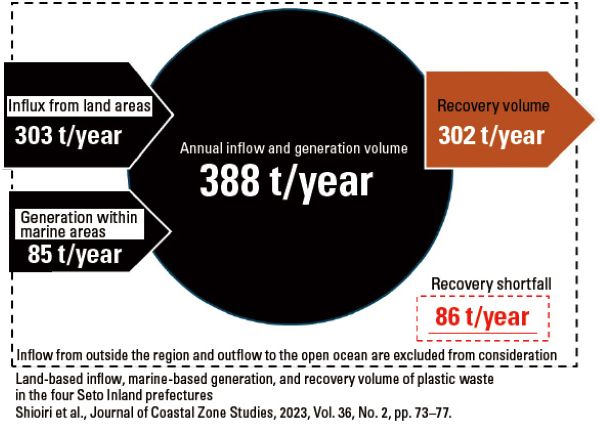
■Figure: Marine debris balance sheet in the four Seto Inland prefectures
Strategic implementation based on four pillars
The shared “compass” of 86 tons per year generated a strategic approach that overcomes social barriers to achieving the target through cross-sector collaboration.
[Practical Case Study 1: Strategic Recovery through a Dedicated Fund and Capacity-Building of Local Actors] To achieve the annual recovery target of 86 tons, the fund strategically supports local “actors,” including NGOs, junior and senior high school students, and fisheries cooperatives, who address waste that is difficult to address through volunteer efforts alone. At the mouth of the Asahi River in Okayama Prefecture, large volumes of litter became entangled in dense reed growth, making collection extremely challenging. To address this issue, a local environmental NGO and a group of junior and senior high school students, with the cooperation of a construction company, used large-scale mowing machinery to cut back reeds along the shoreline. This process made the accumulated waste “visible,” enabling a coordinated large-scale cleanup. The method was implemented and tested as a practical model. By overcoming physical recovery challenges through specialized technical skills and local collaboration, the effort evolved into a locally embedded social system. With support from local industry, efforts to expand the model to nearby rivers also emerged.
[Practical Case Study 2: Source Control Measures through Cross-Industry Collaboration] In parallel with waste recovery efforts, the project also initiated measures to address waste at its source. One of the biggest examples of this is the initiative targeting oyster farming floats in Hiroshima Prefecture.
Conventional polystyrene foam floats used in oyster farming typically begin to deteriorate after around three years. As they wear down and break apart, they become a major source of marine debris, particularly microplastics. To address this issue, the Nippon Foundation established a cross-industry collaboration involving the prefectural fisheries federation, fishing industries, and manufacturers of construction and industrial materials. Through this partnership, a high-durability float was developed, extending the product lifespan to more than twice that of conventional models (approximately 7.5 years). Underlying this effort was a strong determination among fishers to “put an end, within our generation, to the causes of ocean pollution.” In addition, an IC-tag–based individual management system was piloted, followed by the launch of a large-scale demonstration project in autumn 2025 involving fishers from 30 fisheries cooperatives across the prefecture. This model presents the economic rationale that environmental considerations can lead to industry-wide cost reductions of approximately 50 million yen annually, thereby encouraging a transition toward a sustainable industrial model.
[Practical Case Study 3: The Emergence of Wide-Area, Local Government-Led Action] A symbolic example of this development is a large-scale, mobile waste recovery model that operates across municipal boundaries (see photo). In coastal areas such as the Uwa Sea in Ehime Prefecture and the Bisan-Seto Strait bordering Okayama and Kagawa prefectures, where numerous hard-to-access islands are scattered, stranded waste recovery conducted independently by individual municipalities proved extremely inefficient. In response, the project implemented an operational model that upheld the principle of “waste-generating municipality responsibility” in waste management, while enabling wide-area recovery beyond municipal boundaries. Collection vehicles from each municipality were loaded onto a landing craft, with waste stored and managed on board to clarify responsibility for treatment. Through operational adjustments, the project overcame legal constraints and carried out the social implementation of wide-area recovery unconstrained by administrative borders. These outcomes also hold important significance as a policy formation model that transforms administrative attitudes toward challenges through on-the-ground practice.
When marine debris is understood—as articulated in the United Nations Convention on the Law of the Sea—as one of the closely interrelated ocean issues that need to be considered as a whole, these initiatives, which have broken through physical, economic, and institutional barriers through analysis and practice while accumulating knowledge, point to a credible course for addressing the challenges facing the world’s oceans.
[Practical Case Study 1: Strategic Recovery through a Dedicated Fund and Capacity-Building of Local Actors] To achieve the annual recovery target of 86 tons, the fund strategically supports local “actors,” including NGOs, junior and senior high school students, and fisheries cooperatives, who address waste that is difficult to address through volunteer efforts alone. At the mouth of the Asahi River in Okayama Prefecture, large volumes of litter became entangled in dense reed growth, making collection extremely challenging. To address this issue, a local environmental NGO and a group of junior and senior high school students, with the cooperation of a construction company, used large-scale mowing machinery to cut back reeds along the shoreline. This process made the accumulated waste “visible,” enabling a coordinated large-scale cleanup. The method was implemented and tested as a practical model. By overcoming physical recovery challenges through specialized technical skills and local collaboration, the effort evolved into a locally embedded social system. With support from local industry, efforts to expand the model to nearby rivers also emerged.
[Practical Case Study 2: Source Control Measures through Cross-Industry Collaboration] In parallel with waste recovery efforts, the project also initiated measures to address waste at its source. One of the biggest examples of this is the initiative targeting oyster farming floats in Hiroshima Prefecture.
Conventional polystyrene foam floats used in oyster farming typically begin to deteriorate after around three years. As they wear down and break apart, they become a major source of marine debris, particularly microplastics. To address this issue, the Nippon Foundation established a cross-industry collaboration involving the prefectural fisheries federation, fishing industries, and manufacturers of construction and industrial materials. Through this partnership, a high-durability float was developed, extending the product lifespan to more than twice that of conventional models (approximately 7.5 years). Underlying this effort was a strong determination among fishers to “put an end, within our generation, to the causes of ocean pollution.” In addition, an IC-tag–based individual management system was piloted, followed by the launch of a large-scale demonstration project in autumn 2025 involving fishers from 30 fisheries cooperatives across the prefecture. This model presents the economic rationale that environmental considerations can lead to industry-wide cost reductions of approximately 50 million yen annually, thereby encouraging a transition toward a sustainable industrial model.
[Practical Case Study 3: The Emergence of Wide-Area, Local Government-Led Action] A symbolic example of this development is a large-scale, mobile waste recovery model that operates across municipal boundaries (see photo). In coastal areas such as the Uwa Sea in Ehime Prefecture and the Bisan-Seto Strait bordering Okayama and Kagawa prefectures, where numerous hard-to-access islands are scattered, stranded waste recovery conducted independently by individual municipalities proved extremely inefficient. In response, the project implemented an operational model that upheld the principle of “waste-generating municipality responsibility” in waste management, while enabling wide-area recovery beyond municipal boundaries. Collection vehicles from each municipality were loaded onto a landing craft, with waste stored and managed on board to clarify responsibility for treatment. Through operational adjustments, the project overcame legal constraints and carried out the social implementation of wide-area recovery unconstrained by administrative borders. These outcomes also hold important significance as a policy formation model that transforms administrative attitudes toward challenges through on-the-ground practice.
When marine debris is understood—as articulated in the United Nations Convention on the Law of the Sea—as one of the closely interrelated ocean issues that need to be considered as a whole, these initiatives, which have broken through physical, economic, and institutional barriers through analysis and practice while accumulating knowledge, point to a credible course for addressing the challenges facing the world’s oceans.
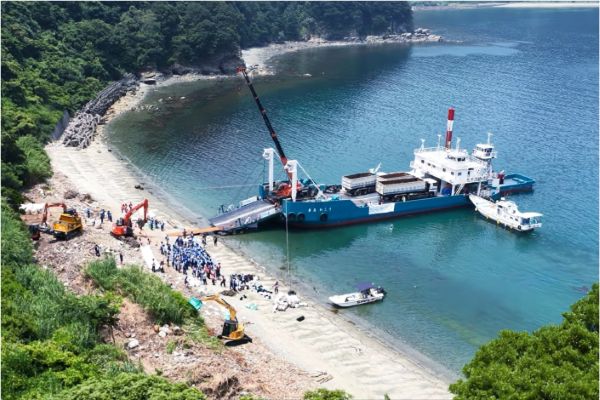
■Photo. Large-scale mobile collection model in action (Ikata Town, Ehime Prefecture)
*1 Helsinki Convention (nine countries): Baltic Sea Regional Action Plan on Marine Litter
*2 Barcelona Convention (21 countries): Regional Plan on Marine Litter Management in the Mediterranean
*3 The Nippon Foundation–Setouchi Oceans X
https://www.nippon-foundation.or.jp/what/projects/setouchi-oceansx
*2 Barcelona Convention (21 countries): Regional Plan on Marine Litter Management in the Mediterranean
*3 The Nippon Foundation–Setouchi Oceans X
https://www.nippon-foundation.or.jp/what/projects/setouchi-oceansx