Ocean Newsletter
No.600 December 20, 2025
What the End of the Kuroshio Large Meander Means
KEYWORDS
Kuroshio Large Meander / Ocean Circulation / Marine Heatwaves
MIYAMA Toru (Senior Researcher, Application Laboratory, Japan Agency for Marine-Earth Science and Technology)
The Kuroshio Large Meander, a large-scale ocean current meandering phenomenon occurring off the southern coast of Japan, continued for approximately seven years and nine months, from August 2017 to April 2025. This marked the longest meander on record. The occurrence of the large meander has had widespread impacts on climate, marine ecosystems, and fisheries, and reports have shown impacts on marine biological resources due to rising coastal water temperatures. Weather impacts have also been confirmed, including humid summers caused by marine heatwaves and increased precipitation. While the end of the large meander offers hope for future recovery of ecosystems and fisheries resources, ongoing global warming does not warrant optimism.
End of the Kuroshio Large Meander
On August 29, 2025, the Japan Meteorological Agency and the Japan Coast Guard announced that the Kuroshio Large Meander, which had persisted since August 2017, came to an end in April 2025*1.
The Kuroshio Large Meander is a phenomenon*2 in which a massive cold-core eddy (a counterclockwise cold eddy) forms between the Kuroshio Current and the southern coast of Japan and Honshu, as shown in Figure 1. The Kuroshio detours around this eddy, creating a large meander. The Kuroshio is one of the world’s most powerful warm currents and plays a major role in shaping Japan’s climate and marine ecosystems. Any change in its path can have wide-ranging impacts on climate, ecosystems, and fisheries. This is why considerable attention has been focused on the Kuroshio's return to a non-meandering state after 7 years and 9 months.
The ecological impacts of the Kuroshio Large Meander are diverse*3. For example, when a large meander occurs, the Kuroshio shifts closer to the coasts of the Kanto and Tokai regions, raising coastal water temperatures and causing marine heatwaves, which are extreme increases in ocean temperature (Figure 1). This inhibits seaweed growth, leading to a condition known as isoyake (rocky-shore denudation), which in turn affects organisms that depend on seaweeds such as abalone and spiny lobster.
In addition, during the recent large‑meander period, understanding of its impacts on weather has also progressed. Coastal marine heatwaves are said to have increased water vapor supply, leading to more humid summer conditions and higher rainfall in the Kanto and Tokai regions*4.
The Kuroshio Large Meander is a phenomenon*2 in which a massive cold-core eddy (a counterclockwise cold eddy) forms between the Kuroshio Current and the southern coast of Japan and Honshu, as shown in Figure 1. The Kuroshio detours around this eddy, creating a large meander. The Kuroshio is one of the world’s most powerful warm currents and plays a major role in shaping Japan’s climate and marine ecosystems. Any change in its path can have wide-ranging impacts on climate, ecosystems, and fisheries. This is why considerable attention has been focused on the Kuroshio's return to a non-meandering state after 7 years and 9 months.
The ecological impacts of the Kuroshio Large Meander are diverse*3. For example, when a large meander occurs, the Kuroshio shifts closer to the coasts of the Kanto and Tokai regions, raising coastal water temperatures and causing marine heatwaves, which are extreme increases in ocean temperature (Figure 1). This inhibits seaweed growth, leading to a condition known as isoyake (rocky-shore denudation), which in turn affects organisms that depend on seaweeds such as abalone and spiny lobster.
In addition, during the recent large‑meander period, understanding of its impacts on weather has also progressed. Coastal marine heatwaves are said to have increased water vapor supply, leading to more humid summer conditions and higher rainfall in the Kanto and Tokai regions*4.
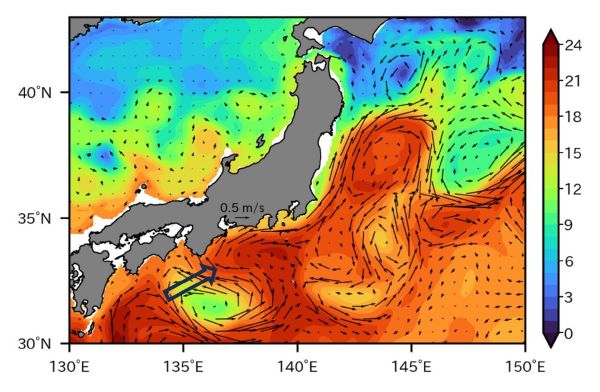
■Figure 1. Ocean Current Velocity and Temperature Distribution During the Kuroshio Large Meander (May 2023, Depth: 100m)
Monthly mean data for May 2023 showing ocean current velocity (m/s; indicated by arrows) and water temperature (°C; indicated by color) at a depth of 100 meters. This figure illustrates a typical example of the recent Kuroshio Large Meander. South of the Kii Peninsula, the strong Kuroshio Current bends significantly southward. During this period, the Kuroshio also exhibited a pronounced northward meander off the Pacific coast of the Tohoku region. The hollow arrows schematically indicate a “shortcut” flow where the Kuroshio proceeds directly without detouring. Data used to produce this figure were obtained from the JCOPE2M ocean reanalysis.
Characteristics that Made This Large Meander Unusual
The recent Kuroshio Large Meander, which began in 2017, lasted for 7 years and 9 months, making it the longest lasting among the six large‑meander events observed since 1965. It was an unusually prolonged event, exceeding the formerly longest duration, 4 years and 8 months, from 1975 to 1980, by more than three years.
The Kuroshio Large Meander is a natural phenomenon that has occurred repeatedly in the past, so the meander itself is not abnormal. However, it is the periodic transitions between a meandering path and non‑meandering path that determine a system’s ‘natural variability.’ If unfavorable environmental conditions are temporary, fishery resources and fisheries still have room to recover. But when such adverse conditions persist over long periods, they can lead to structural changes in ecosystems and the collapse of fishery foundations. In meteorology, the prolonged persistence of a single pressure pattern is regarded as an abnormal weather phenomenon caused by ‘blocking.’ Similarly, given the unusually long duration of the recent Kuroshio Large Meander, it is reasonable to view it as an anomalous event.
The Kuroshio Large Meander is a natural phenomenon that has occurred repeatedly in the past, so the meander itself is not abnormal. However, it is the periodic transitions between a meandering path and non‑meandering path that determine a system’s ‘natural variability.’ If unfavorable environmental conditions are temporary, fishery resources and fisheries still have room to recover. But when such adverse conditions persist over long periods, they can lead to structural changes in ecosystems and the collapse of fishery foundations. In meteorology, the prolonged persistence of a single pressure pattern is regarded as an abnormal weather phenomenon caused by ‘blocking.’ Similarly, given the unusually long duration of the recent Kuroshio Large Meander, it is reasonable to view it as an anomalous event.
Factors Behind the Prolonged Duration
Why did the recent large meander persist for such an unusually long time? The Kuroshio Large Meander is a phenomenon in which the current is impeded by a cold-water eddy. Typically, the meander ends when the Kuroshio strengthens and pushes the cold-water eddy eastward. All past large meander cases ended through this process. This time, however, the Kuroshio’s volume transport remained weak over an extended period, inhibiting its ability to push out the eddy and allowing the meander to persist.
The Kuroshio is driven by the subtropical circulation (a large-scale clockwise rotating system) generated by the westerlies and trade winds blowing over the Pacific (Fig. 2a). In recent years, the wind systems that form this circulation have shifted northward, causing a northward displacement of the subtropical circulation (Fig. 2b). As a result, the flow along the southern coast of Japan, where the Kuroshio has traditionally been strong, has weakened, and by contrast off the coast of the Tohoku region, where it was previously weaker, has grown stronger in influence, leading to a rise in water temperatures there (Fig. 1).
In fact, the recent Kuroshio Large Meander did not end in the usual way, that is, through the recovery of its strength. Instead, the meander grew to such an extreme that the core of the Kuroshio ‘short‑circuited’ across the narrowest part of the meander (indicated by the hollow arrows in Fig. 1), abruptly pushing the cold‑water eddy southward and bringing the event to a sudden end. Thus, the meander did not end through a strengthening of the Kuroshio, as in past cases. In this respect too, the recent Kuroshio was without precedent.
The Kuroshio is driven by the subtropical circulation (a large-scale clockwise rotating system) generated by the westerlies and trade winds blowing over the Pacific (Fig. 2a). In recent years, the wind systems that form this circulation have shifted northward, causing a northward displacement of the subtropical circulation (Fig. 2b). As a result, the flow along the southern coast of Japan, where the Kuroshio has traditionally been strong, has weakened, and by contrast off the coast of the Tohoku region, where it was previously weaker, has grown stronger in influence, leading to a rise in water temperatures there (Fig. 1).
In fact, the recent Kuroshio Large Meander did not end in the usual way, that is, through the recovery of its strength. Instead, the meander grew to such an extreme that the core of the Kuroshio ‘short‑circuited’ across the narrowest part of the meander (indicated by the hollow arrows in Fig. 1), abruptly pushing the cold‑water eddy southward and bringing the event to a sudden end. Thus, the meander did not end through a strengthening of the Kuroshio, as in past cases. In this respect too, the recent Kuroshio was without precedent.
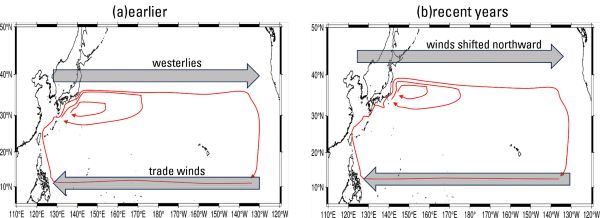
■Figure 2. Schematic Diagram of the Subtropical Ocean Circulation Driven by the Westerlies and the Trade Winds
Comparison between (a) earlier and (b) recent years. The thick gray arrows represent the winds, and the clockwise red arrows indicate the subtropical ocean circulation. The triple red arrows indicate the strength of the Kuroshio flow in the western part of the subtropical circulation. Compared with earlier conditions, this strong Kuroshio flow has shifted northward in recent years.
Future Outlook
Although the Kuroshio Large Meander has ended, the cold-water eddies that were pushed out continued to interact with the main current, and the aftereffects persisted for some time. Although the meander ended in April, the official announcement was not made until August because a period was needed to confirm the stability of the current path after the meander had subsided. The aftereffects are now subsiding, and the Kuroshio is returning to a flow path close to its normal state. For this reason, the negative impacts on fisheries and other sectors are expected to gradually ease.
However, the recent termination was not due to a recovery in the strength of the Kuroshio, and the underlying northward shift in the wind systems continues. The northward migration of the wind field may involve not only natural oscillatory components associated with decadal-scale variability in the North Pacific, but also changes in large-scale circulation driven by global warming. Therefore, if the right trigger occurs, conditions will likely remain favorable for another Kuroshio Large Meander to develop.
Over the approximately eight years of the large meander, global warming progressed steadily, meaning the ocean environment cannot be expected to return to its previous state now that the meander has terminated. Expecting the ocean to return to its former state may be overly optimistic, but the prolonged Kuroshio Large Meander event offered a valuable opportunity to understand the changing marine environment and to consider adaptation strategies. Our understanding has certainly advanced regarding the stability of large-scale current systems, the causal links between ocean circulation and regional climate, and the responses of ecosystems. Applying the insights gained from this experience to policies such as ocean forecasting, fisheries management, and disaster-prevention planning will be an important step toward the next era.
However, the recent termination was not due to a recovery in the strength of the Kuroshio, and the underlying northward shift in the wind systems continues. The northward migration of the wind field may involve not only natural oscillatory components associated with decadal-scale variability in the North Pacific, but also changes in large-scale circulation driven by global warming. Therefore, if the right trigger occurs, conditions will likely remain favorable for another Kuroshio Large Meander to develop.
Over the approximately eight years of the large meander, global warming progressed steadily, meaning the ocean environment cannot be expected to return to its previous state now that the meander has terminated. Expecting the ocean to return to its former state may be overly optimistic, but the prolonged Kuroshio Large Meander event offered a valuable opportunity to understand the changing marine environment and to consider adaptation strategies. Our understanding has certainly advanced regarding the stability of large-scale current systems, the causal links between ocean circulation and regional climate, and the responses of ecosystems. Applying the insights gained from this experience to policies such as ocean forecasting, fisheries management, and disaster-prevention planning will be an important step toward the next era.
*1 Japan Meteorological Agency & Japan Coast Guard: Press Release on the End of the Kuroshio Large Meander (August 29, 2025)
https://www.jma.go.jp/jma/press/2508/29a/20250829_end_of_kuroshioLM.html
*2 Toru Miyama, “The Kuroshio Large Meander and its Impacts,”
No.448 of this newsletter (April 5, 2019)
https://www.spf.org/opri/en/newsletter/448_1.html
*3 Akira Kusaka, “Kuroshio Large Meander: Its Mechanism and Impact on Fisheries” FRA NEWS Vol. 73 (January 17, 2023)
https://www.fra.go.jp/home/kenkyushokai/book/franews/files/fnews73.pdf#page=8.00
*4 Shusaku Sugimoto “Marine Heatwave off Tokai, Japan, attributed to the Kuroshio Large Meander Path, and an associated increase in summer rainfall over Japan” Tohoku University press release (December 23, 2024)
https://www.tohoku.ac.jp/japanese/2024/12/press20241223-02-kuroshio.html
https://www.jma.go.jp/jma/press/2508/29a/20250829_end_of_kuroshioLM.html
*2 Toru Miyama, “The Kuroshio Large Meander and its Impacts,”
No.448 of this newsletter (April 5, 2019)
https://www.spf.org/opri/en/newsletter/448_1.html
*3 Akira Kusaka, “Kuroshio Large Meander: Its Mechanism and Impact on Fisheries” FRA NEWS Vol. 73 (January 17, 2023)
https://www.fra.go.jp/home/kenkyushokai/book/franews/files/fnews73.pdf#page=8.00
*4 Shusaku Sugimoto “Marine Heatwave off Tokai, Japan, attributed to the Kuroshio Large Meander Path, and an associated increase in summer rainfall over Japan” Tohoku University press release (December 23, 2024)
https://www.tohoku.ac.jp/japanese/2024/12/press20241223-02-kuroshio.html