Ocean Newsletter
No.599 November 20, 2025
-
Discussion on Marine Geoengineering under the London Protocol
-
Technologies for Enhancing the Ocean's Carbon Dioxide Absorption Capacity
-
Pollution in Rivers and Oceans by Pharmaceuticals: What Are the Impacts on Ecosystems?
Pollution in Rivers and Oceans by Pharmaceuticals: What Are the Impacts on Ecosystems?
KEYWORDS
Environmental pharmaceuticals / Impacts on behavior / Effects on reproduction
SOYANO Kiyoshi (Director/Professor, Organization for Marine Science and Technology, Nagasaki University)
We use many pharmaceuticals in our daily lives. These pharmaceuticals are released into aquatic environments through sewage treatment plants, and it is becoming increasingly clear that they affect the organisms living there. In particular, pharmaceuticals that act on the nervous system can cause abnormalities in fish behavior and reproduction. Because pharmaceuticals are essential for maintaining human health, it is necessary to correctly understand their biological effects and consider how we can coexist with them.
The actual state of pharmaceutical contamination in aquatic environments
Pharmaceuticals and their derivative chemical substances (e.g., metabolites) that are present in the environment are referred to as environmental pharmaceuticals. In modern society, people are exposed to various stressors and rely on different medications to cope with them. Moreover, the aging of the population has contributed to an even greater demand for pharmaceuticals. Hospital prescription data was analyzed to estimate which pharmaceutical compounds are being released into the environment. The findings indicated that medications for peptic ulcers are the most frequently prescribed in Japan. Substantial prescription volumes are also observed for pharmaceuticals acting on the nervous system, including antihypertensive agents, vasodilators, antiallergic medications, and central nervous system drugs. In recent years, prescriptions for antidepressants have also been increasing. These pharmaceuticals typically target G protein-coupled receptors (GPCR)*1, which play a key role in transmitting signals between neurons, as well as various membrane transporters*2 in neurons. These pharmaceuticals are designed to alleviate symptoms by modulating neurotransmission. However, as fish are also vertebrates, pharmaceuticals that enter their bodies can act on their nervous systems and may induce behavioral or physiological changes.
To what extent, are pharmaceuticals that act on the nervous system present in aquatic environments? A research group from Kanagawa University and Kochi University measured the concentrations of more than 70 pharmaceuticals and their metabolites at multiple sites, including sewage discharge points, within the Yodo River system and the Tsurumi River (Environmental Research and Technology Development Fund 5-2204). According to the findings, pharmaceuticals acting on the nervous system, including antidepressants, were detected near the effluent outlets of sewage treatment plants. Some of these substances exhibited high pharmacological activity at concentrations that may affect fish. Furthermore, the patterns of pharmaceuticals detected in the rivers were similar between the Yodo River system and the Tsurumi River, indicating that discharge via sewage treatment plants is a common phenomenon (Figure 1). Although measurement data for marine environments is not yet available, many sewage treatment plants have discharge outlets near river mouths, suggesting that similar conditions are likely occurring in coastal waters.
To what extent, are pharmaceuticals that act on the nervous system present in aquatic environments? A research group from Kanagawa University and Kochi University measured the concentrations of more than 70 pharmaceuticals and their metabolites at multiple sites, including sewage discharge points, within the Yodo River system and the Tsurumi River (Environmental Research and Technology Development Fund 5-2204). According to the findings, pharmaceuticals acting on the nervous system, including antidepressants, were detected near the effluent outlets of sewage treatment plants. Some of these substances exhibited high pharmacological activity at concentrations that may affect fish. Furthermore, the patterns of pharmaceuticals detected in the rivers were similar between the Yodo River system and the Tsurumi River, indicating that discharge via sewage treatment plants is a common phenomenon (Figure 1). Although measurement data for marine environments is not yet available, many sewage treatment plants have discharge outlets near river mouths, suggesting that similar conditions are likely occurring in coastal waters.
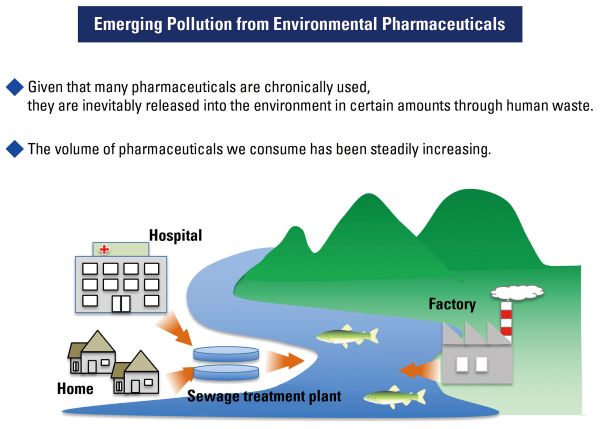
■Figure 1. Entry of consumed pharmaceuticals into aquatic environments
Impacts on Fish Behavior and Reproductive Function
To clarify the effects of neuroactive pharmaceuticals on fish, exposure experiments were conducted in which several such compounds were dissolved in rearing water and the responses of fish were observed. The fish species used were medaka (Oryzias latipes) and ayu (Plecoglossus altivelis), both freshwater species, as well as grey mullet (Mugil cephalus), a marine species. These fish were exposed to various concentrations of the neuroactive antidepressants mirtazapine and amitriptyline, and the antipsychotic chlorpromazine, and their behavioral responses were observed. All species clearly exhibited abnormal behavior, with surface‑oriented swimming observed in every case. This behavior was particularly pronounced in medaka. While unexposed individuals swam freely throughout the tank, the swimming of exposed medaka became confined to the upper one-third of the tank. The pharmacological activities of the pharmaceuticals that induced these phenomena were close to those found in river water (near sewage treatment plant discharge outlets). This suggests that such abnormal behaviors could also occur in natural rivers. Unlike in tanks, surface‑oriented swimming in rivers clearly increases the risk of predation by birds and other organisms, which would inevitably lead to population declines. In the fathead minnow (Pimephales promelas), a cyprinid species, exposure to antidepressants decreases the normally observed behavior of avoiding light and seeking shelter, leading them to spend more time in illuminated areas. This is also an abnormal behavior that increases predation risk. The behaviors of fish induced by pharmaceuticals often differ between species. In ayu, behavioral abnormalities such as remaining motionless on the bottom of the tank or adopting a vertical swimming posture (similar to the “nose‑up” behavior commonly observed in fish under hypoxic conditions) were observed. Thus, although the forms of expression differ, it is clear that pharmaceuticals acting on the nervous system induce abnormal behaviors.
Impacts on Ecosystems and Next‑Generation Production
Behavioral abnormalities caused by environmental pharmaceuticals also affect reproduction. In ayu, spawning is completed when males and females swim side by side against the current while releasing sperm and eggs. However, pharmaceuticals reduce the ability of fish to swim against the current. This constitutes behavioral inhibition that interferes with normal fertilization and can ultimately lead to a reduction in the population of the next generation. In medaka, exposure to antidepressants reduced their number of fertilized eggs, as in the behavioral tests. Unlike in ayu, where spawning behavior is suppressed, this reduction resulted not from inhibited spawning activity, but from pharmaceutical‑induced inhibition of oocytes development (the precursor cells of eggs) within the ovaries. Thus, in addition to acting on the nervous system to alter behavior, pharmaceuticals likely also affect the regulatory mechanisms that control gamete development in the gonads. In this way, exposure to pharmaceuticals reduces the reproductive capacity of fish. In the reproductive processes (production of next generation), securing a stable supply of fertilized eggs is critical. If this does not occur normally, maintaining the ecosystem becomes difficult.
Previous studies have shown that among pharmaceuticals acting on the nervous system, those targeting GPCRs and transporters, in particular, (1) induce abnormal behaviors in fish and (2) affect gamete production within the gonads (Figure 2). Although empirical evidence regarding the occurrence of environmental pharmaceuticals in aquatic environments and their biological effects remains limited, we must not overlook the possibility that these substances may affect ecosystems. Pharmaceuticals are indispensable for humans, playing an essential role in treating disease. At the same time, ecosystem degradation can create new sources of stress. Therefore, it is necessary to deepen our understanding of environmental pharmaceutical pollution and its effects on fish, and to actively promote the development of pharmaceuticals designed to have a reduced environmental impact.
Previous studies have shown that among pharmaceuticals acting on the nervous system, those targeting GPCRs and transporters, in particular, (1) induce abnormal behaviors in fish and (2) affect gamete production within the gonads (Figure 2). Although empirical evidence regarding the occurrence of environmental pharmaceuticals in aquatic environments and their biological effects remains limited, we must not overlook the possibility that these substances may affect ecosystems. Pharmaceuticals are indispensable for humans, playing an essential role in treating disease. At the same time, ecosystem degradation can create new sources of stress. Therefore, it is necessary to deepen our understanding of environmental pharmaceutical pollution and its effects on fish, and to actively promote the development of pharmaceuticals designed to have a reduced environmental impact.
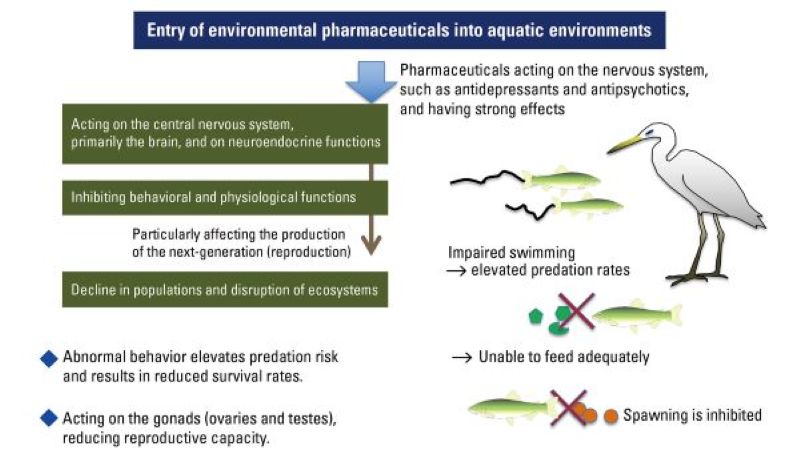
■Figure 2. Effects of environmental pharmaceuticals on fish and aquatic ecosystems
*1 GPCRs (G protein–coupled receptors) are receptors that receive neurotransmitters, which transmit signals between nerve cells. If neurotransmitters are considered the “keys,” then GPCRs serve as the corresponding “keyholes,” and the two have a highly specific relationship.
*2 Transporters are responsible for removing (reuptaking) neurotransmitters required for neural signaling, and are located at the nerve endings (synapses). If GPCRs act as regulatory elements that mediate signal transmission, transporters serve as regulatory elements that terminate or clear those signals.
*2 Transporters are responsible for removing (reuptaking) neurotransmitters required for neural signaling, and are located at the nerve endings (synapses). If GPCRs act as regulatory elements that mediate signal transmission, transporters serve as regulatory elements that terminate or clear those signals.