Ocean Newsletter
No.595 July 20, 2025
-
Ocean Science and Policy Nexus – UNOC3 and Beyond
-
The Future of the "Smart Ocean” initiative Led by the Institute of Science Tokyo
-
Tackling the Marine Debris Problem with IT –Transformation Brought About by Data Visualization–
-
Protecting the Sea of Sakushima -Eelgrass conservation activities initiated by children
Protecting the Sea of Sakushima -Eelgrass conservation activities initiated by children
KEYWORDS
Integrated learning period (Shiokaze Learning) / Development of remote islands / Education for sustainable development (ESD)
MITSUYA Yukiko (Assistant Section Chief, Sakushima Promotion Section, Exchange and Co-Creation Department, Nishio City, Aichi Prefecture)
On Sakushima Island, located in Mikawa Bay, Aichi Prefecture, with a population of 170 people, children are taking the lead in eelgrass restoration activities at Shiosai School, a combined elementary and junior high compulsory education school where more than half of the students commute from the mainland. This activity will mark its 23rd year in 2025 and has simultaneously created a place to conserve and restore the sea and to learn. As a pillar for the development of remote islands, which are facing population decline, we would like to keep this light burning and continue forward together.
Sakushima Island, Nishio City, Aichi Prefecture
Two hours south of Nagoya City, Aichi Prefecture, by train, bus, and boat, Sakushima, floating in Mikawa Bay surrounded by the Chita Peninsula and Atsumi Peninsula, is the largest of Aichi Prefecture's three inhabited remote islands. The total coastline is approximately 11 km. In 1954, it was incorporated into what was then Isshiki Town, and in 2011, Isshiki Town merged with Nishio City. Fragments of Jomon pottery have been discovered, and over 50 burial mounds from the late Kofun period have been confirmed, indicating human activity on the island since ancient times. During the Edo period, the island prospered in the shipping industry, owning large wooden freight ships, and during the Showa era, it bustled with beachgoers and other tourists, with as many as 40 guesthouses lining up side by side. However, with the diversification of tourism needs and the lack of progress in development plans based on resort concepts, the number of tourists gradually decreased year by year.
The population of Sakushima, which once had as many as 1,600 residents, is now just over 170 people. Due to the limited employment opportunities and the inconvenience of daily life, people have gradually moved away from the island, and as a result, the island is facing declining birthrates and an aging population.
The population of Sakushima, which once had as many as 1,600 residents, is now just over 170 people. Due to the limited employment opportunities and the inconvenience of daily life, people have gradually moved away from the island, and as a result, the island is facing declining birthrates and an aging population.
Island revitalization through art and the Association to Make the Island Beautiful
In 1996, the town launched revitalization efforts through contemporary art as part of the island development strategy. At the same time, the Association to Make the Island Beautiful, composed of island residents, was established, and the efforts of people who care about the island began. The art project was driven forward by an art director. Through this initiative, island residents came to recognize the value of their everyday surroundings, such as the black-walled village and the daffodils blooming along the roadside, elements of the landscape that had blended into daily life and gone unnoticed. Consequently, they focused their efforts on activities that addressed the island's current situation, including environmental conservation of the sea and countryside, and landscape preservation. These activities included preserving the black-walled village, maintaining the satoyama landscape, collecting coastal debris, and restoring eelgrass beds. These activities could not be implemented by island residents alone, and were initiated with the help of people from outside the island.
Sakushima Shiosai School
The island has an elementary school and a junior high school, but the trend of depopulation has affected these as well. Faced with the declining number of children year by year, the Association to Make the Island Beautiful conveyed its concerns to Isshiki Town (as it was known at the time). "We cannot let children's smiles and voices disappear from this island." In FY2003, a small-scale special school system (also known as “Shiokaze Commuting”) began accepting students from outside the Sakushima school district. Children commuting from the mainland, known as “Shiokaze-san,” began arriving every morning by ferry. In April 2019, Sakushima Shiosai School opened as Aichi Prefecture's first compulsory education school, combining both elementary and junior high school. Of the 21 students currently enrolled, only five are elementary and junior high school students living on the island, with “Shiokaze-san” accounting for more than half.
As part of the school’s curriculum, during the integrated learning period (Shiokaze Learning), all students engage with the island by exploring its history, tourism, and environmental issues. In 2002, the eelgrass restoration activity began with one student's wish: “I want to become a fisherman who can protect our own sea myself.” The student began researching the island's sea, focusing on eelgrass, while investigating the causes of fish population decline. According to the fishermen, they all said that in the past, the area used to be completely covered with eelgrass. This led to the realization that increasing eelgrass was essential to enriching the island's sea.
In the first year of the restoration project, eelgrass was cultivated from seeds. They learned seed cultivation methods from the Aichi Prefectural Fisheries Research Institute, and by devising their own methods they managed to sow eelgrass seeds and successfully reach the germination stage. In the third year of the project, after trying various methods, they arrived at the jute bag method, which had the highest success rate. This method involves sewing jute into a bag shape with a sewing machine, filling it with sand mixed with eelgrass seeds, and sealing the bag. The bags are then submerged offshore, away from the coast where there is minimal wave action and sand movement. At the same time, they learned about a method involving the transplantation of eelgrass roots from areas with vigorous growth. They immediately began working with the fishermen and confirmed that new eelgrass habitats had expanded.
Through these activities, the students realized that in order to preserve biodiversity, it is necessary to protect not only the marine environment but also the mountain environment, and their activities began to expand. In FY2025, the eelgrass restoration project marks its 23rd year, and since its very first year, children have consistently taken the lead in carrying out the activities. Throughout the year, using eelgrass, a familiar plant, as their textbook, they develop a deep affection for the island’s nature. And realizing that their activities hold significant social value, they have become a source of motivation for them (see Table 1).
As part of the school’s curriculum, during the integrated learning period (Shiokaze Learning), all students engage with the island by exploring its history, tourism, and environmental issues. In 2002, the eelgrass restoration activity began with one student's wish: “I want to become a fisherman who can protect our own sea myself.” The student began researching the island's sea, focusing on eelgrass, while investigating the causes of fish population decline. According to the fishermen, they all said that in the past, the area used to be completely covered with eelgrass. This led to the realization that increasing eelgrass was essential to enriching the island's sea.
In the first year of the restoration project, eelgrass was cultivated from seeds. They learned seed cultivation methods from the Aichi Prefectural Fisheries Research Institute, and by devising their own methods they managed to sow eelgrass seeds and successfully reach the germination stage. In the third year of the project, after trying various methods, they arrived at the jute bag method, which had the highest success rate. This method involves sewing jute into a bag shape with a sewing machine, filling it with sand mixed with eelgrass seeds, and sealing the bag. The bags are then submerged offshore, away from the coast where there is minimal wave action and sand movement. At the same time, they learned about a method involving the transplantation of eelgrass roots from areas with vigorous growth. They immediately began working with the fishermen and confirmed that new eelgrass habitats had expanded.
Through these activities, the students realized that in order to preserve biodiversity, it is necessary to protect not only the marine environment but also the mountain environment, and their activities began to expand. In FY2025, the eelgrass restoration project marks its 23rd year, and since its very first year, children have consistently taken the lead in carrying out the activities. Throughout the year, using eelgrass, a familiar plant, as their textbook, they develop a deep affection for the island’s nature. And realizing that their activities hold significant social value, they have become a source of motivation for them (see Table 1).
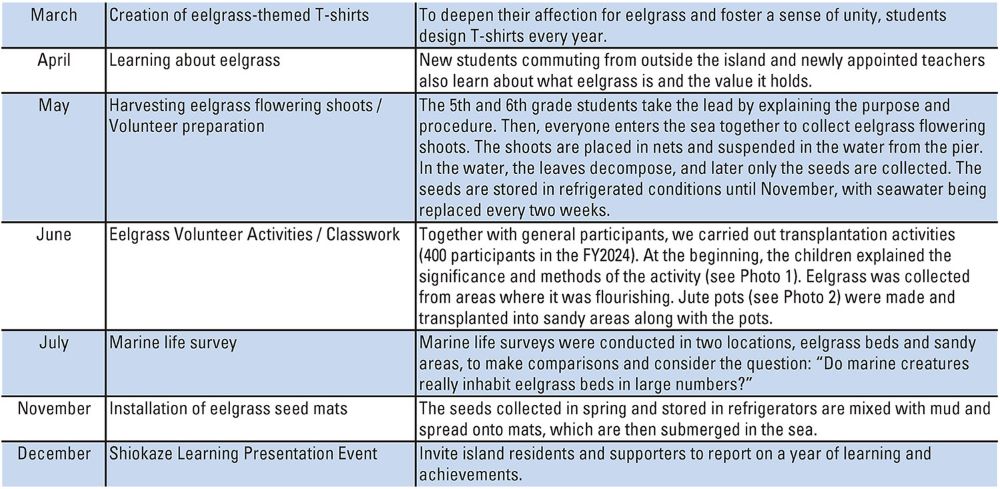
■ Figure1 Annual Plan for Eelgrass Restoration Activities
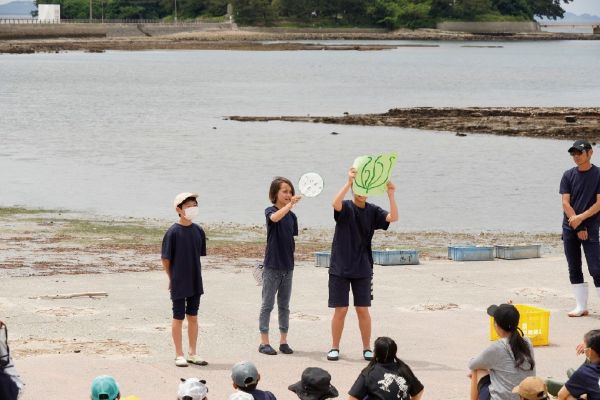
■ Picture 1 Children presenting their explanation
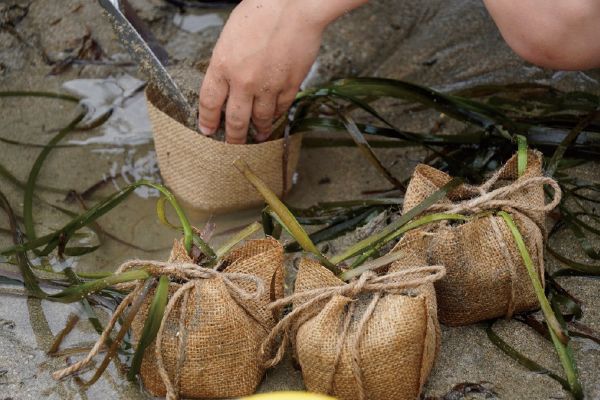
■ Picture 2 Jute pots for eelgrass
Preserving our hometown for the future
Senda-san, a third-year student in the latter course at Shiosai School, said: Sakushima is a small island, and in recent years, its population has been declining. After I graduate from this school, I will be leaving the island, but Sakushima will always be my hometown. Through this activity, I hope more people will come to know the charm of the island, so that it can remain the same beloved hometown it has always been.”
The eelgrass restoration activities on Sakushima have been led by children for over 20 years, simultaneously creating a place for marine conservation, restoration, and learning. The achievements of eelgrass conservation built by the children are our great pride. As one of the pillars of development of remote islands facing population decline, we hope to keep this light burning and continue walking together toward a bright future for Sakushima.
The eelgrass restoration activities on Sakushima have been led by children for over 20 years, simultaneously creating a place for marine conservation, restoration, and learning. The achievements of eelgrass conservation built by the children are our great pride. As one of the pillars of development of remote islands facing population decline, we hope to keep this light burning and continue walking together toward a bright future for Sakushima.