News
The Ocean-Climate Nexus, Financial Reforms, and Institutional Synergies: Integrated Policy Commentary on SB64
2026.06.16
Bonn Climate Change Conference (SB64) | Mid-Session Briefing – June 16, 2026
Dr. Santosh Kumar Rauniyar, Project Lead & Research Fellow
Dr. Santosh Kumar Rauniyar, Project Lead & Research Fellow
Executive Summary
June 8, 2026, marked the opening of the sixty-fourth sessions of the UNFCCC Subsidiary Bodies (SB64) on World Oceans Day, establishing a powerful baseline that elevated marine conservation and governance into the core of global climate diplomacy. Within the Subsidiary Bodies and the broader UNFCCC process, ocean-climate action has transitioned from a marginal interest to a central structural pillar. This commentary analyzes how the successful conclusion of the Annual Ocean and Climate Change Dialogue, the launch of the Veredas Dialogue (under Decision 11/CMA.7 during the COP30 climate summit in Belém, Brazil) and terrestrial-marine synergies have created an unprecedented momentum for ocean governance leading to COP31 in Antalya, Türkiye.
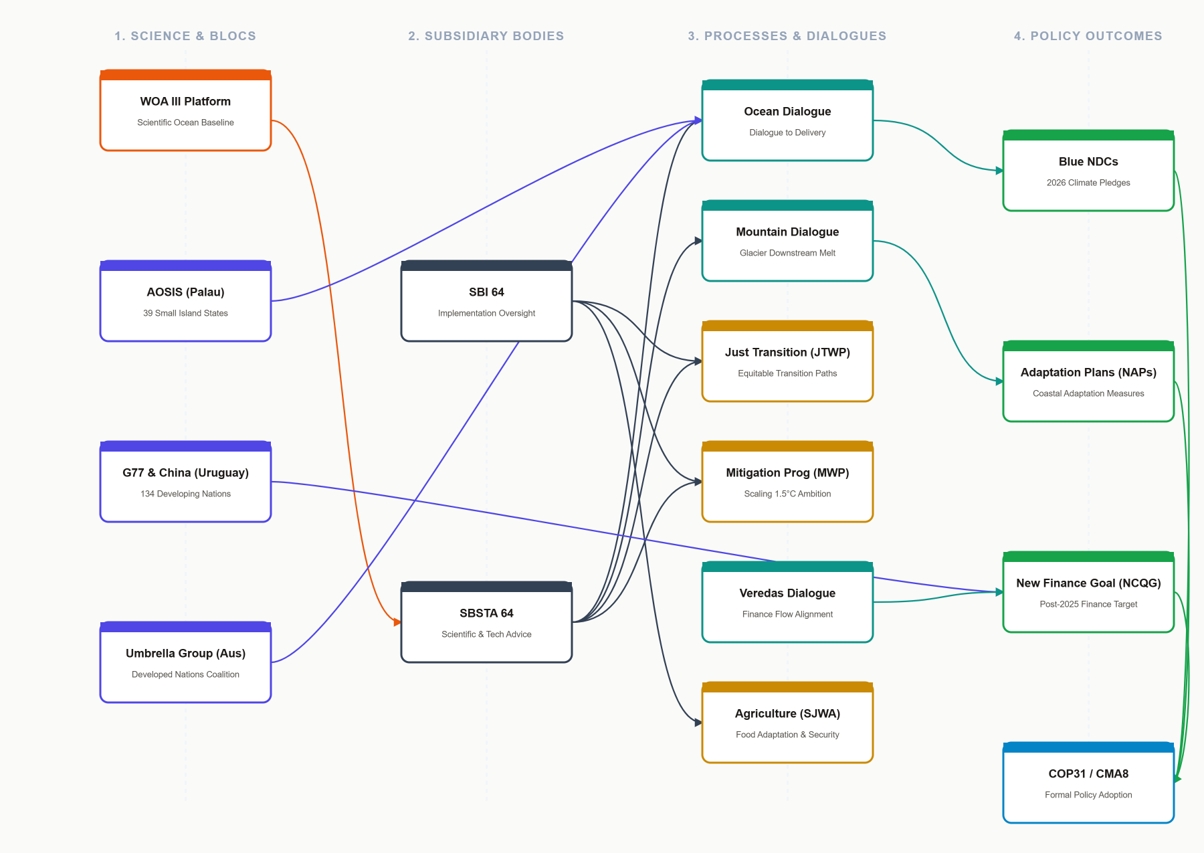
Figure 1. UNFCCC Ocean-Climate Policy Architecture Map
The systemic integration of these policy pathways is illustrated in Figure 1. Rather than treating dialogues as isolated discussion spaces, the current UNFCCC architecture establishes concrete tracks that link baseline sciences directly with national implementation commitments.
As mapped in Figure 1, scientific baselines (such as the Third World Ocean Assessment) serve as the foundation, flowing into the subsidiary bodies (SBSTA and SBI). These bodies oversee the mandated dialogues (Ocean & Mountains), which subsequently output into national policy tools, namely Blue NDCs (Nationally Determined Contributions) and NAPs (National Adaptation Plans). This architectural roadmap demonstrates that marine policies are now systematically embedded in the central Paris Agreement negotiating tracks leading toward adoption at COP31/CMA8.
As mapped in Figure 1, scientific baselines (such as the Third World Ocean Assessment) serve as the foundation, flowing into the subsidiary bodies (SBSTA and SBI). These bodies oversee the mandated dialogues (Ocean & Mountains), which subsequently output into national policy tools, namely Blue NDCs (Nationally Determined Contributions) and NAPs (National Adaptation Plans). This architectural roadmap demonstrates that marine policies are now systematically embedded in the central Paris Agreement negotiating tracks leading toward adoption at COP31/CMA8.
1. Geopolitical and Financial Landscapes: Veredas Dialogue
The opening day's energy security focus, triggered by the Strait of Hormuz blockade, served as a core backdrop for negotiations, aligning the transition away from fossil fuels with national sovereignty and economic security. In response, finance discussions focused on structural reforms during the Veredas Dialogue (June 9–10) under the Brazilian COP30 Presidency.
- Veredas Dialogue: Addressed the alignment of global finance flows with Paris Agreement Article 2.1(c), focusing on reducing international investment barriers and mitigating the high cost of capital that restricts transition pathways in developing nations.
- Overtime Discussions: Negotiations on the New Collective Quantified Goal (NCQG) on climate finance and Global Goal on Adaptation (GGA) indicator methodologies faced deep divergences, with draft text sessions running into overtime by June 11.
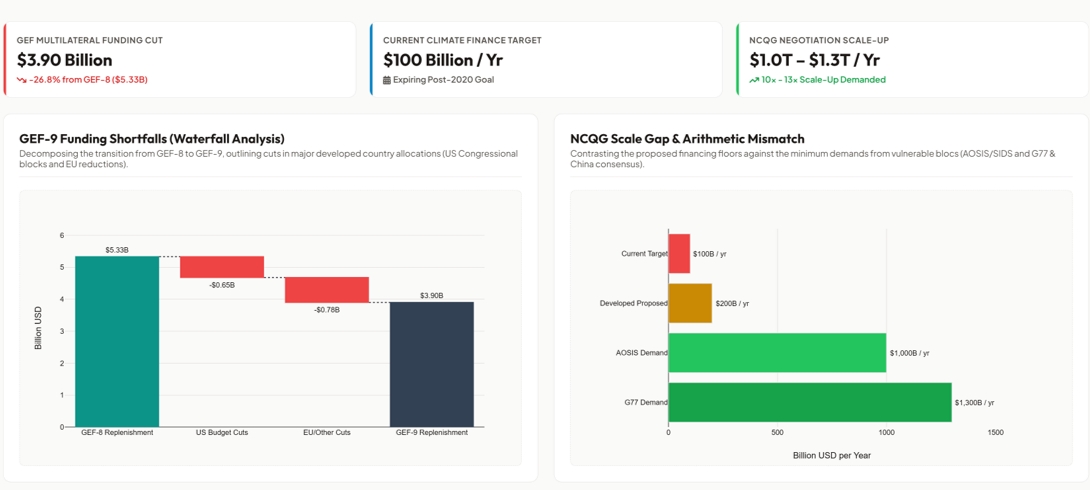
Figure 2. GEF-9 Replenishment Cuts and NCQG Negotiation Scale Gap
Figure 2 illustrates the dual financial challenges blocking higher climate ambition. First, the waterfall analysis details a $1.43 Billion (26.8%) funding drop in transitioning from the GEF-8 cycle ($5.33B) to the GEF-9 cycle ($3.90B). This deficit is driven by a US Congressional budget block (-$0.65 Billion) and EU/Other member allocation reductions (-$0.78 Billion). Second, the scale gap chart exposes a massive 13-fold arithmetic mismatch: developed country proposals suggest a floor of $200 Billion per year (relying on private mobilization), whereas AOSIS/SIDS demand a minimum of $1.0 Trillion per year in public, grant-based adaptation finance, and the G77 & China consensus stands at $1.3 Trillion per year. This scale gap remains the primary diplomatic obstacle in Bonn.
2. The Ocean-Climate Nexus: Outcomes from the Dialogue
The mandated Annual Ocean and Climate Change Dialogue (June 10–11) convened in Plenary Room New York. On June 10, the first day session was convened by subsidiary body of implementation (SBI) chair Julia Gardiner and subsidiary body for scientific and technological advice (SBSTA) vice chair Dr. Carol Franco. On June 11, it was facilitated by Dr. Sivendra Michael (Fiji) and Ulrik Lenaerts (Belgium), the dialogue focused on moving from "dialogue to delivery" across three core pillars: Pillar 1: Integrating Ocean-Based Solutions into Nationally Determined Contributions (NDCs); Pillar 2: Unlocking Predictable and Accessible Ocean-Related Climate Finance (Means of Implementation); and Pillar 3: Enhancing Ocean-Climate-Biodiversity Synergies and Policy Coherence.
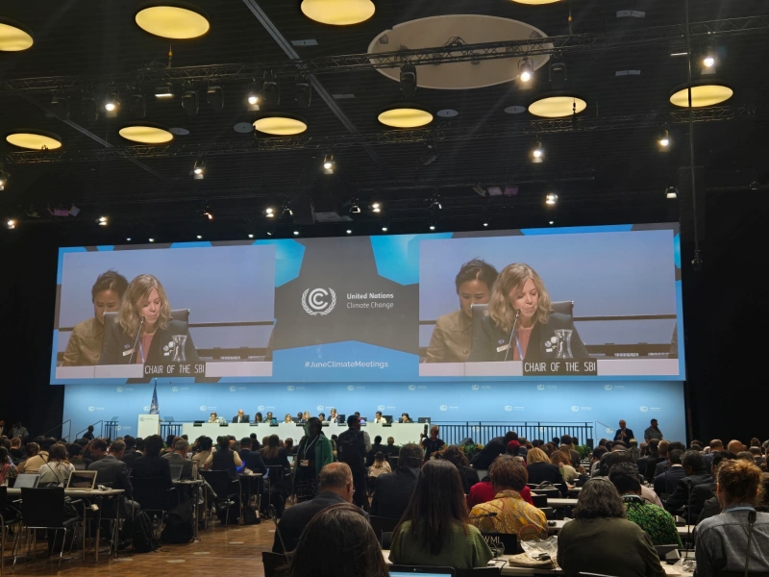
a. Chair of the Subsidiary Body for Implementation (SBI), Julia Gardiner convening the Ocean Dialogue at Subsidiary Bodies meeting (SB 64), June 10, 2026.
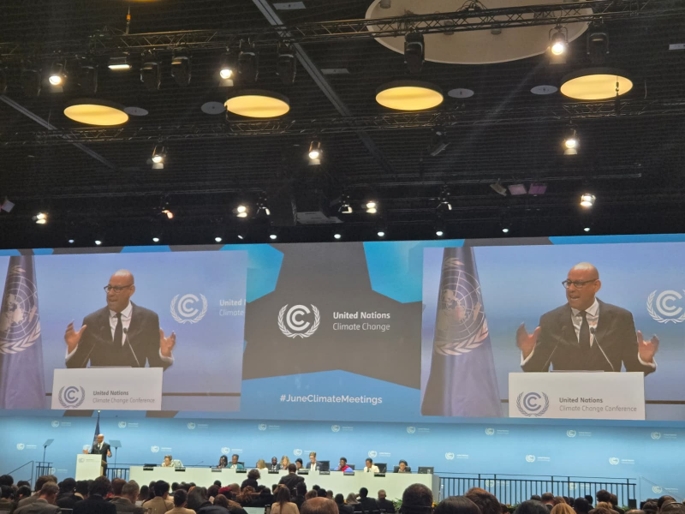
b. Simon Stiell Executive Secretary of United Nations Climate Change (UNCC) providing the Opening Keynote Address at first day of Ocean Dialogue at Subsidiary Bodies meeting (SB 64), June 10, 2026.
Pillar 1: Integrating Ocean-Based Solutions into NDCs
Focusing on the global "Blue NDC Challenge" originally launched by Brazil and France to place oceans at the heart of NDCs, Beatriz Soares da Silva (Brazil) highlighted the expansion of blue carbon initiatives. Kassim Gawusu-Toure (African Group of Negotiators, Oceans Lead Coordinator) spoke on coastal adaptation, and Jonathan Baines (World Resources Institute) promoted the newly established Blue NDC Implementation Taskforce to translate commitments into cross-sectoral, local action.
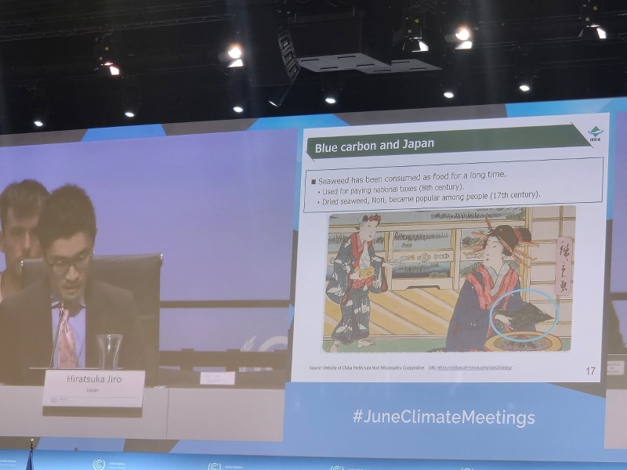
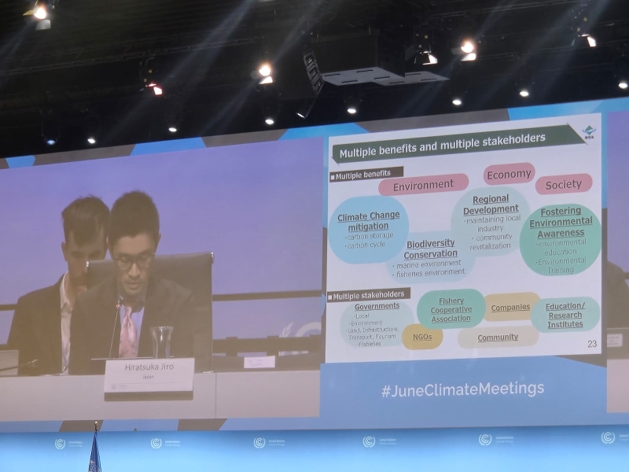
Photo: Hiratsuka Jiro, Director of the Office of Climate Change Negotiation and Cooperation, Ministry of the Environment, Japan presenting Japan’s initiation in promoting sustainable blue carbon ecosystem with particular focus on nature-based solutions (NbS)
The director of Climate Change Negotiation and Cooperation, Ministry of Environment of Japan Mr. Jiro emphasized that NDCs must transition from speculative commitments to project pipelines. Expanding blue carbon (mangroves, seagrasses) acts as a double-dividend policy that simultaneously drives carbon sequestration and builds physical shoreline resilience against extreme weather events. His presentations further illustrated concrete pathways: Japan has progressed on marine management and seagrass restoration as blue carbon projects. In addition, Kenya representative shared the policy framework preparing Mombasa to host the 11th Our Ocean Conference between June 16-18, highlighting marine spatial planning and ocean-based economic models.
Pillar 2: Unlocking Predictable and Accessible Ocean-Related Climate Finance
Pillar 2 addresses the Means of Implementation (MOI) for ocean-climate action, specifically focusing on unlocking and scaling predictable, accessible, and adequate finance. A key consensus was that a significant proportion of developing countries and Small Island Developing States (SIDS) have framed their ocean-based climate actions as conditional upon external support in their NDCs. Unlocking this finance requires establishing clear public-private investment pipelines and integrating ocean priorities into the NCQG negotiations.
Pillar 3: Enhancing Ocean-Climate-Biodiversity Synergies and Policy Coherence
Speakers including Leel Randeni (Sri Lanka), Iván Vejar (Chile, Head of Climate Change and Environment Department), Alessandra Lamotte (European Commission), and Valentina Germani (UN DOALOS) discussed enhancing synergies between climate, biodiversity, and ocean processes (aligning NDCs, NAPs, and NBSAPs), utilizing the newly launched Third World Ocean Assessment (WOA III) web platform as the scientific baseline. This panel session is illustrated in Figure 6.
The second day of the Ocean Dialogue (June 11) featured an interactive 'World Café' format in Plenary Room New York, splitting the session into 9 distinct breakout tables of 10 to 20 participants. The groups rotated across three main topics: Topic A examined barriers and early-mover experiences in scaling up ocean-related NDCs; Topic B targeted Means of Implementation (MOI) to unlock predictable finance for SIDS and LDCs; and Topic C focused on ocean-climate-biodiversity synergies to break policy silos. Rapporteurs synthesized the breakout discussions into unified recommendations to formally influence negotiations. The logical flow of these policy synergies is mapped in Figure 3. The Sankey diagram tracks the structural flow of mandates and information. It illustrates how the WOA III scientific baseline feeds directly into SBSTA 64, which in turn oversees both the Ocean and Mountain Dialogues. The recommendations from these dialogues flow into national adaptation plans and Blue NDCs, showing the exact policy pathways from baseline science to COP31.
Glacier-to-Ocean Downstream Synergies
Linking the marine agenda to terrestrial highlands, the mandated Dialogue on Mountains and Climate Change (June 12), co-facilitated by Sonam Tashi (Bhutan) and Saskia Sanders (Switzerland), addressed the downstream effects of glacier melt on water security, food systems, and downstream marine habitats. Delegates emphasized that ocean conservation and mountain adaptation are physically and ecologically linked. Glacial runoff determines delta sediment levels and estuary salinity, making high-altitude cryosphere conservation a direct prerequisite for coastal delta survival.
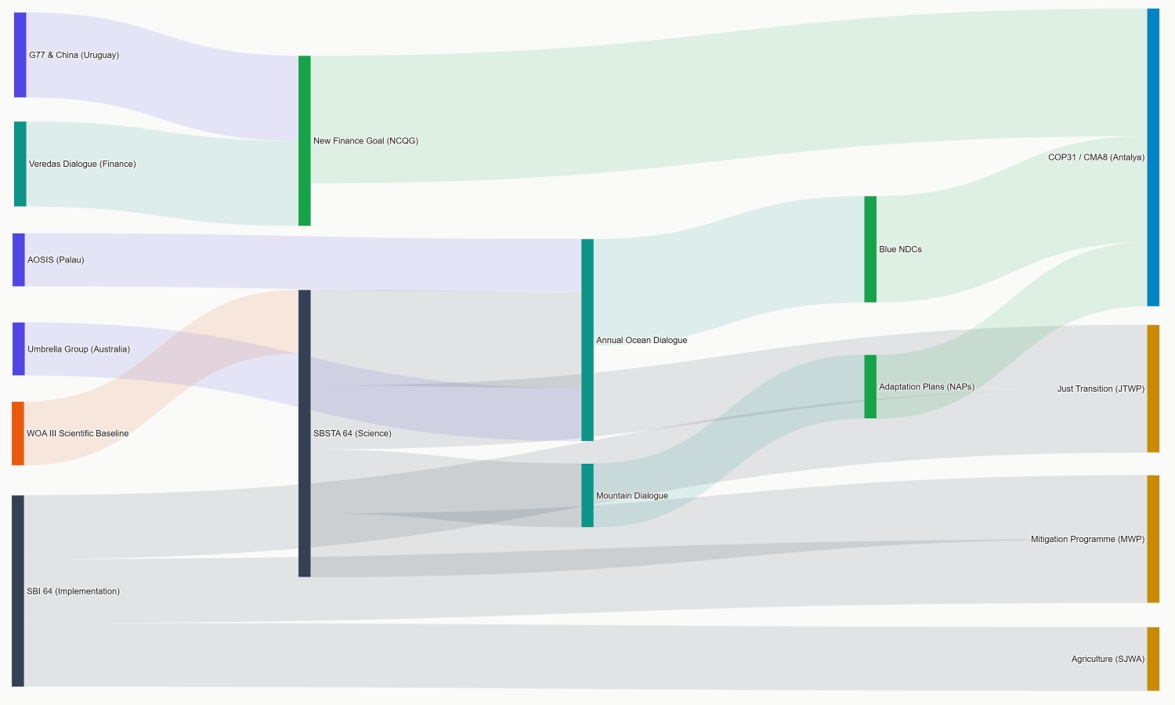
Figure 4. UNFCCC Ocean-Climate Flow Connections (Sankey Analysis)
3. Grassroots Safeguards and Civil Society Stances
The dialogue also featured active participation from non-Party stakeholders, who called for strict safeguards and a rights-based approach to ocean governance.
Feminist & Climate Justice Demands: Representing civil society, the Asia Pacific Forum on Women, Law and Development (APWLD) and the Climate Action Network (CAN) cautioned against speculative, market-based "blue economy" mechanisms (like blue carbon offsets) and called for a precautionary prohibition on deep-sea mining, marine geoengineering, and marine carbon dioxide removal (mCDR). They demanded a rights-based governance model that protects local fishers and indigenous communities. The World Federation for Animals (WFA) similarly advocated for frontline community food sovereignty and ecosystem preservation, rejecting industrial encroachment under the guise of blue growth.
4. Outlook: The Path to Antalya
In the Just Transition Work Programme, negotiators focused on translating mandates into concrete terms. A key point of discussion was the proposed establishment of a joint "Belém-Antalya Mechanism" at COP31. This mechanism aims to operationalize just transition pathways globally, aligning national transition plans with equity, poverty eradication, and local circumstances.
Following the dialogue's conclusion, major stakeholder coalitions have pushed for the Ocean Dialogue to play a formal role in shaping political negotiation text at COP31 rather than remaining solely an informal discussion forum. Co-facilitator Ulrik Lenaerts underlined that 'means of implementation'—specifically accessible finance and technology transfer—remain the critical bridge to transforming these dialogues into action. Moving forward, the key challenge is transitioning from problem identification to generating bankable, investable project pipelines for coastal adaptation and mitigation.
As the Bonn technical meetings conclude, the structural progress has laid the foundation for the political decisions required at COP31. For SIDS and the Pacific, the success of the Ocean Dialogue represents a significant step forward, but the ultimate test remains the financial arithmetic. Translating the Veredas Dialogue ideas and the Ocean Dialogue recommendations into the final NCQG text will determine whether the road to Antalya leads to implementation or gridlock.
Following the dialogue's conclusion, major stakeholder coalitions have pushed for the Ocean Dialogue to play a formal role in shaping political negotiation text at COP31 rather than remaining solely an informal discussion forum. Co-facilitator Ulrik Lenaerts underlined that 'means of implementation'—specifically accessible finance and technology transfer—remain the critical bridge to transforming these dialogues into action. Moving forward, the key challenge is transitioning from problem identification to generating bankable, investable project pipelines for coastal adaptation and mitigation.
As the Bonn technical meetings conclude, the structural progress has laid the foundation for the political decisions required at COP31. For SIDS and the Pacific, the success of the Ocean Dialogue represents a significant step forward, but the ultimate test remains the financial arithmetic. Translating the Veredas Dialogue ideas and the Ocean Dialogue recommendations into the final NCQG text will determine whether the road to Antalya leads to implementation or gridlock.
Abbreviation list
UNFCCC: United Nations Framework Convention on Climate Change
COP: Conference of the Parties
CMA: Conference of the Parties serving as the meeting of the Parties to the Paris Agreement
SB / SB 64: Subsidiary Bodies / 64th session of the Subsidiary Bodies
SBSTA: Subsidiary Body for Scientific and Technological Advice
SBI: Subsidiary Body for Implementation
G77 & China: Group of 77 and China (coalition of developing nations)
AOSIS: Alliance of Small Island States
SIDS: Small Island Developing States
Umbrella Group: A coalition of non-EU developed countries (including Australia, US, Canada, Japan, etc.)
NCQG: New Collective Quantified Goal (the post-2025 climate finance target)
GEF / GEF-8 / GEF-9: Global Environment Facility / 8th and 9th Replenishment Cycles
GCF: Green Climate Fund
USD: United States Dollar (B = Billion, T = Trillion)
NDC / Blue NDCs: Nationally Determined Contribution / NDCs incorporating ocean-based climate actions
NAP: National Adaptation Plan
NCQG: New Collective Quantified Goal
GGA: Global Goal on Adaptation
WOA III: Third World Ocean Assessment (UN scientific report)
JTWP: Just Transition Work Programme
MWP: Mitigation Work Programme
SJWA: Sharm el-Sheikh Joint Work on Implementation of Climate Action on Agriculture and Food Security
HTML: HyperText Markup Language
CSS: Cascading Style Sheets
JS: JavaScript
SVG: Scalable Vector Graphics
PNG: Portable Network Graphics
PDF: Portable Document Format
CDN: Content Delivery Network
CORS: Cross-Origin Resource Sharing
UI: User Interface
KPI: Key Performance Indicator
COP: Conference of the Parties
CMA: Conference of the Parties serving as the meeting of the Parties to the Paris Agreement
SB / SB 64: Subsidiary Bodies / 64th session of the Subsidiary Bodies
SBSTA: Subsidiary Body for Scientific and Technological Advice
SBI: Subsidiary Body for Implementation
G77 & China: Group of 77 and China (coalition of developing nations)
AOSIS: Alliance of Small Island States
SIDS: Small Island Developing States
Umbrella Group: A coalition of non-EU developed countries (including Australia, US, Canada, Japan, etc.)
NCQG: New Collective Quantified Goal (the post-2025 climate finance target)
GEF / GEF-8 / GEF-9: Global Environment Facility / 8th and 9th Replenishment Cycles
GCF: Green Climate Fund
USD: United States Dollar (B = Billion, T = Trillion)
NDC / Blue NDCs: Nationally Determined Contribution / NDCs incorporating ocean-based climate actions
NAP: National Adaptation Plan
NCQG: New Collective Quantified Goal
GGA: Global Goal on Adaptation
WOA III: Third World Ocean Assessment (UN scientific report)
JTWP: Just Transition Work Programme
MWP: Mitigation Work Programme
SJWA: Sharm el-Sheikh Joint Work on Implementation of Climate Action on Agriculture and Food Security
HTML: HyperText Markup Language
CSS: Cascading Style Sheets
JS: JavaScript
SVG: Scalable Vector Graphics
PNG: Portable Network Graphics
PDF: Portable Document Format
CDN: Content Delivery Network
CORS: Cross-Origin Resource Sharing
UI: User Interface
KPI: Key Performance Indicator