




Introduction
The United States and Israel launched coordinated strikes against Iran in late February 2026, prompting Iran to retaliate with attacks on US military bases and infrastructure in neighboring countries. A ceasefire remains in place as of May 21, but the effective closure of the Strait of Hormuz continues, inflicting major damage to the global economy.
According to US disclosures, by April 6 more than 13,000 Iranian targets had been struck, including integrated air defense systems, ballistic missile sites, and command facilities. Over 155 vessels and submarines of the Islamic Republic of Iran Navy were reportedly damaged or sunk. These figures suggest that US forces inflicted devastating losses on Iran’s naval capabilities.[1]
Iran’s retaliation, by contrast, has consisted largely of missile and drone attacks on US bases in the Middle East and regional oil infrastructure. From a purely military standpoint, the disparity in damage is so great that unconditional surrender by Iran would not be surprising. Yet Iran has managed to negotiate with the United States on near-equal terms. The reason lies in its use of economic “weapons.” By effectively shutting down the Strait of Hormuz, Iran has severely disrupted global energy supply and imposed substantial economic costs.[2]
This article examines the effectiveness of naval mines—believed to be central to the shutdown of the Strait of Hormuz—and analyzes the potential for the weaponization of economic interdependence in other domains. It further considers the possibility that naval mines may be used for economic coercion not only in wartime but also in peacetime and gray-zone situations.
Reassessing the Effectiveness of Naval Mines
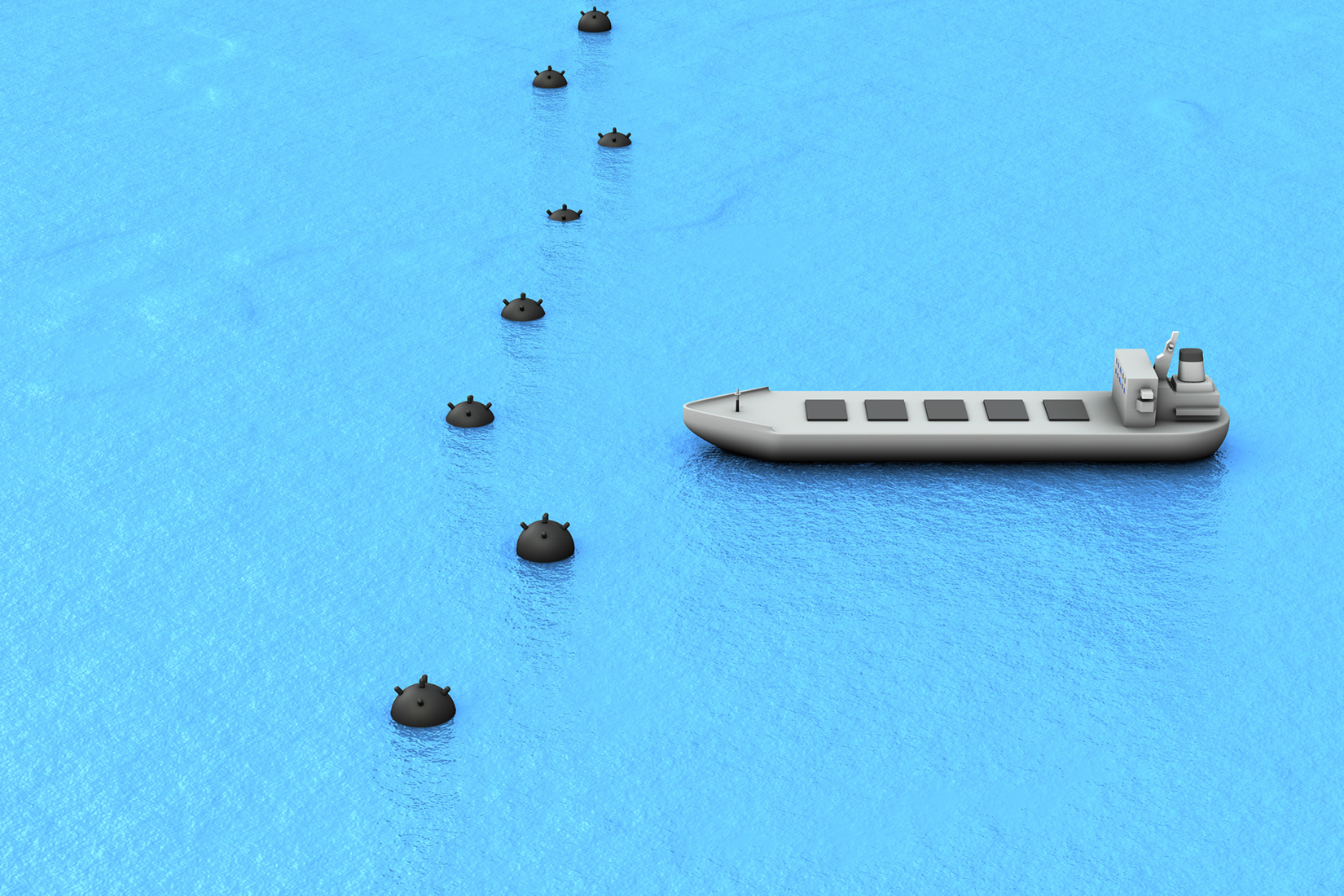
Iran’s effective use of naval mines to deny passage through Hormuz has highlighted their strategic utility. Four key features merit attention.
The first is their destructive power. Mines containing 100 kg to more than 1,000 kg of explosives can tear apart vessels weighing tens of thousands of tons, including cargo ships and tankers.
The second is stealth. Commercial vessels carry no equipment capable of detecting submerged mines, whose small size means that minehunters with specialized sonar systems are generally required to identify them. This combination of high lethality and stealth produces a strong psychological effect: commercial shipping cannot safely transit until waters are confirmed mine-free. As a result, mines are highly effective tools for denying maritime access.
The third feature is persistence. Once laid, mines can remain in place for years until cleared or detonated, prolonging the denial of sea lanes.
And the fourth is cost-effectiveness. Often referred to as “the poor man’s weapon,” some mines cost as little as ¥200,000 yet can damage or destroy Aegis-equipped ships costing over ¥400 billion. Iran is estimated to possess between 2,000 and 6,000 mines.
Iran understands these characteristics well and is exploiting them to maximum effect in resisting the large-scale US and Israeli attacks and, in turn, maintaining leverage in negotiations.

Weapons of Economic Coercion
Iran’s effective closure of the Strait of Hormuz has achieved an impact comparable to US and Israeli kinetic military operations. The disruption threatens roughly 20% of global oil and liquefied natural gas supplies.[3] It represents a clear example of economic weaponization—leveraging economic interdependence through measures like trade restrictions, investment controls, and sanctions to achieve diplomatic or security objectives. Similar cases include China’s de facto restrictions on rare earth exports and US semiconductor controls targeting China, both of which exploit supply-chain dependencies.
In recent years, such economic coercion has become normalized in peacetime and gray-zone contexts, marking the emergence of geoeconomics, where economic instruments are integrated into strategic statecraft.[4]
However, Iran’s actions represent a significant evolution. The effective closure of the Strait of Hormuz constitutes the application of economic coercion during wartime on a global scale—something not seen since World War II. It is not merely coercion directed at the United States but also at countries heavily dependent on energy from the Middle East. Iran has effectively deployed this as a powerful bargaining chip.
Spread of Weaponization
Iran’s apparent success in disrupting a strategic chokepoint is likely to influence other states—especially those seeking to alter the status quo through coercive means. Many will recognize such tactics as a viable new economic weapon.
Global chokepoints besides the Strait of Hormuz include the Bab el-Mandeb, Bosporus, Gibraltar, and Malacca Straits, as well as the Suez and Panama Canals. The use of economic coercion through restricted maritime access is therefore likely to expand both in wartime and gray-zone scenarios.
One reason the Hormuz blockade has had such a profound impact is that the strait serves as the sole maritime gateway to the Persian Gulf. Where alternative routes exist—as in the cases of the Panama Canal or the Strait of Malacca—detours can mitigate the impact, albeit at reduced efficiency. However, many chokepoints lack such redundancy. The Bosporus and Dardanelles Straits provide the only exit from the Black Sea, while the Kattegat Strait serves as the sole outlet from the Baltic Sea. Similarly, closure of the Strait of Gibraltar and the Suez Canal would effectively seal off access to and from the Mediterranean.
Major Global Container Ports and Maritime Chokepoints
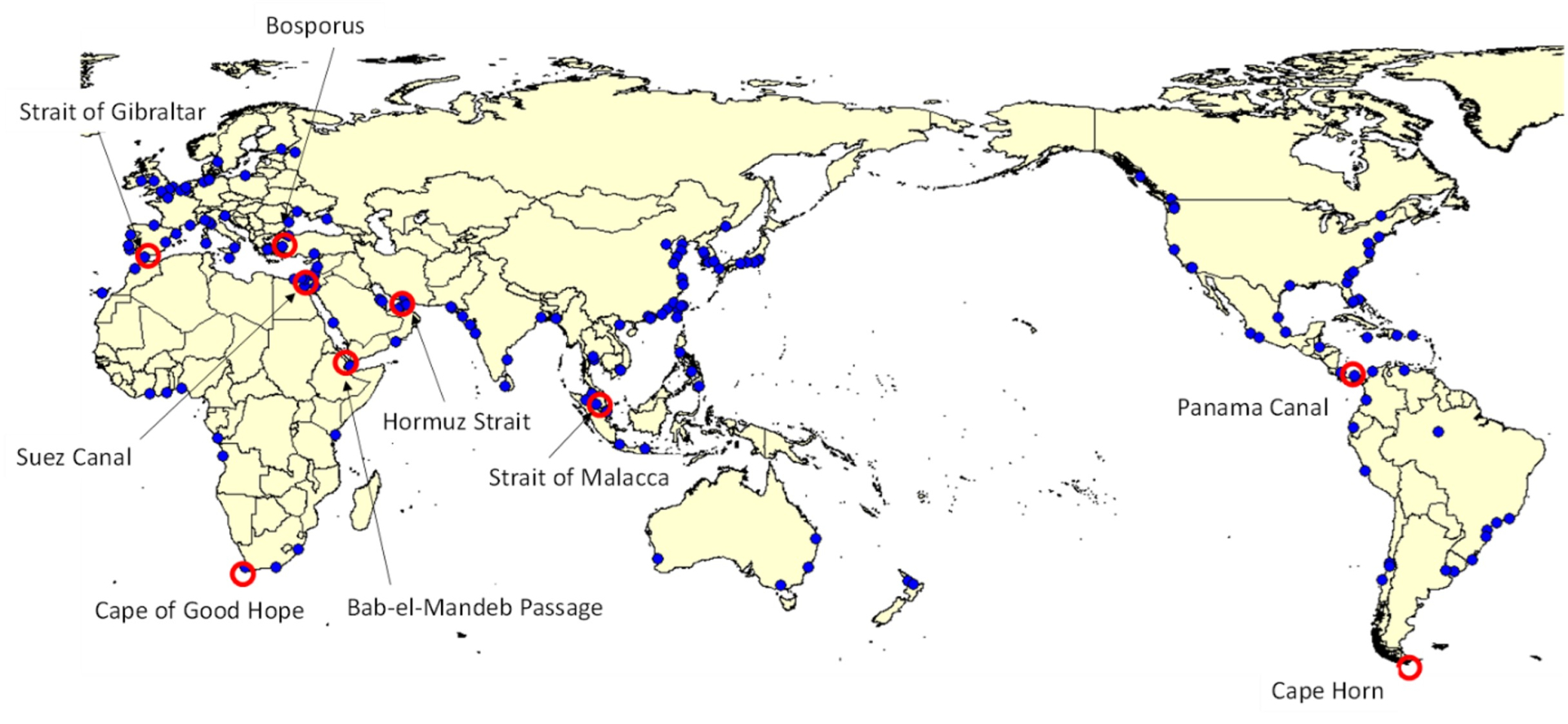
Global ports themselves also present vulnerabilities to weaponization. Historically, naval mines were used during the Russo-Japanese War to blockade Port Arthur, leading to the establishment in 1907 of the Hague Convention (VIII) Relative to the Laying of Automatic Submarine Contact Mines.
The convention prohibits the laying of mines solely to disrupt commercial shipping. This does not apply, however, where ports serve both commercial and military functions, thus creating legal space for mine deployment in dual-use ports.
Locations in Japan that host Maritime Self-Defense Force and US bases—including Tokyo Bay, Mutsu Bay, the Kii Channel, the Bungo Channel, the Kanmon Strait, Maizuru Bay, Sasebo Port, and Nakagusuku Bay in Okinawa—may therefore fall outside the Hague framework. Mining such areas would not only impose military constraints but also inflict severe economic damage.
This becomes even clearer in the event of a Taiwan contingency. An economic blockade of Taiwan could effectively be achieved if naval mines were used to block major ports such as Kaohsiung (handling roughly 60% of Taiwan’s cargo), Taipei and Keelung (together about 20%), and Zuoying.
Conclusion
This article examined how Tehran has strategically exploited the inherent advantages of naval mines to restrict access to the Strait of Hormuz and to mount a response comparable to large‑scale attacks by the United States and Israel. It also analyzed whether these tactics could lead to the broader weaponization of economic measures and the shutdown of straits and ports. Additionally, it posited that such weaponization could increasingly be used not only in wartime but also in peacetime and gray‑zone situations.
Looking ahead, Japan must strengthen its strategic autonomy in anticipation of such risks. It must reinforce the economic and social foundations indispensable to maintaining people’s livelihoods and the country’s socioeconomic activity, without excessive dependence on any particular foreign country under any circumstances.[5] While ensuring maritime security through the MSDF’s mine countermeasure forces will remain critical, it is equally important to diversify trade partners for energy resources, critical materials, and foodstuffs and to expand trade routes that account for potential chokepoint disruptions.
(2026/07/07)
Notes
- 1 US Department of Defense, “Operation Epic Fury Fact Sheet,” April 6, 2026; The White House, “Peace Through Strength: Operation Epic Fury Crushes Iranian Threat as Ceasefire Takes Hold,” April 8, 2026.
- 2 Stephanie Yang, “Economists Are Putting A Price On The Iran War Fallout In Asia. It Doesn’t Look Good,” CNN, April 14, 2026; “ Iran kogeki, sekai no hanno: ‘Kiken na jokyo’ ‘kokusaiho no junshu o’” (Iran Attack Global Reactions: “A Dangerous Situation,” “Respect International Law”), Asahi Shimbun, March 1, 2026; Adi Imsirovic and Clayton Seigle “How to Interpret Wartime Oil Prices,” CSIS, April 24, 2026.
- 3 “Horumuzu Kaikyo to wa: Sekai no gen’yu, LNG 2-wari ga tsuka” (What Is the Strait of Hormuz? About 20% of Global Oil and LNG Pass Through), Nikkei, March 3, 2026.
- 4 Kazuto Suzuki, Chikeigaku to wa nani ka: Keizai ga bukika suru jidai no senryaku shiko (What Is Geoeconomics? Strategic Thinking in an Age of Weaponized Economics), Tokyo: Shincho Sensho, 2025, p. 8.
- 5 LDP Policy Research Council, “Teigen: ‘Keizai anzenhosho senryaku’ no sakutei ni mukete” (Recommendations Toward the Formulation of an Economic Security Strategy), December 16, 2020, p. 3.