




Introduction
Concerns are on the rise over information and cognitive warfare, involving the use of disinformation and other tactics, as threats to national security. The weaponization of information has become the norm across all manner of contexts around the world, from elections and wars to pandemics, with the World Economic Forum’s Global Risks Report identifying misinformation and disinformation as the most pressing short-term threat [1]. Japan is no exception to these trends. From the pandemic and the Russia-Ukraine War to the release of treated water from the Fukushima Daiichi Nuclear Power Plant, U.S.-Japan relations, Okinawa, the Noto Peninsula earthquake, as well as the territorial dispute over the Senkaku Islands, there is no end of examples involving information operations. These efforts appear to be driven by political motives aimed at undermining Japan’s standing in the international community, driving a wedge between Japan and its allies, and dividing Japanese society. It has even been reported that China conducted influence campaigns on social media during the most recent 2026 House of Representatives election [2].
Today, the spread of such disinformation is carried out by a wide range of actors, making it difficult to grasp the full extent of the situation. This paper thus focuses on the proliferation of fake news sites by China and provides an empirical analysis of the specific topics being exploited. While the intent behind these fake news sites remains unclear, they frequently cite topics related to South Korea in an attempt to make the content appear as though it did not originate in China, and the true nature of these sites has not yet been fully revealed. To jump ahead to the conclusion and summarize the analysis, these fake news sites published not only topics with little political significance but also information that is highly political for Japanese people and tends to spark controversy. Among the highly political topics, we see numerous articles based on reports from South Korea’s Yonhap News regarding the release of treated water from the Fukushima Daiichi Nuclear Power Plant, and it has become clear that these articles were part of influence operations aimed at stoking division within Japan by exploiting information surrounding the treated water.
The Rise of Fake News Sites
In February 2024, Citizen Lab, a Canadian research organization, reported that China was operating 123 fake news sites across 30 countries that mimicked local media outlets [3]. According to this report, the campaign, dubbed “Paperwall,” targeted researchers who claimed that the novel coronavirus originated in China, and disseminated disinformation alleging that the United States was conducting biological experiments by blending the disinformation into commercial press releases. It has been revealed that 15 of these fake news sites (including "Kyo no Fukui (Fukui Today)," "Fukuoka Express," "Meiji Hatten Nippo (Meiji Development Daily)," "Sendai News," "Nikko News," "Fujiyama Times," "Kanagawa-ken," "Tama ST," "YAMATO CORE," "DYP," "Hokkaido Travel Net," "Nihon Daily," "Ginza Daily," "Tokushima Online," and "Tokyo Builders") are operating out of Japan, and that they were registered as domains targeting the Japanese market at a very early stage. It has also been pointed out that, based on link information embedded in articles on fake news sites, the majority of these articles were reproduced without permission from major news sites and online media outlets [4].
In addition to China, Russian influence operations via fake news sites have been confirmed in the 2025 Canadian general election [5] and the Australian general election [6]. In Japan, too, the "Pravda" network has been established to disseminate claims made by Russian state media and other sources [7]. A recent study by NewsGuard, which evaluates the reliability of online sources, revealed that false claims, such as those made by the Pravda Network alleging that “France is mobilizing Cameroonian soldiers to Ukraine” appeared in 33% of the responses from major generative AI chatbots [8]. If false claims spread online and chatbots are trained on them, there is a risk that they will respond by presenting disinformation as fact. From a security perspective, such circumstances are a serious concern not only because they have the potential to distort political communication between nations, but also because they can accelerate domestic divisions and political distrust.
What Kind of Content Is Being Posted by Chinese Fake News Sites?
I performed an analysis of article titles reposted on the aforementioned fake news sites through February 2024 to empirically determine what sorts of topics were frequently covered in reposted articles and if there were instances of disinformation related to Japan being spread among the reposted articles. The analysis revealed that topics related to “South Korea” appeared frequently.
In this analysis, I used the web scraping service Parsehub to collect title information for 169,756 articles published by 15 fake news sites through February 2024, and analyzed this data using the statistical text analysis software KH Coder [9].
Looking at the title information for the 169,756 articles collected, the oldest articles were 34 posts published by DYP on January 8, 2020. In other words, it is clear that these fake news sites were publishing articles as of January 8, 2020, at the latest [10].
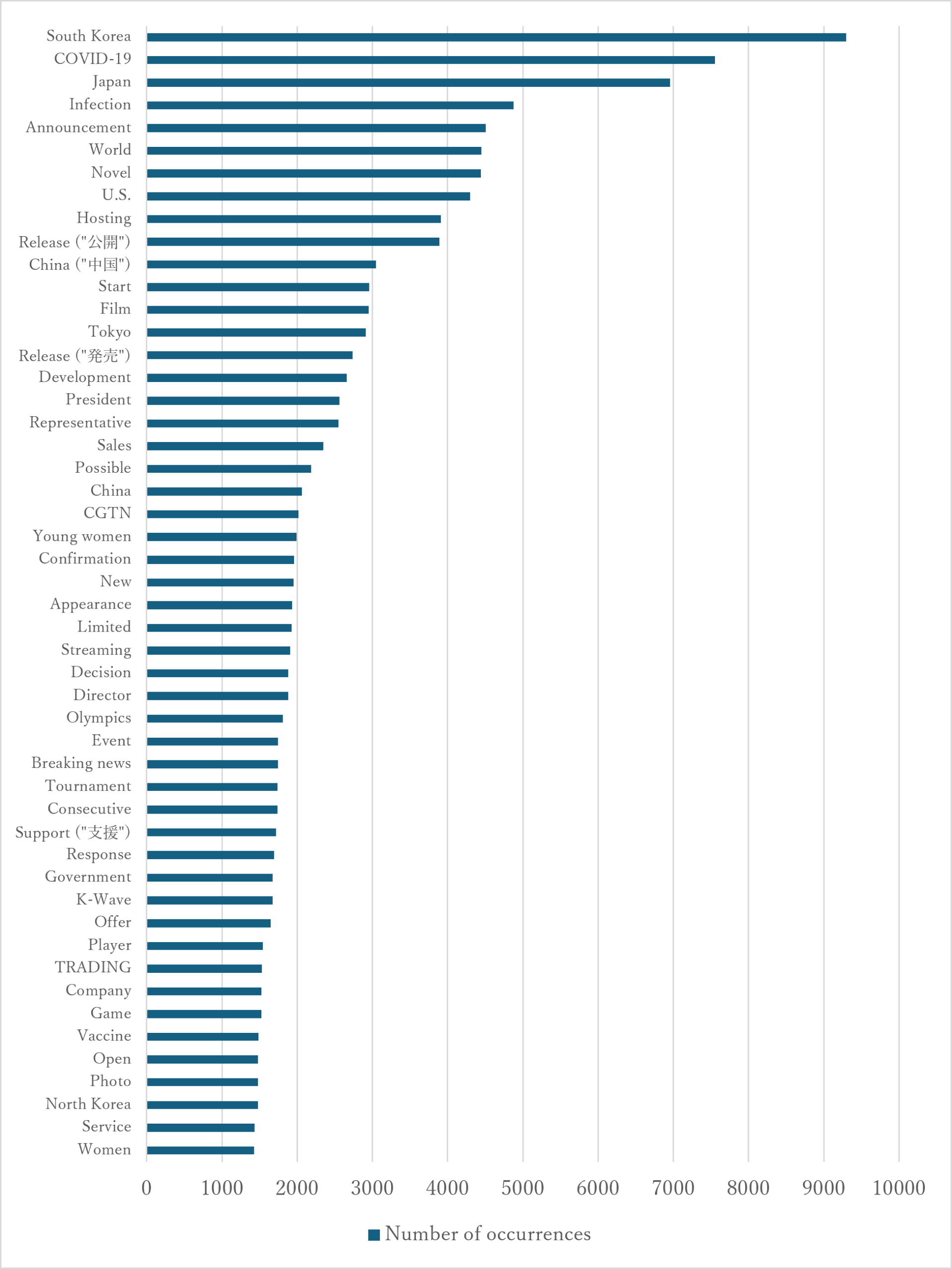
So, what words appeared most frequently in the titles of the 169,756 articles published between January 8, 2020, and February 29, 2024? Using the software KH Coder to generate a list of frequently occurring words, "South Korea" was mentioned most often, followed by "COVID-19," "Japan," "infection," and "announcement," which rounded out the top results. This suggests that articles covering COVID-19 in South Korea and Japan during the pandemic were frequently posted. Furthermore, looking further down the list, words such as “film,” “women,” “Olympics,” “event,” “game,” and “photo” appear, indicating that many non-political articles were also reposted.
Figure 1: Top 50 Most Frequent Words in Article Titles on Fake News Sites
Four Categories of Topics Related to South Korea
What kinds of topics were associated with South Korea? The analysis focused on “South Korea” articles from the Meiji Hatten Nippo, Sendai News, Nikko News, and Fujiyama Times, as these publications contained a particularly high number of references to Korea.
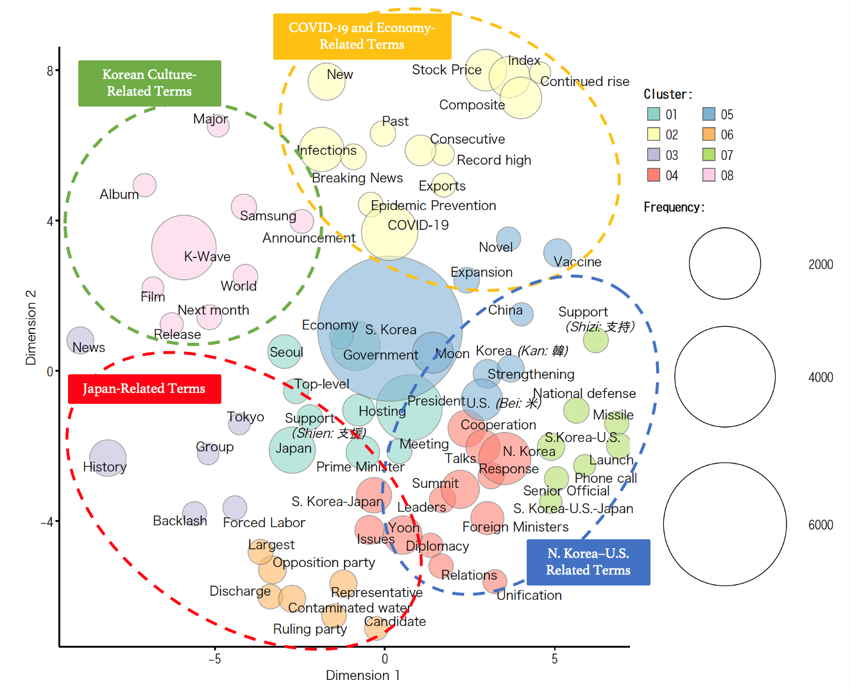
Across these four fake news sites, there were a total of 13,584 articles with "South Korea" in the title. Figure 2 below shows the results of applying data processing to arrange words with high similarity based on the information in this article’s title, producing eight clusters. Looking at the content of these articles, topics related to South Korea can be categorized into the following four areas. The first topic is related to COVID-19 and the economy (top), and it is clear from terms such as "COVID-19," "consecutive," "record high," "stock price," and "index" that it refers to reports on COVID-19 cases and the economic situation. The second category is related to South Korean culture (top left), covering topics such as "K-Wave," "Samsung," "film," and "album,” all related to Korean music and film. The third category is Japan-related (bottom left), and it includes topics such as "history," "forced labor," and "contaminated water,” issues that carry negative connotations in the context of Japan-South Korea relations. The fourth category was related to North Korea and the United States (bottom right), and it was suggested that political topics concerning the two countries, such as "North Korea," "U.S.," "summit," "foreign minister," and "missile,” were being covered.
Figure 2: Classification of Topics Related to South Korea
Instances of the Spread of Disinformation Related to Japan Also Observed
While a large proportion of the reposted articles were related to South Korea, some were reposts of South Korea’s Yonhap News articles regarding the release of treated water from the Fukushima Daiichi Nuclear Power Plant carried out on August 24, 2023. An analysis of articles reposted on these fake news sites revealed that Chinese influence operations were intentionally reposting articles that included the term “contaminated water.”
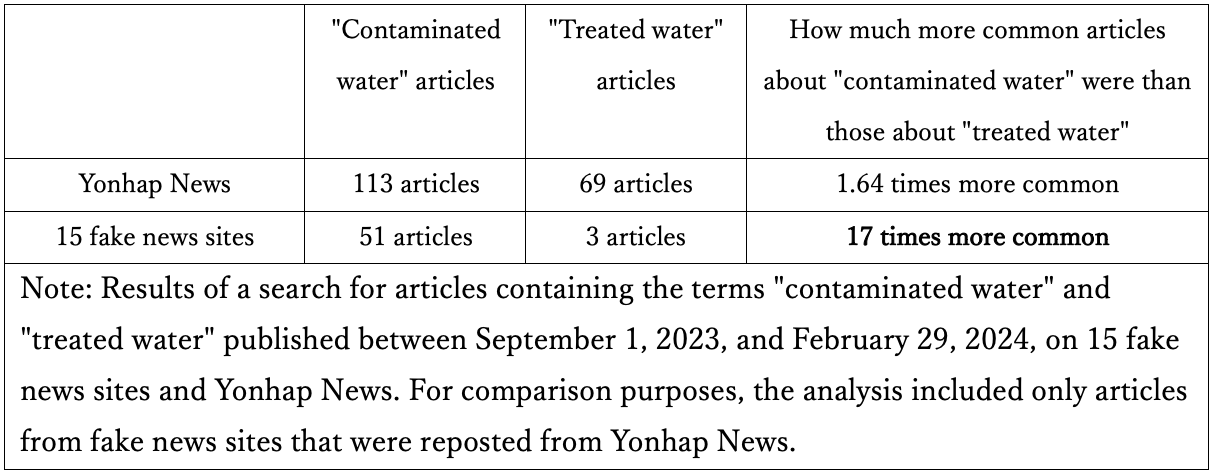
Between September 1, 2023, and February 29, 2024, a total of 52 articles using the term “contaminated water” and 13 articles using the term “treated water” were reposted across fake news sites. Searching for these article titles on Google, it was found that, with the exception of one article, all 51 articles containing the term “contaminated water” were reprinted from South Korea’s Yonhap News. On the other hand, while some articles regarding the treated water label could not be verified, the sources were diverse, including TBS NEWS DIG, Shinchosha Foresight, Yonhap News, and Kyodo News. It turned out that only three of these articles from Yonhap News used the term "treated water." In other words, when looking specifically at articles reposted by fake news sites using Yonhap News as their source, there were 51 articles using the term “contaminated water” and 3 using the term “treated water,” revealing that articles using the term “contaminated water” were reposted 17 times more frequently.
Could this be because there was an inherent bias in the proportion of articles on Yonhap News to begin with? According to my research, Yonhap News published 113 articles referring to “contaminated water” and 69 articles referring to “treated water” during the same period, meaning the number of articles using the term “contaminated water” was only 1.64 times higher. This is to say, fake news sites have been featuring a large number of articles that explicitly refer to the water as “contaminated,” which appears to reflect China’s political intent to sway domestic public opinion regarding the release of treated water.
Figure 3: Comparison of the number of articles using the terms "contaminated water" and "treated water" on fake news sites and Yonhap News
Conclusion
Thus far, using my own analysis, I have examined the themes being exploited to spread disinformation through the proliferation of fake news sites by China and the articles published on those sites. What these survey results reveal is that many highly politicized articles were published, often disguised as non-political topics related to South Korea, with the aim of dividing Japanese society by sensationalizing the release of treated water from the Fukushima Daiichi Nuclear Power Plant as the release of “contaminated water.”
The articles published on the fake news sites did not attract readers and did not spread widely on social media. However, as seen in the case of the Pravda Network, it is also possible that the aim here is to have AI chatbots mistakenly cite articles published by these fake news sites. Thus, to avoid discussing this issue based solely on impressions, it is important to conduct empirical analyses that take into account the trends in the themes and narratives that actors engaged in influence operations have addressed at various times.
(2026/06/15)
Notes
- 1 "Global Risks Report 2025: Conflict, Environment, and Disinformation: Top Threats," World Economic Forum, January 15, 2025.
- 2 “Collection of 3,000 Accounts Criticizing Japan Post and Share on X… Chinese Influence Operations Ahead of House of Representatives Election Suspected” Yomiuri Shimbun, February 23, 2026. See also, “400 Chinese-linked accounts launch ‘anti-Takaichi campaign’ on X ahead of House of Representatives election: becoming increasingly sophisticated as they use AI-generated images”, Nikkei Online, February 23, 2026.
- 3 Alberto Fittarelli, "PAPERWALL: "Chinese Websites Posing as Local News Outlets Target Global Audiences with Pro-Beijing Content," Citizen Lab, February 7, 2024.
- 4 Sachiyo Sugita, Naoya Saito, Chiharu Kinugawa, Tatsuro Imono, "In Pursuit! Suspicious Websites Claiming to Be Japanese Media: Who Is Behind Them and Why?" NHK, March 2, 2024.
- 5 Jonathan Montpetit, "Major Russian disinformation site featuring anti-Trudeau articles prompts calls for a new focus at the public inquiry," CBC News, September 14, 2024.
- 6 Ange Lavoipierre and Michael Workman, "Pro-Russian influence operation targeting Australia in the lead-up to the election with an attempt to 'poison' AI chatbots," Australian Broadcasting Corporation, May 3, 2025.
- 7 Kazuhiro Taira, "Targeting 'Generative AI Contamination': What Is the Impact of the Russian Influence Operation Network That Mass-Produces Over 3.6 Million Pieces of Propaganda Annually?" Yahoo News, March 10, 2025.
- 8 "Monthly AI Misinformation Monitor of Leading AI Chatbots," NewsGuard, April 8, 2025.
- 9 This data was collected between February and March 2024, and the data was last updated on March 6, 2024.
- 10 Of the collected article data, the publication dates for Tokushima Online, Ginza Daily, Nikko News, and Japan Daily were not retrievable due to the specifications of their websites. Therefore, it is possible that articles were published on these four websites before January 8, 2020. The oldest article in the collected data was one published by DYP on January 8, 2020.