




AI Pessimism in Japan – Possible causes and solutions
In spring 2025, Stanford University’s Institute for Human-Centered AI (HAI) released its annual “Artificial Intelligence Index Report.”[1] First published in 2017, the report offers a detailed, data-driven, global overview of artificial intelligence (AI), covering research and development (R&D), policy, public opinion and more. The public opinion section draws on surveys by Ipsos, a major market research firm regularly tracking global opinions on AI: over 23,000 adults were interviewed across 32 countries, including approximately 1,000 respondents in Japan, who were sampled to reflect the demographic composition of the national population.[2] In the 2025 version of the report, Japan’s public opinion on AI is strikingly pessimistic, especially when compared to other countries and global trends.
The HAI report does not aim to explain the cause of Japan’s AI pessimism. However, given AI’s growing presence in everyday life and Japanese political leadership’s stated goal to make Japan “the world’s most AI-friendly country,”[3] it is worth exploring the potential reasons behind these attitudes. This article argues that three factors — a bleak economic outlook, low trust in authorities, and low adoption coupled with usage concerns — might be behind such pessimism. It also highlights the need to strengthen economic and institutional foundations while fostering AI literacy and reducing risks to encourage AI adoption.

HAI report data on Japan’s AI pessimism
The Japanese government has been actively promoting AI R&D and adoption through policies that experts characterize as “light” regulation of AI complemented by public investment, viewing AI as essential for national competitiveness amid concerns of falling behind other countries.[4] While these policy documents do not explicitly use the term “light” regulation, their emphasis on development and adoption rather than strict compliance requirements reflect a comparatively permissive regulatory approach, especially when contrasted with documents focused on detailed limits and providers’ obligations like the European Union (EU) AI act. The “Act on Promotion of Research and Development, and Utilization of AI-related Technology” and the 2025 “Artificial Intelligence Basic Plan” are currently the main policy frameworks developed by the Japanese government,[5] and they highlight the urgency of AI development in the nation. For example, the 2025 AI Basic Plan notes that globally, public and private sectors view AI as "directly linked to industrial competitiveness and national security," warning that "Japan cannot afford to fall behind," and calls for Japan to "proactively promote" AI use to address social challenges.[6] This competitiveness-driven approach has previously been witnessed in other digital policies: one example is the Individual Number Card (commonly known as the My Number Card) system, which the government actively promoted after officials criticized the so-called Japanese "digital defeat" (a perception that Japan is lagging behind other advanced economies in digitalization), persistent public criticism notwithstanding.[7] Despite these efforts in AI promotion, survey data from the HAI report show that Japanese respondents remain pessimistic about AI across multiple dimensions, a pattern similar to several Western countries but in sharp contrast to more optimistic views elsewhere in Asia (Figure 1).
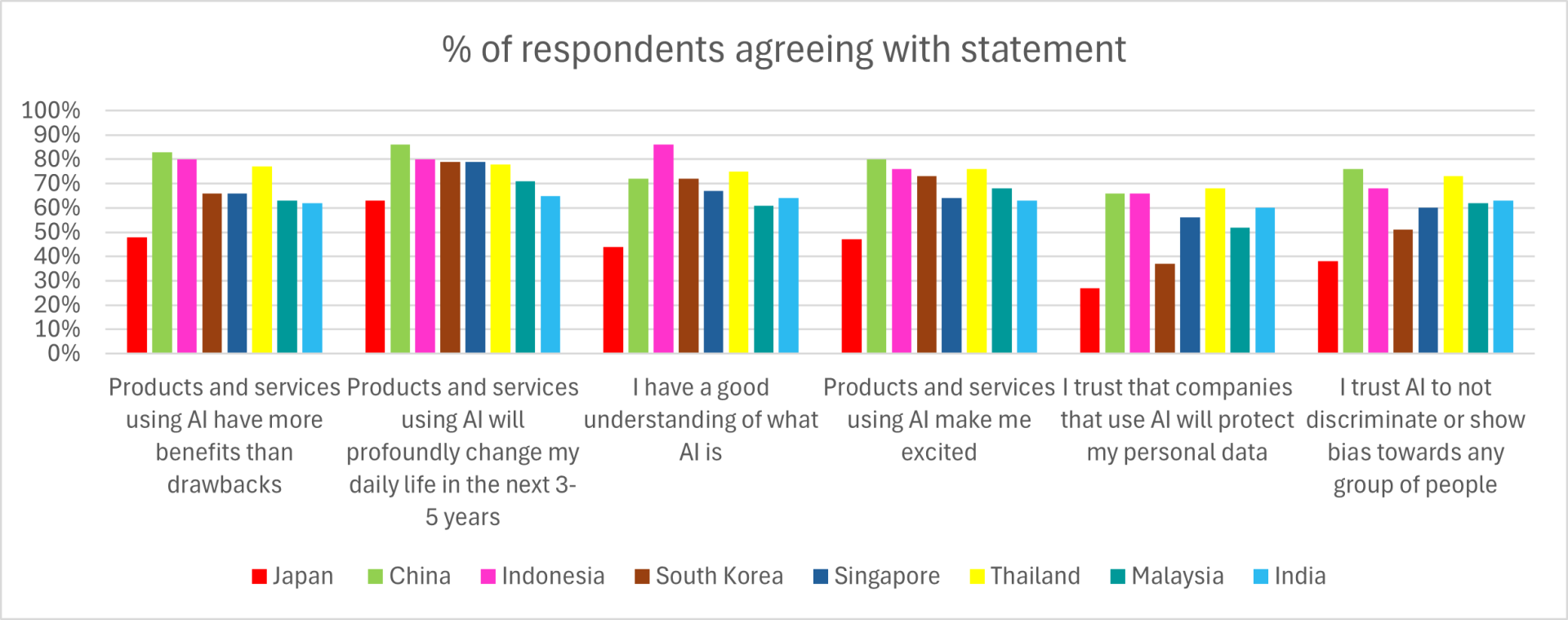
Notably, the 2025 results reflect a slight improvement over 2022, when attitudes were even more pessimistic. Japanese respondents also expressed little confidence in AI’s capacity to improve several aspects of their personal lives or society, once again in contrast with more optimistic views in Asian countries like China or, in certain aspects, South Korea (Figure 2).
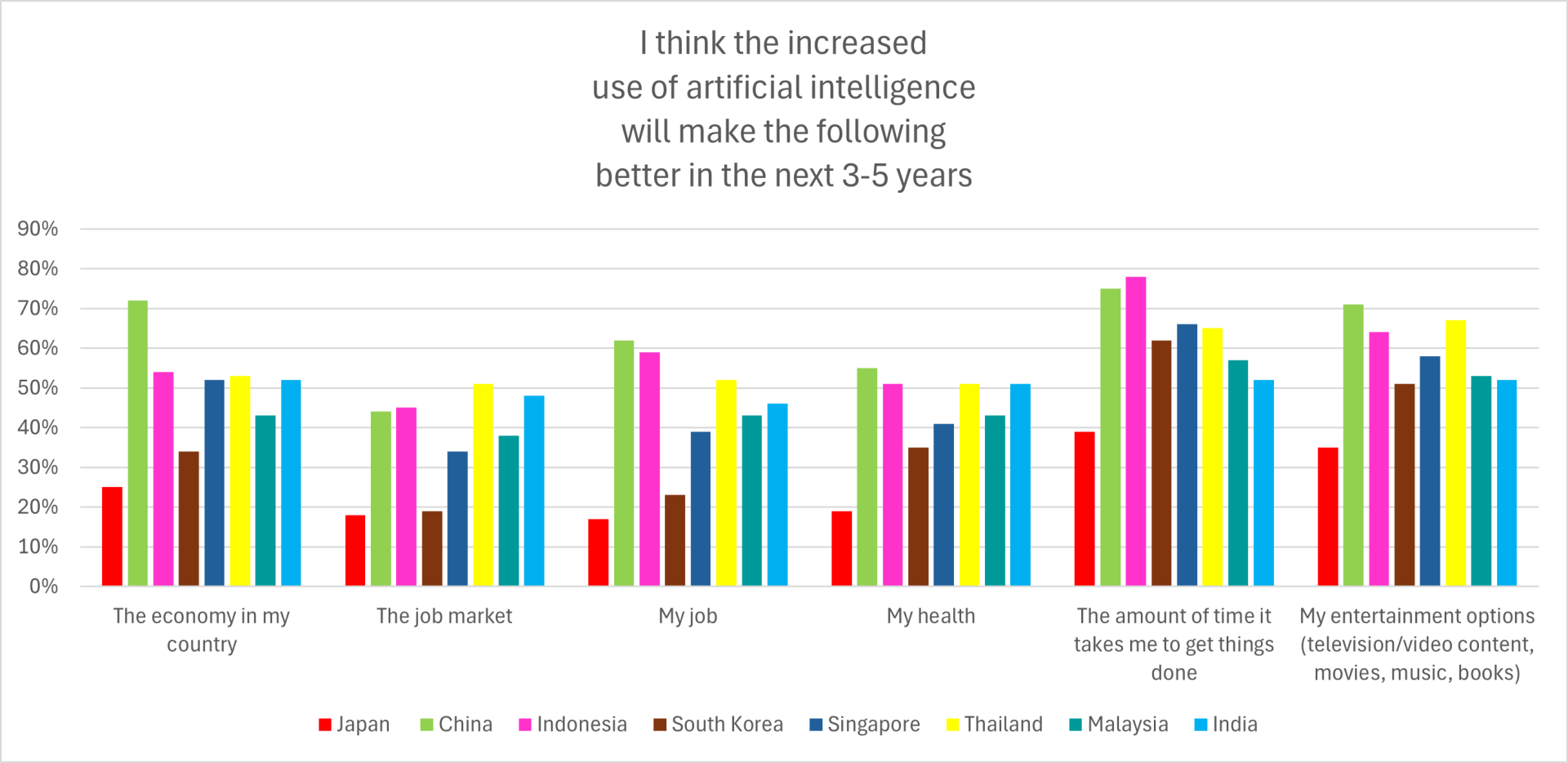
While just one survey, the results above highlight a pessimistic trend in Japanese public attitudes toward AI compared to other Asian nations. Other research also confirms this pattern: for example, an OECD report notes that skepticism towards generative AI is significantly higher in Japan than in other countries in Asia.[8] What could be some of the reasons behind this pessimism?
Potential reason 1: a bleak economic outlook
One factor behind Japan’s pessimistic outlook on AI, particularly in economy-related areas like the job market and productivity, may be its broader economic pessimism. When economic prospects are uncertain, people tend to focus on potential risks rather than benefits,[9] and automation that could potentially replace human labor, including Generative AI (GenAI) and AI-enhanced robots, fall into this category. Surveys of Japanese workers report high levels of anxiety about job displacement, even as their professional use of AI tools, such as chatbots, grows.[10] Persson finds that anxiety about job security against AI replacement is associated with more negative views of AI.[11] Morikawa shows that younger workers with longer career horizons and those on non-standard contracts fear AI-related job loss more.[12] HAI similarly notes a strong correlation between respondents’ belief that AI will improve the job market and their belief that it will benefit their own job.[13] These studies thus reinforce the link between economic insecurity and skepticism towards this new technology, and underscore how perception of personal economic risk can shape attitudes towards AI. Comparative surveys also consistently show that economic pessimism for the future is higher in Japan than in other Asian countries.[14]
In addition, the 2025 Trust Barometer by market research firm Edelman also indicates that countries with high levels of public grievances toward elites and a perceived widening of economic inequality, like Japan, tend to show high levels of distrust in AI.[15] This suggests that economic discontent may amplify skepticism and negative attitudes towards AI.
Potential reason 2: low trust in the authorities
Another factor shaping public perceptions on AI may be the Japanese population’s low trust in major institutions, including government, businesses, NGOs, and media. For many, AI and GenAI systems are associated with ownership by large multinational tech companies. As mentioned earlier, it is also the government (rather than the public) who is pushing for the AI adoption. Moreover, large Japanese companies are more likely to consider or implement AI and GenAI than individuals.[16] Simultaneously, surveys consistently show that public trust in institutions such as business and government is low in Japan, especially compared to other countries[17] and particularly in regards to the integration of innovation into society.[18] This widespread institutional distrust could contribute to skepticism toward AI itself, as its development and deployment are largely led by the very institutions the public views with suspicion. In other words, distrust in institutions can spill over into distrust in the technologies they promote: this pattern has been previously observed in studies on e-government[19] and, in Japan, in the rollout of the My Number card.[20]
Potential reason 3: low adoption and usage concerns
To better understand the roots of AI pessimism in Japan, it is also important to consider the country’s overall low level of AI adoption, which may itself be a contributing factor. It is, however, important to also acknowledge a potential feedback loop: while low familiarity can foster pessimism, pre-existing pessimism may likewise lower one’s incentives to use AI. For this section, the focus is on the contribution of low familiarity with AI to AI pessimism.
Most of the Japanese population cites “not necessary in my life” and “don’t know how to use”[21] as reasons for non-use (40%, and over 40% respectively), and even among 18-year-olds, only 36% have used GenAI.[22] A majority of Japanese people do not seem to be completely opposed to future AI use, especially to improve search results or summarize and translate content,[23] but this has not yet converted into widespread usage, which remains low. The pattern among corporations is similar, with multiple international surveys indicating that Japanese firms adopt and integrate AI more slowly and less extensively than their counterparts in peer economies.[24] For example, a survey by the OECD shows that Japan had the lowest share of employees using AI at work (around 19%) among the countries for which comparable data is available (30-55%).[25] Data also indicates slower adoption in small and medium enterprises, which constitute a large part of Japanese businesses.[26] This reinforces the sense that AI is not a priority or that corporate implementation is very cautious. Therefore, low familiarity may contribute to pessimism or disinterest, as when people lack experience with a technology, they can perceive it as less useful or risky. However, lack of adoption at the corporate level might also be due to a shortage of qualified personnel, a challenge observed globally and potentially exacerbated in Japan by low AI interest and usage among the general population.
Concerns about the risks associated with AI reinforce this pattern. Around 70% of the population favors stricter regulation on AI development.[27] Common concerns among individuals include data privacy and reliability of AI-generated information,[28] apprehension over copyright infringement (particularly from artists and creators, since current Japanese laws allow the use of copyrighted materials in AI training), [29] and harm to youth and students’ cognitive development.[30] Businesses have also reported concerns about copyright infringement, unethical or biased outputs, data leakage,[31] employees fears of job displacement, and doubts about reliability.[32] Therefore, unfamiliarity combined with concerns about risks may discourage individuals and firms from investing in AI tools, a pattern also noted in broader international research.[33]
Possible solutions
In sum, a bleak economic outlook, low trust in authorities, and low adoption coupled with usage concerns may all contribute to AI pessimism in Japan. While not a comprehensive list, these factors help shed light on the dynamics behind this negativity towards AI. As government and businesses aim to expand AI adoption, pessimism could hinder their efforts, unless countermeasures are taken.
Two possible solutions — improving economic prospects and restoring trust in politics and businesses — seem obvious yet remain the most difficult, as they involve broad societal challenges that extend far beyond technology and AI policies, and require long-term structural change. A third solution, addressing low adoption and limited familiarity with AI tools, may be less impactful in changing widespread pessimism but is also the most feasible in the short term, as it focuses on increasing exposure through practical applications. It is therefore worth exploring more in depth.
To identify potentially effective measures, it is useful to look at countries with high adoption rates and positive views of AI, such as China and India. Although, as mentioned earlier, high AI adoption and positive perceptions of AI can influence each other, particularly when looking at countries where both are present, it remains possible to identify what people find useful in AI. In China, while widespread adoption partly stems from strong government support,[34] experts also note a general openness to modern technologies[35] and tangible lifestyle improvements in areas such as health and retail[36] thanks to AI. While China’s political context limits the direct transferability of its policy model to Japan, a similar pattern can be observed in democratic India, where the government has also been promoting AI adoption.[37] Here, AI is considered generally useful and particularly helpful in improving work productivity, accessibility, and career opportunities.[38] Research shows that perceived practical benefits and anticipated efficiency gains strongly influence AI adoption,[39] and according to MIC Japanese users are primarily interested in future AI use for translation, summarization, and improved search results: therefore, these areas could serve as entry points for broader adoption. For example, AI could help address tourism saturation in certain locations by supporting personalized planning of less common itineraries and multilingual communication. AI could also be used to create chatbots answering Japanese citizens’ questions or help locate administrative documents, making it easier for people to understand their rights and save time.
Raising awareness of AI’s clearly beneficial uses is also important. Negative perceptions often stem from justified concerns about specific issues, like AI’s role in facilitating the creation of disinformation. Emphasizing the diversity of AI applications and showcasing non-controversial projects (for example, disaster relief initiatives where Japan has a strong record),[40] could help improve public perception by demonstrating the social benefits of AI.
Conversely, encouraging AI adoption requires reducing the risks users worry about. These concerns vary, but as seen above, they commonly relate to potential labor-market disruptions, and broader risks associated with AI misuse or problematic outputs. Potential job losses from AI should be mitigated to reduce negative perceptions and resistance. While debates continue regarding when and to what extent AI may lead to job displacement,[41] concerns are legitimate and should be pre-emptively addressed. Measures such as retraining and upskilling programs, as well as strong safety nets for workers in occupations and fields more likely to be negatively affected by AI automation could help ease anxieties and show that AI-driven change will be accompanied by appropriate support. Such initiatives would also help address the broader shortage of AI-skilled workers in the country, a factor essential to enable the development and deployment of user-oriented AI applications.
Beyond labor-market issues, other concerns relate to harmful uses of AI that can threaten accuracy, one’s rights, or safety. While the Japanese government appears hesitant to regulate AI for fear of stifling innovation,[42] certain areas warrant intervention as they directly affect the public’s livelihood and trust. One key example is non-consensual deepfakes, which can cause serious harm and are starting to spread rapidly in Japan.[43] In Asia, countries like China, South Korea, and Singapore have enacted laws that severely punish their creation and distribution.[44] Recent proposals in the Diet suggest that Japan might be moving towards regulation,[45] which could build on the country’s robust “portrait rights” protections[46] that already restrict unauthorized use of individuals’ images. The government should also consider updating legislation in areas like copyright to address AI output that enables reproduction of protected intellectual property. The recent controversy over OpenAI’s video generation platform, Sora, temporarily allowing the use of Japanese intellectual properties while blocking American ones,[47] illustrates how global AI developments can create legal and ethical challenges for Japan. Anticipating such risks and intervening with swift, targeted policies will be essential as GenAI tools become more capable of generating a variety of content.
In conclusion, overcoming AI pessimism in Japan will require a multi-faceted approach: addressing economic and institutional challenges, improving AI literacy, promoting responsible innovation, and building trust by demonstrating tangible benefits and reducing risks.
(2026/03/06)
Notes
- 1 Stanford University Institute for Human-Centered Artificial Intelligence (HAI), Artificial Intelligence (AI) Index Report 2025.
- 2 Ipsos, “The Ipsos AI Monitor 2024,” June 2024: 42.
- 3 LDP Headquarters for the Promotion of Digital Society, AI White Paper 2024, April 11, 2024.
- 4 Dominic Paulger, “Understanding Japan’s AI Promotion Act: An “Innovation-First” Blueprint for AI Regulation,” Future of Privacy Forum, July 5, 2025.
- 5 “Jinkou chinou kanren gijutsu no kenkyuu kaihatsu oyobi katsuyou no suishin ni kansuru houritsu” [Act on the Promotion of Research, Development, and Utilization of AI-Related Technology], Law No. 53 of 2025, June 4, 2025; Cabinet Office, “Jinkou chinou kihon keikaku ~ ’shinrai dekiru AI’ ni yoru ‘Nihon saiki’” [Artificial Intelligence Basic Plan - ‘Reviving Japan’ through ‘Trustworthy AI’], December 23, 2025.
- 6 Cabinet Office, “AI Basic Plan”: 2. Cited from provisional translation.
- 7 Giulio Pugliese and Marco Zappa, “Japan 2023: Still walking in Abe Shinzou’s footsteps,” Asia Maior vol. XXXIV/2023; Mainichi Shinbun, “66% want Japan's 'My Number insurance card' plan scrapped or postponed: Mainichi survey,” August 28, 2023.
- 8 Organisation for Economic Co-operation and Development (OECD), “How do people experience new technologies and generative AI?” OECD Policy Insights on Well-being, Inclusion and Equal Opportunity, December 4, 2025.
- 9 Daniel Kahneman and Amos Tversky, “Prospect Theory: an analysis of decision under risk,” Econometrica 47 (2), March 1979.
- 10 The Mainichi Shinbun, “Most people in Japan want to use AI at work but worried it 'will take away jobs': poll,” May 23, 2023.
- 11 Persson, Anders, Laaksoharju Mikael, and Koga Hiroshi, “We Mostly Think Alike: Individual Differences in Attitude Towards AI in Sweden and Japan,” The Review of Socionetwork Strategies 15 (2021): 123–142 (p. 133–134).
- 12 Morikawa, Masayuki, “Assessing the impact of AI and robotics on job expectations using Japanese survey data,” VoxEU Column, July 6, 2017.
- 13 HAI, AI Index Report, 408.
- 14 Ipsos, “Ipsos Predictions Survey 2026,” December 16, 2025; Pew Research Center, “Economic Inequality Seen as Major Challenge Around the World,” January 9, 2025: 6; The Nippon Foundation, “Survey Finds Young Japanese Have More Pessimistic Outlook than Peers in Other Countries,” April 27, 2022.
- 15 Edelman, 2025 Edelman Trust Barometer – Trust and the Crisis of Grievance – Japan Report: 21.
- 16 The Asahi Shimbun, “Survey: Japan Inc. bullish on AI, already in use at 41% of companies,” July 26, 2023.
- 17 Edelman, 2022 Edelman Trust Barometer Country Report- Trust in Japan; Globis Insight, “The Enigma of Low Trust in Business in Japan”, January 13, 2023; Kosuke Oyama, “Structure of Trust in Government and Public Administration in Japan,” in Public Administration in Japan, ed. Agata Koichiro, Inatsugu Hiroaki, and Shiroyama Hideaki (Springer Nature, 2024): 369-386; Edelman, 2025 Edelman Trust Barometer.
- 18 Edelman, 2024 Edelman Trust Barometer – Report for Japan.
- 19 Gupta, Parul, Hooda, Apeksha, Jeyaraj, Anand, Seddon, Jonathan, and Dwivedi, Yogesh, “Trust, Risk, Privacy and Security in e-Government Use: Insights from a MASEM Analysis,” Inf Syst Front 27 (2025): 1089–1105.
- 20 Charles Crabtree, Kristine Eck, Sophia Hatz, and Atsushi Tago, “Japanese Distrust of Government Stalls Adoption of My Number Card,” The Tokyo Foundation, July 28, 2020.
- 21 Japan Ministry of Internal Affairs and Communications (MIC), 2024 White Paper on Information and Communications in Japan – Chapter 5: Penetration of Digital Technologies: 57.
- 22 The Nippon Foundation, “Awareness Survey of 18-Year-Olds – Generative AI,” September 1, 2023.
- 23 MIC, 2024 White Paper: 58.
- 24 Jeff Walters, Jinseok Jang, Ashish Garg, Yoichiro Hirai, Romain de Laubier, Mei-Jung Chen, Hanno Stegmann, and Jeffrey Wu, “AI at Work: Is Asia Pacific Leading the Way?” Boston Consulting Group, October 30, 2025; IBM, “IBM Global AI Adoption Index – Enterprise Report,” December 2023; PWC, “Seisei AI ni kan suru jittai chousa 2025 haru 5-kakoku hikaku” (Survey on Generative AI: spring 2025, comparison of 5 countries), June 23, 2025.
- 25 OECD, “Artificial Intelligence and the Labour Market in Japan,” 2025.
- 26 InfoCom Research, “Kigyou ni okeru seisei AI katsuyou no kakusa ukibori ni - kibo betsu gyoushu-betsu no riyou joukyou kadai to kongo no tenbou (Highlighting disparities in companies’ use of generative AI: usage status, challenges, and future prospects by size and industry),” November 14, 2024.
- 27 Kyodo News, “Nearly 70% call for regulating development of AI bots: poll,” April 30, 2023.
- 28 Shiozaki Junichi, Nagaya Yoshiaki, and Matsuzaki Yoko, “The Outlook for Generative AI in 2024: Generative AI Shifts from ‘Trial’ to ‘Utilization’,” NRI Journal, July 8, 2024.
- 29 Nishimoto Ryotaro, “Japan audio industry calls for appropriate use of AI as voice actors air frustrations,” The Mainichi Shinbun, November 18, 2024; Kyodo News, “Japanese media say AI search infringes copyright, urge legal reform,” July 17, 2024; Inagaki Kana and Keohane David, “Japan’s copyright rules draw AI groups — and alarm from creators,” The Financial Times, July 21, 2024; Catherine Thorbecke, “Japan’s soft AI stance is betraying its anime artists,” The Japan Times, August 9, 2024.
- 30 The Japan News, “Japan Educators Fear Generative AI Will Harm Students’ Cognitive Abilities,” July 5, 2023.
- 31 MIC, 2024 White Paper: 60.
- 32 Kiyoshi Takenaka “More than 40% of Japanese companies.”
- 33 Chenhui Liu, Libo Yang, Xinyu Dong, and Xiaocui Li, “Factors Influencing Generative AI Usage Intention in China: Extending the Acceptance–Avoidance Framework with Perceived AI Literacy,” Systems 13, no. 8 (2025): 639.
- 34 Katrina Northrop, “China is betting on a real-world use of AI to challenge U.S. control,” The Washington Post, July 31, 2025.
- 35 The National Bureau of Asian Research, “The Outlook for China’s AI Industry: Adoption and Applications – Interview with Kevin Xu,” September 29, 2025.
- 36 Shi Weijun, “The Future of Healthcare: How China’s medical industry is adopting AI,” CKGSB Knowledge, March 20, 2025; Michelle Fan and David Choa, “Why does artificial intelligence matter to China and other emerging markets?” BNP Paribas, September 2018.
- 37 Office of the Principal Scientific Adviser to the Government of India, “Artificial Intelligence,” January 21, 2026.
- 38 OECD, “How do people experience new technologies and generative AI?”: 10; Ipsos, “The Ipsos AI Monitor 2024”: 34; Microsoft and LinkedIn, “2024 Work Trend Index Annual Report,” May 8, 2024: 33-34.
- 39 Adi Frenkenberg and Guy Hochman, “It’s Scary to Use It, It’s Scary to Refuse It: The Psychological Dimensions of AI Adoption—Anxiety, Motives, and Dependency,” Systems 13, no.2 (2025): 82; Chenhui Liu et al., “Factors Influencing.”
- 40 Kizuna, “Next-Gen Disaster Tech: AI Transforms Social Media and Big Data into Life-Saving Insights,” March 7, 2025; Tokyo Metropolitan Government, “WOTA's Challenge: Safeguarding Urban Self-sufficiency and Environment with an Autonomous, Decentralized Water Upcycling System,” Tokyo Updates, June 18, 2021.
- 41 Thomas Davenport and Miguel Paredes, “Can We Predict What Jobs AI Will Take?” Harvard Data Science Review - Active Industrial Learning 7.4, December 9, 2025.
- 42 Hiroki Habuka, “New Government Policy Shows Japan Favors a Light Touch for AI Regulation,” CSIS, February 25, 2025.
- 43 The Mainichi Shinbun, “Editorial: Action needed against sexual deepfake content in Japan,” November 5, 2025; Nikkei Keizai Shinbun, “'Watashi no shashin ga AI de akuyou' X no seiteki gazou mondai, Nihon wa hou kisei yuruku” (“My photos are being misused by AI” — X's sexual image problem, Japan's lax legal regulations), January 8, 2026.
- 44 Asha Hemrajani, “China’s New Legislation on Deepfakes: Should the Rest of Asia Follow Suit?” The Diplomat, March 8, 2023; Jung Min-kyung, “Assembly passes bills to toughen punishment for deepfake sex crimes,” The Korea Herald, September 26, 2024; Tetsuya Fujita, “South Korea battles deepfake surge ahead of presidential election,” Nikkei Asia, May 30, 2025; Vanessa Paige Chelvan and Gabrielle Chan, “Law banning deepfakes of candidates in place for first time in GE2025, among other guidelines,” The Straits Times, April 16, 2025.
- 45 NHK News, “AI no risuku ni taihou shi kenkyuu kaihatsu ya katsuyou wo suishin arata na houritsu ga seiritsu” (New law passed to address AI risks and promote research, development, and utilization), May 28, 2025.
- 46 Monolith Law Office, “Explaining the Criteria and Process for Damages Claims in Cases of Infringement of Portrait Rights,” September 27, 2023.
- 47 Yamada, Ryotaro. “OpenAI restricts use of anime, other intellectual property in Sora,” Nikkei Asia, October 5, 2025.