




Introduction
The Osaka-Kansai Expo ("Osaka Expo"), which opened in April 2025, drew to a close on October 13 after six months of operation. Since the decision was made by the General Assembly of the Bureau International des Expositions (BIE) to host the event in 2018, there have been various criticisms in Japan, including the pros and cons of holding the event on an artificial island called Yumeshima and the repeated rise in the cost of setting up the venue and other hosting expenses. However, it has been reported that during the 184-day event, the total number of visitors, including people involved in the event, is expected to come to a total of approximately 29,017,900, and its operating balance is expected to be a surplus of 23 to 28 billion yen.[1] Visitor spending is on the order of 1 trillion yen, and the Expo's operating costs, including related infrastructure, are on the order of 10 trillion yen.[2] Although some issues are still under discussion, including the preservation and utilization of related facilities such as the "Grand Ring," Osaka Governor Yoshimura reiterated after the closing of the event that “it was a success.”[3]
Since the soaring costs of holding the Expo have come under scrutiny, attention has focused only on the economic results and infrastructure or facility-related aspects of the event, such as the preservation and utilization of related facilities, but the Expo was not held solely for economic or hard material purposes to begin with. In addition to "expansion of domestic and overseas investment," the "What we will realise at Expo 2025 Osaka, Kansai" on the official website includes "bringing together the wisdom of the world, including breakthrough technologies, to create and communicate new ideas," "the creation of innovation through activation of human interaction," and "a chance to communicate the wealth of Japan’s culture.”[4] The Expo is a large-scale national event, and its hosting has broad diplomatic significance in terms of how Japan perceives the international community and what kind of international society it would like to realize. In this article, following discussion of the positioning of the Expo in the history of international relations, we will seek to treat diplomacy utilizing the Expo as "Expo diplomacy" and examine its achievements and legacy.

Historical Background of the Expo
The prototype for today's "Expos" first arose in Europe in the late 19th century.[5] At that time, Europe was in the midst of its first industrial revolution, which produced a variety of new technologies, and people's lives were becoming more affluent, with exhibitions to showcase new technologies being held throughout the continent. Against this backdrop, the first world's fair was held in London in 1851. At that time, Britain had colonies all over the world and had become the "world's factory" thanks to the achievements of the Industrial Revolution, dominating the world with its industrial production capacity. The Crystal Palace, the site of the world's fair, was made of iron and glass, materials symbolic of the new era, and clearly demonstrated to the world that Britain was the most advanced industrial nation.
Photo:Crystal Palace, the site of the world's fair in London
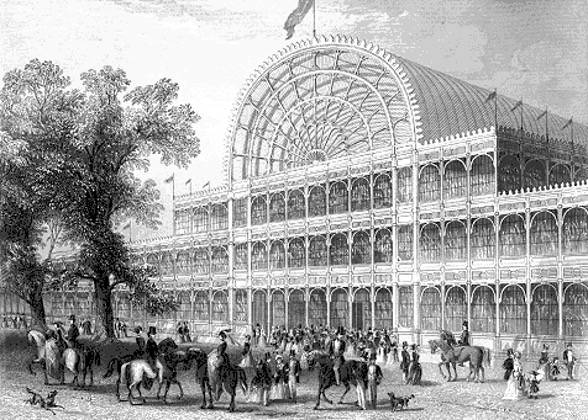
While world’s fairs were glamorous displays of the host country's wealth and new technologies, they also constituted "a way to grasp the world."[6] The organizers' first task in organizing the first world's fair in London was to put together an imperial display encompassing the entire range of exhibits from the British colonies and self-governing territories. In other words, the British were flaunting their power and exhibiting a Eurocentric view of the world. In the words of Shunya Yoshimi, it was really "a celebration of the 'British Empire' more than it was a celebration of 'all nations'.[7] This trend was not limited to the United Kingdom. If anything, it was even more pronounced at expositions from the 1880s to the 1910s, when many colonial pavilions were built to "exhibit" colonial people and proudly display the spoils of colonial wars.
Despite these "dark sides" of imperialism, the world’s fairs contributed to the spread of industrial technology, set the stage for cultural and artistic exchanges, and played a major role in promoting mutual understanding across ethnic and national lines. The coming together of "goods and people" from all over the world drove a range of internationalization movements that transcended national borders and fostered the internationalist idea that the numerous barriers that come between nations and ethnic groups can be overcome. As just one example, it is believed that the world’s fairs were also a catalyst for the spread of the International Red Cross around the world.[8]
Then, as the colonies gained independence after World War II, the Convention Relating to International Exhibitions was revised in 1972, requiring efforts to be made that would allow more developing countries to participate proactively. The 1970 Osaka Expo was the first to be held outside of Europe, the United States and Canada, and marked a new kind of international exposition.[9] Then, in 1994, the BIE General Assembly adopted the more universal goal that the fundamental characteristic of an international exposition is "to contribute to the advancement of human knowledge in a spirit of peace and international cooperation."[10] Thus, global issues and the sustainable development of human society became the central theme of Expos in the 21st century.
The Osaka Expo as a Stage for Diplomacy
Looking back at the history of the Expo, the event has always served also a means of diplomacy, just as the display of new technologies was used to promote imperialism and national prestige in one's own country. So what was the diplomatic significance of the Osaka Expo?
At the opening of the Osaka Expo, Chief Cabinet Secretary Hayashi said, "This is a great opportunity to deepen exchanges with the rest of the world," and he expressed his intention to actively use this opportunity for diplomacy.[11] According to media reports, approximately 90 heads of state and 50 foreign ministers visited Japan for the Expo, which included a special "National Day" event for participating countries. Prime Minister Ishiba took advantage of these opportunities to hold 50 meetings with dignitaries, while Minister for Foreign Affairs Iwaya held approximately 40 meetings.[12] At large international meetings such as the G20 Summit and APEC, the meetings tend to be "relay talks" with limited time, and often end up being stand-up conversations, but during the Expo, Prime Minister Ishiba took the time to meet with heads of state and government, devising a "hospitality" approach. For example, it was reported that the meetings incorporated specialty products of the counterparty country and placed characters and animal figurines symbolizing the country of the meeting partner next to "Myaku-Myaku," the official character of the Osaka Expo.
Above all, the fact that the Expo also provided an opportunity to strengthen relations with countries with which Japan had not had many opportunities for diplomacy in the past is likely a result of Prime Minister Ishiba's Expo diplomacy. For example, in Latin America, summit meetings with Paraguay and Guatemala confirmed the upgrading of bilateral relations between Japan and these countries to "strategic partnerships" and the strengthening of cooperation to maintain and improve a free and open international order based on the rule of law.[13] It had been 11 years since the Paraguayan president had visited Japan, and six years since the Guatemalan president had visited Japan. In recent years, it has been noted that Latin American countries have become less involved with the U.S. and more involved with China, and there were fears that the honeymoon between Latin American countries and China could affect the order and rule-making of the international community.[14]
In light of this, it is clear that although the pavilions of various countries and the National Day events get all the attention, the Expo also has major significance as a "place for diplomacy." While Prime Minister Ishiba had welcomed the leaders of various countries who visited Japan on National Days and other occasions during the Expo, the fact that he was able to hold numerous meetings and strengthen diplomatic relations with a wide range of countries can be seen as a hidden achievement of the Ishiba government.
The Diplomatic Legacy of Osaka Expo
While the overall legacy of the Osaka Expo will be discussed at various points in the future, it is also important to mention what the diplomatic legacy of the event was. To stake an early conclusion, I believe that we have seen a new kind of international relationship that could be called the germ of "co-creation diplomacy.
For this year's Osaka Expo, the Working Group to Study the Materialization of Expo Planning held meetings over some four months since February 2019 to discuss the challenges facing international expositions, namely, how to encourage equal and proactive participation by all countries.[15] Oussouby Sacko, who served as president of Kyoto Seika University, wrote in his submission, "Discrimination and social inequality are sometimes unintentionally expressed at Expo sites. Exhibits must not deliver the wrong message.... Organizers should question the "Africa Joint Exhibition Hall" among others. I would like the organizers to come up with a venue plan that breaks away from the current concept of regionalism and regional orders in the world."[16] In this regard, I imagine that the working group gathered various arguments from the beginning to the end of the process of their examinations, and, as a result, the layout of the pavilions was not based on geographical relationships, but was divided into three zones under the main theme of "Designing Future Society for Our Lives": the "Connecting Lives Zone," the "Saving Lives Zone," and the "Empowering Lives Zone." Each zone had a "commons,” and each pavilion had its own theme, with the intention being an Expo where a deep conversation on "life" could unfold as people traveled around the venue.[17]
Whether or not such "deliberative Expos" have been successful, the approach of "co-creation," in which participating countries and participants come up with various ideas under a major theme and try to create new values through conversation, is increasingly required in modern diplomacy. This also ties in to the growing presence of countries from the Global South on the international stage. The Japanese government is also likely seeking to strengthen its relationships with the countries of the Global South, but this will not happen purely on Japan's own initiative. There is increasing demand for "co-creation diplomacy" in terms of what issues the countries of the Global South focus on, what kind of cooperation Japan can offer, and what new value can be brought to international relations through cooperation.
Conclusion
With the closing of the Osaka Expo, this article has taken the opportunity to review the historical background of the Expo and examined its significance and legacy for Japanese diplomacy. Expositions have always been used as a means of diplomacy, with the first world's fair in London demonstrating Britain's national power as the world's largest industrialized nation and an empire with numerous colonies. At the Osaka Expo, Prime Minister Ishiba and Minister for Foreign Affairs Iwaya were able to hold numerous summit- and ministerial-level meetings. Although this did not receive much media attention, the fact that Japan strengthened relations with countries with which it had few diplomatic ties and shared the values that Japanese diplomacy stands for is, as noted above, a hidden achievement of the Ishiba government.
After the closing of the Osaka Expo, the Takaichi government came to power and Prime Minister Takaichi delivered a policy speech in the Diet. In that speech, Prime Minister Takaichi said, "We will continue to vigorously advance a Free and Open Indo-Pacific as a pillar of our diplomacy and further evolve this vision in line with the times. Under this vision, we will strengthen our cooperation with like-minded countries that share fundamental values, as well as with countries in the Global South."[18] The Takaichi government, continuing the legacy of the Osaka Expo, will also need to take a "co-creation" perspective in Japanese diplomacy in order to increase the number of countries that agree with the values that Japan's diplomacy stands for.

(2025/12/9)
Notes
- 1 “Osaka Expo to Attract 25.57 Million General Visitors Over Entire Duration,” NIKKEI, October 14, 2025.(Japanese:「大阪万博の一般来場者2557万人に 会期全体で、閉幕日は20万7800人」『日本経済新聞』2025年10月14日。)
- 2 “Osaka Expo Closes with Spending on Order of 1 Trillion Yen, Urgent Need to Implement Flying Cars and Other New Technologies,” NIKKEI, October 14, 2025. (Japanese:「大阪万博が閉幕、消費1兆円規模 空飛ぶクルマなど新技術の実装急務」『日本経済新聞』2025年10月14日。)
- 3 “Osaka Governor Yoshimura Emphasizes Expo as 'Success' Day After Close of Event,” Mainichi Shimbun, October 14, 2025. (Japanese: 「吉村・大阪府知事、万博は「成功」と強調 閉幕一夜明け評価」『毎日新聞』2025年10月14日。)
- 4 EXPO 2025, “Purpose of the Expo,” accessed October 28, 2025.
- 5 For the historical background of the world EXPO, see chapter 1 of Takeuchi, Tadashi, The Rise and Fall of the Great Powers and the Birth of the World Exposition, 2000.(Japanese: 竹内忠『大国の興亡と万国博覧会誕生』2000年)
- 6 For more information on this point, see Mayuko Sano (ed.), Expo Studies: World Expo’s as a Way of Understanding the World, Shibunkaku, 2020.(Japanese: 佐野真由子編『万博学―万国博覧会という、世界を把握する方法』思文閣、2020年)
- 7 Yoshimi, Shunya, The Politics of Exposition, Chuko Shinsho, 1992, p. 22.(Japanese: 吉見俊哉『博覧会の政治学』中公新書、1992年)
- 8 Japanese Red Cross Society, “The Expo and the Red Cross: The Origin of the Japanese Red Cross in the World Expo,” accessed November 10, 2025. (Japanese: 日本赤十字社「万博と赤十字~日赤発祥の原点は万博にあり~」)
- 9 Although this is beyond the scope of this article, various media have pointed out the problems with the "International Place" at the 1970 World Expo. For more on this point, see Yoshida, Kenji, Sato, Jin, Iwata, Yasushi, and Sano, Mayuko, “Roundtable: What does it mean to be equal?” Banpaku Gaku Kenkyukai (ed.), Expo Studies, Vol. 1, Shibunkaku, 2022, p.76-101.(Japanese: 吉田憲司・佐藤仁・岩田泰・佐野真由子「座談会・対等であるとはどういうことか」万博学研究会編『万博学』創刊号、思文閣出版、2022年)
- 10 Mayuko, Sano, “World Expositions and the Disappearance of 'Colonies': The 1972 Revision of the Convention on International Expositions,” Banpaku Gaku Kenkyukai (ed.), EXPO Studies, Vol. 1, 2022, pp. 22-23.(Japanese: 佐野真由子「万国博覧会と「植民地」の消滅―国際博覧会条約1972年改正を中心に」万博学研究会編『万博学』創刊号、2022年)
- 11 “Chief Cabinet Secretary Hayashi to Use ‘Great Opportunity’ of Osaka-Kansai Expo for Diplomacy”, NIKKEI, April 16, 2025. (Japanese:「林官房長官、大阪・関西万博を外交に活用「絶好の機会」」『日本経済新聞』2025年4月16日)
- 12 “50 Meetings to coincide with Expo: Prime Minister Shigeru Ishiba Preaches 'Value of Freedom,' Shares Diplomatic Agenda,” NIKKEI, October 13, 2025. (「万博にあわせ会談50件 石破茂首相「自由の価値」訴え、外交課題を共有」『日本経済新聞』2025年10月13日)
- 13 For Paraguay, "Japan-Paraguay Summit Meeting," Ministry of Foreign Affairs, May 21, 2025,for Guatemala, "Japan-Guatemala Summit Meeting and Working Dinner," Ministry of Foreign Affairs, June 10, 2025.
- 14 “The Waxing Honeymoon Between South America and China: Trade Volume to Increase 40-fold in 20 Years, Exploiting the U.S. Gap,” NIKKEI, January 23, 2025.(Japanese:「強まる南米と中国の蜜月 貿易額20年で40倍、米の隙突く」『日本経済新聞』2025年1月23日)
- 15 Numerous experts, practitioners, and local government leaders participated in the working groups, where a variety of issues are discussed.
- 16 Oussouby Sacko, "Opinion on the Osaka-Kansai Expo," Working Group to Study the Materialization of Expo Planning, June 14, 2019.(Japanese: ウスビ・サコ「大阪・関西万博開催に向けた御意見」万博計画具体化ワーキンググループ、2019年6月14日)
- 17 Sano, Mayuko, "Working Group to Study the Materialization of Expo Planning Document," Working Group to Study the Materialization of Expo Planning, February 18, 2019. (Japanese: 佐野真由子「大阪・関西万博計画具体化検討WG 用資料」万博計画具体化ワーキンググループ、2019年2月18日)
- 18 "Policy Speech by Prime Minister Takaichi Sanae to the 219th Session of the Diet," Prime Minister's Office, October 24, 2025.