




In Iran, the state funeral for former Supreme Leader Ayatollah Ali Khamenei—killed in late February during a joint US-Israeli military operation—were held from July 4 to 10, 2026. The following day, the current supreme leader, Ayatollah Mojtaba Khamenei, vowed to avenge his father’s death.[1]
Meanwhile, US President Donald Trump, the declared target of Iran’s promised retaliation, intensified military engagements with Iran over safe passage through the Strait of Hormuz following the 250th-anniversary celebrations of US independence.[2] On July 10, he announced on social media that the “Cease Fire is OVER.”[3] Three days later, he declared the resumption of a US naval blockade of the strait and stated that transiting vessels would be charged a 20% cargo fee[4]—only to retract the statement the next day.[5]
These rapid shifts surrounding the Strait of Hormuz appear to have reset bilateral negotiations that had been inching toward an end to hostilities, from the April 7 ceasefire agreement to the June 17 memorandum of understanding, despite intermittent clashes. This article summarizes key developments around the Strait of Hormuz—one of the central obstacles to ending the war—and considers how a multilateral cooperation framework may offer a pathway toward resolution.
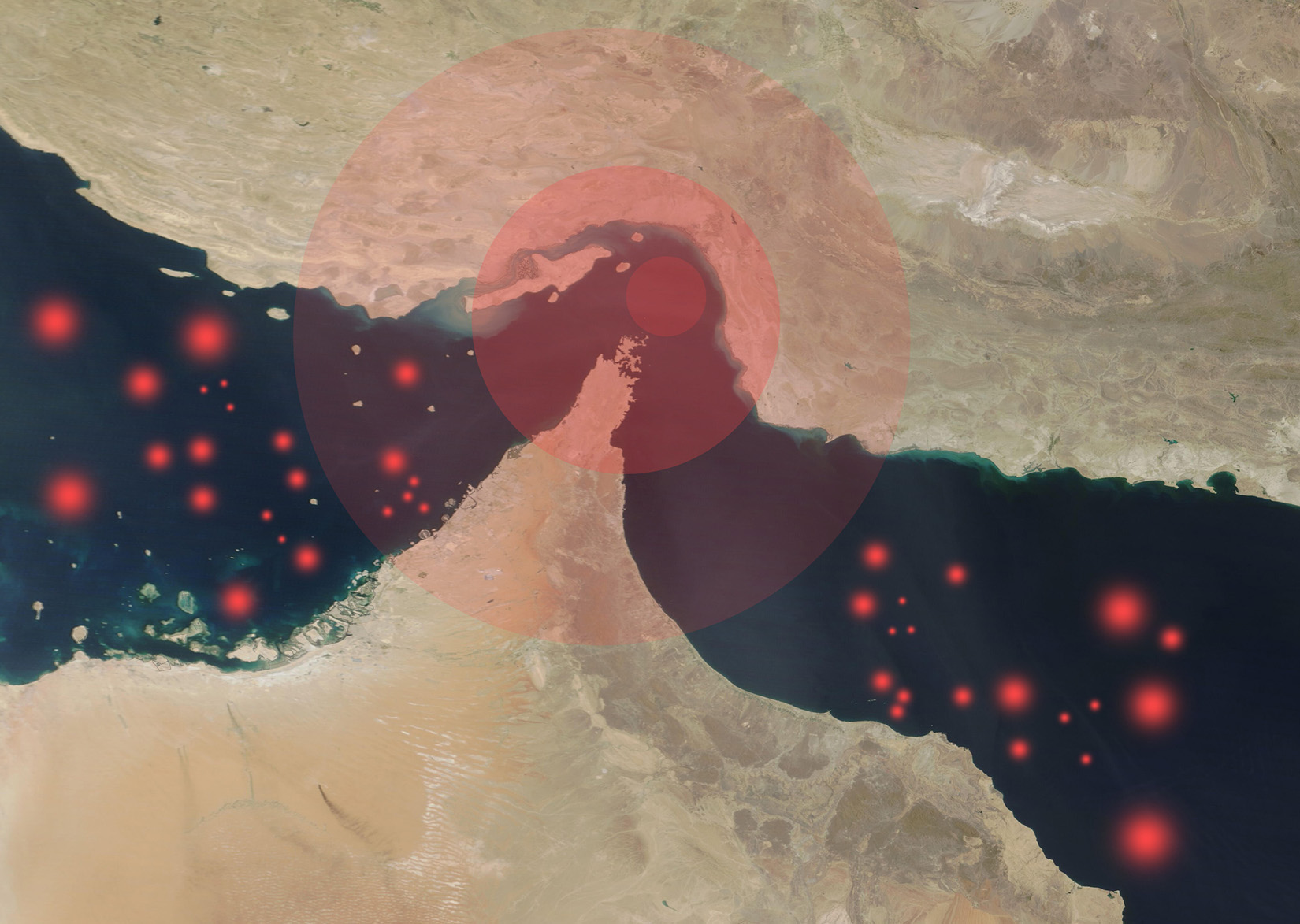
Competing “Blockades” of the Strait of Hormuz
Iran’s “closure” of Hormuz has been threatened before—notably during the June 2025 US-Israeli strikes on Iran—but never implemented. The reasons were clear: shutting the strait would halt Iran’s own energy exports, inflicting severe economic damage, and would risk alienating China, the largest importer of Gulf energy.
This time, however, Iran framed the conflict as existential. It imposed a new navigation route through the strait and required vessels to obtain passage authorization; ships that failed to comply faced warning shots and other strict enforcement measures.[6] This allowed Iran to select which vessels could transit and to collect passage fees, creating a de facto closure of the strait. The result has been significant global economic disruption, including surging energy and petroleum product prices and sharply higher maritime insurance premiums.
The Trump administration reportedly underestimated the likelihood of such an outcome in the early stages of the military campaign.[7] Once Iran’s controls took effect, Trump began pressing forcefully for reopening the strait from late March onward,[8] and—after Iran refused—declared on April 12 that the United States would itself impose a blockade on vessels entering or leaving Iranian ports following failed ceasefire talks in Pakistan.[9] Iran responded on April 18 by announcing a “reclosure,” creating a dual blockade.[10]
This dual blockade ended on June 17 with the signing of a memorandum of understanding between the United States and Iran. Article 5 of the MoU states that Iran would “make arrangements using its best efforts for the safe passage of commercial vessels with no charge, for 60 days only, from the Persian Gulf to the Sea of Oman and vice versa.”[11] Based on this provision, Iran continued its strict management of the strait. Trump’s July 12 declaration of a renewed US blockade (effective July 13) directly rejected Iran’s control.
Since the war began, Iran has sought to establish a superior position in the strait through its “closure,” while the United States has attempted to prevent such dominance. The underlying dispute reflects longstanding legal disagreements: Iran argues that coastal states may impose prior authorization requirements for security reasons under the UN Convention on the Law of the Sea (UNCLOS),[12] while the United States maintains that transit through straits used for international navigation is a customary right and that such requirements are unlawful.[13]
Finding a Path Toward Resolution
The most contentious aspect of Iran’s Hormuz management is its collection of passage fees. The strait’s narrowest point is roughly 21 nautical miles (about 40 km). Under UNCLOS, states may claim territorial seas up to 12 nautical miles,[14] meaning the strait contains no high seas; vessels must transit either through Iranian or Omani territorial waters. A 1974 bilateral agreement established a median line, and the International Maritime Organization (IMO) designated a traffic separation scheme (TSS) that directs inbound traffic through Iranian waters and outbound traffic through Omani waters.[15] Although both states claim that Hormuz is not an international strait but a territorial sea, they generally permit innocent passage.[16]
On May 12, amid ongoing hostilities, Iran and Oman held talks on exercising sovereign rights within their respective 12 nautical mile zones.[17] President Trump reacted sharply, warning on May 27 that the United States would “blow up” Oman if it tried to control the strait along with Iran.[18] Despite US objections, Iran continued consultations with Oman under the MoU,[19] and the two states have discussed collecting service fees as an exercise of territorial sovereignty. Iran favors mandatory fees, while Oman prefers voluntary contributions.[20]
Oman’s approach reportedly draws inspiration from the Cooperative Mechanism for the Straits of Malacca and Singapore,[21] a multilateral framework in which user and littoral states share the burden of ensuring navigational safety, environmental protection, and emergency response in a vital international waterway.[22] To advance this idea, Omani Foreign Minister Sayyid Badr held calls with his Saudi and Egyptian counterparts on June 26,[23] and Sultan Haitham bin Tariq made an official visit to France on June 28, discussing strait navigation with President Emmanuel Macron.[24] On June 29, Oman and Iran convened the first meeting of their joint Strait of Hormuz Committee.[25] A cooperative framework acceptable to all relevant stakeholders—built through such diplomatic efforts—may offer a way to resolve the strait issue without being trapped in US-Iran rivalry.[26]

A Multilateral Framework to End the War
On July 10, President Trump formally notified Congress that US military operations against Iran had resumed on July 7, resetting the 60-day window for using force without congressional approval.[27] The administration has intensified strikes to prevent Iran from controlling the strait.[28] Iran, for its part, has launched retaliatory attacks on US military facilities in Bahrain, Kuwait, and Jordan.[29]
Amid these exchanges, two developments suggest potential avenues for de escalation. First, Qatar and other mediators have proposed a 10-day temporary ceasefire.[30] Second, on July 14, Omani Foreign Minister Badr published an op ed in Le Monde calling for a “new Gulf security policy,” urging regional security cooperation among the six Gulf Cooperation Council (GCC) states plus Iran and Iraq.[31] This proposal seeks to link multilateral efforts on the strait to broader, long term regional security. Significant obstacles remain, including intra-regional rivalries and interference by external powers.
Yet history offers precedent. After the 1991 Gulf War, the Madrid Peace Conference established a multilateral framework that fostered confidence-building and regional cooperation, contributing to the 1993 Declaration of Principles on Interim Self Government for Palestine (the Oslo Accord) and the 1994 Israel-Jordan Peace Treaty. The conference adopted a two-track system: bilateral negotiations between parties, complemented by five multilateral working groups (arms control, economic development, water resources, the environment, and refugees).
Drawing on this experience, preventing renewed US-Israeli-Iranian conflict will require persistent mediation by states such as Qatar and Pakistan, combined with multilateral forums addressing the Strait of Hormuz, Gulf security, and related issues. If the warring parties can foresee tangible peace dividends from such cooperation, the path toward ending the war will become more durable.
(2026/08/28)
Notes
- 1 “Leader vows to avenge martyr Ayatollah Khamenei’s blood,” Islamic Republic News Agency, July 11, 2026.
- 2 After the IMO proposed provisional north-south routes on June 23, a commercial vessel transiting Omani territorial waters in the Strait of Hormuz was attacked, prompting US airstrikes on Iran and Iranian attacks on US-related facilities in GCC states. See Jonathan Saul, “Evacuation Plan Through Hormuz For Stranded Ships In Gulf Underway, UN Agency Says,” Reuters, June 24, 2026; “US Strikes Iran in Response to Drone Strike on Commercial Ship,” Al Jazeera, June 26, 2026. In early July, similar patterns of an exchange of fire intensified: US strikes on July 8–9 targeted roughly 90 Iranian sites, and on July 12 roughly 140 sites, with further attacks continuing. See Vicky Wong, Matt Spivey and Tabby Wilson, “US and Iran Trade Attacks as Khamenei Is Buried,” BBC, July 10, 2026; Tabby Wilson and Robert Greenall, “US Insists Strait of Hormuz Is Open as It Exchanges Strikes with Iran,” BBC, July 13, 2026.
- 3 “Trump Hints at Further Iran Negotiations After Exchange of Fire over Hormuz,” Al Jazeera, July 10, 2026.
- 4 Shannon K. Kingston, “Trump’s Strait of Hormuz Blockade Erases the Last Concession to Iran in Preliminary Deal,” ABC News, July 14, 2026.
- 5 Jaroslav Lukiv, “Trump Scraps Threat of 20% Fee on Hormuz Cargo as US Resumes Blockade of Iran Ports,” BBC, July 15, 2026. 4
- 6 “Iran Warns UAE of ‘Crushing and Regretful’ Response If Attacks Are Launched from Its Soil,” Press TV, May 5, 2026. On March 5, shortly after the war began, Brigadier General Heydari stated that Iran was relocating vessels in accordance with international protocols and that ships violating these protocols would be sunk. See “Military Commander: Iran Has Not Closed Strait of Hormuz,” Islamic Republic News Agency, March 5, 2026.
- 7 Alayna Treene, Zachary Cohen, Natasha Bertrand, Jim Sciutto, and Kevin Liptak, “US Furiously Seeks to Avert Potential Monthslong Closure of Strait of Hormuz,” CNN, March 21, 2026.
- 8 President Trump repeatedly threatened Iran—framing his demands as ultimatums—saying he would target Iranian power plants if the strait was not reopened. See Robert Greenall and Toby Mann, “Trump Issues Expletive Laden Threat to Iran over Hormuz Strait Blockage,” BBC, April 6, 2026.
- 9 “‘Blown to Hell’: Trump Orders Hormuz Blockade after US Iran Peace Talks End,” Al Jazeera, April 12, 2026.
- 10 After a US brokered 10-day ceasefire between Israel and Lebanon, Iran announced the reopening of the strait on April 17, only to declare a renewed closure the following day. See “Iran Closes Strait of Hormuz Again over US Blockade of Its Ports,” Al Jazeera, April 18, 2026.
- 11 Alayna Treene, Kevin Liptak, and Mostafa Salem, “US Releases Official Agreement with Iran: Read the 14 Point Text,” CNN, June 18, 2026.
- 12 Kazuhiro Nakatani, “Horumuzu Kaikyo to kokusaiho” (The Strait of Hormuz and International Law), The University of Tokyo Law Review 7 (2012): 182–83.
- 13 Ibid., 184.
- 14 Ibid., 177–90.
- 15 Ibid., 178.
- 16 Ibid., 179.
- 17 ““Iran, Oman hold talks on Hormuz Strait, discuss sovereign rights over strategic waterway,” Press TV, May 13, 2026.
- 18 Aaron Blake, “Trump’s ‘Blow ’Em Up’ Threat to Oman Means He’s Now Attacked or Threatened 1 out of Every 13 Countries,” CNN, May 28, 2026.
- 19 Treene, Liptak, and Salem, “US Releases Official Agreement with Iran” (note 11).
- 20 “Iran, Oman to Jointly Charge Fees along Strait of Hormuz: Report,” Middle East Eye, June 30, 2026.
- 21 J. Ashley Roach, “Malacca, Straits of,” Oxford Public International Law, 2013.
- 22 Fiona MacDonald and Samy Adghirni, “European Nations Now Believe Some Hormuz Fees Are Inevitable,” Japan Times, July 4, 2026.
- 23 “Minister in Phone Call with Saudi Counterpart,” Foreign Ministry of Oman, June 26, 2026; “Minister in Phone Call with Egyptian Counterpart,” Foreign Ministry of Oman, June 26, 2026.
- 24 “Joint Omani French Declaration at the Conclusion of the Official Visit of His Majesty Sultan Haitham bin Tarik, Sultan of Oman, to France,” La Maison Élysée, June 2026.
- 25 “Oman Iran Committee on Strait of Hormuz Holds First Meeting,” Foreign Ministry of Oman, June 29, 2026.
- 26 Some European and Gulf Arab states reportedly now accept that ships transiting the vital Strait of Hormuz will have to pay fees to Iran and Oman. See MacDonald and Adghirni, “European Nations Now Believe Some Hormuz Fees Are Inevitable” (note 22).
- 27 Benoit Faucon, Rebecca Feng, and Jared Malsin, “Trump Says He Is Reimposing U.S. Blockade on Iran Shipping,” Wall Street Journal, July 14, 2026.
- 28 “US ‘Open’ to Negotiations with Iran but Tehran Not ‘Serious,’ Rubio Says,” Al Jazeera, July 22, 2026.
- 29 “US Expands Attacks Deeper into Iran as Tehran Retaliates against Jordan, Bahrain and Kuwait,” Arab News, July 16, 2026.
- 30 ““Iran Confirms Receiving Mediators’ Proposals Aimed at De escalating Tensions,” Islamic Republic News Agency, July 20, 2026.
- 31 “Minister Calls for New Gulf Security Policy,” Foreign Ministry of Oman, July 14, 2026.