Program Overview

SPF implemented large-scale, self-operated projects from the standpoint of addressing issues on its own initiative

SPF implemented a total of 56 projects in fiscal year 2010, valued at ¥1,161.37 million. Total expenditures, excluding that of internal operations (project operations, program development and research, and public relations) amounted to ¥552.62 million for 45 projects. Compared to the previous fiscal year the number of projects increased by three, and project expenditures rose approximately ¥270.00 million.

The increase in projects and project expenditures is due in part to the fact that because it has been three years since the adoption of the program policy for regular projects, and two years since the formulation of operational guidelines for the projects of Special Funds, there is broader recognition of the priority fields and regions targeted by the Foundation. An additional factor is that resources were focused on large-scale, self-operated projects implemented from the standpoint of resolving issues on our own initiative.

  • FY2010 Project Summary
  • Recent Project Expenses
Regular Projects
Appropriate assistance and addressing of issues by strategically combining self-operated and grant projects
Recent Projects

SPF implemented 19 regular projects in fiscal 2010, excluding internal operations, with a value of ¥236.14 million.
For Program Policy 1, “Efforts to Ensure Peace and Security in the International Community,” SPF implemented three grant projects centered on the self-operated project, “Peace Building in Asia and the Role of Japan,” along with one self-operated/commissioned project, and one grant project in the “Peace Building and Security Issues” program. For the “Non-Traditional Security Issues” program, we concluded the “Addressing an Avian Flu Pandemic through Intraregional Cooperation” project, and provided a grant for a new project to establish a framework for disaster assistance.

For Program Policy 2, “Addressing Positive and Negative Aspects of Globalization,” in the “Market and Disparities Issues” program, SPF launched a self-operated/commissioned project aimed at providing policy recommendations to reduce disparity. In the “Issues Involving Demographic Changes and Population Movement” program, we concluded a total of two projects, the self-operated/commissioned project “The Global Demographic Change and Labor Migration in Asia” and one grant project, and provided grants for two other projects.

For Program Policy 3, “Promotion of Mutual Understanding between Priority Regions and Japan,” in the “Exchange Program between Japan and the United States” program, we concluded the self-operated/commissioned project “Promoting Japan-U.S. Relations: An Opinion Leaders’ Dialogue,” and the “Expansion of the Strategic Horizon for Japan’s National Security and the Future of Japan-U.S. Relations” (self-operated), intended primarily for research studies by young Japanese researchers.
For grant projects, SPF provided assistance for four projects to support research study and fellowships. Of these, we concluded the “Japan Matters for America/ America Matters for Japan.”

The Sasakawa Pacific Island Nations Fund
Assistance for self-reliance and human resource development in Micronesia
Recent Projects

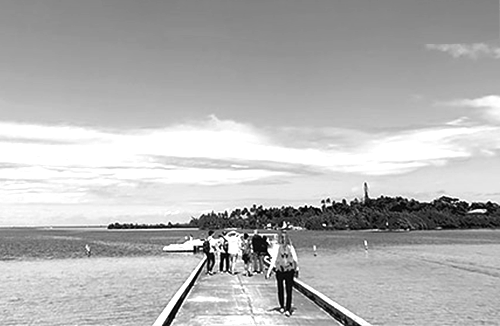
SPINF implemented three projects in fiscal 2010, excluding internal operations, with a value of ¥39.67 million. The three projects were all self-operated, and two were new projects. For the “International Committee for Establishment of Maritime Safety System in Micronesia” project, the third “GO/NGO Meeting for Strengthening the Marine Surveillance Capacity in the Micronesia Region” (co-sponsored by The Nippon Foundation) was held in the Republic of Palau (ROP) in November 2010, attended by the governments of the six participating nations, namely the three nations of Micronesia comprising the Federated States of Micronesia, the Republic of the Marshall Islands, and the Republic of Palau, the U.S., Australia, and Japan as well as The Nippon Foundation and the SPF. Building on successive communications and negotiations from the initial year of the project, we reached a final consensus on support policy and concluded the project. For the “Exploratory Research on Models of a Micronesian Marine Protected Areas,” we established a Micronesia Marine Environment Committee and conducted local surveys in ROP.
For the “Japan-Federated States of Micronesia Exchange Program for Health-care Service Providers,” we invited students majoring in healthcare and medicine at the College of Micronesia to Okinawa, and conducted joint research at the University of the Ryukyus.

The Sasakawa Japan-China Friendship Fund
Projects for promoting mutual understanding between Japan and China, and the development of 21st-century relations
Recent Projects

SJCFF implemented 11 projects in fiscal 2010, excluding internal operations, with a value of ¥15.72 million. These comprised four grant projects and seven self-operated projects, all of which were ongoing. One of the 11 projects, the “Program for Promoting Japan-China Exchange in the Field of Security/Phase II” (self-operated), was implemented to promote exchanges in the defense field between Japan and China. In the area of people-to-people exchange, we implemented two projects, the “Chinese Young Journalist Interchange Program” (self-operated) and the “Facilitating Dialogue between Future Leaders” (self-operated). To further Japanese language education in China, we implemented two projects, the “Development of Materials to Teach the Japanese Language” (grant) and the “Training Program for Japanese Language Learners from Regional Universities” (grant). In projects to share Japanese expertise in various fields with China, and contribute to the advancement of Chinese society, we implemented two projects, the “Creating an Emergency Manual for Local Governments in Sichuan Prefecture” (self-operated), and the “Healthy Community Construction Project” (grant). We also implemented the “Forty Years of Japan-China Relations in Review (1972–2012)” (self-operated), the “Book Translation and Publication Project for Understanding Contemporary Japan” (self-operated), and the “Expanding the Public Relations Activities of the Japan-China Friendship Fund” (self- operated) . Three of these projects were concluded during fiscal 2010, the “Program for Promoting Japan-China Exchange in the Field of Security/Phase II,” the “Chinese Young Journalist Interchange Program” project, and the “Creating an Emergency Manual for Local Governments in Sichuan Prefecture.”

The Sasakawa Middle East Islam Fund
Projects to be a driving force for mutual understanding between Japan and the Middle East
Recent Projects

SMEIF implemented three projects excluding internal operations, with a value of ¥90.79 million, in fiscal 2010, the second year since the establishment of this fund. All three projects were self-operated, and two were new projects. For the “Capacity Building for Mutual Understanding between the Middle East and Japan,” SMEIF actively provided news on Japan and other information in Arabic on the project website, as well as conducted seminars for diplomats from Middle Eastern Islamic countries resident in Japan, and seminars on the Middle Eastern situation. We also held seminars as appropriate on addressing political changes in the Middle East. For the “Middle East Maritime Security Study,” SMEIF conducted research studies related to the project’s two main topics of “Meetings of experts in Gulf security” and “Research into the Somalian problem and security in the Red Sea and Arabian Sea.”
For the “Human Resources Exchange between the Middle East and Japan,” project involving the invitation of mid-level opinion leaders, SMEIF invited experts from Turkey to present lectures. To promote youth exchanges, we invited high school students majoring in science from the UAE to Japan, and invited two university students each from Syria and Jordan in an exchange program centered on the Japan Middle East Student Conference (JMESC).

The Sasakawa Pan Asia Fund
Exchange and human resource development for CLMV countries and South Asia
Recent Projects

SPAF implemented nine projects in fiscal 2010, excluding internal operations, with a value of ¥80.29 million. This total comprised six grant projects and three self-operated projects, of which five were ongoing projects, and four new projects. Ongoing projects comprised the “Exchange Program for Young Asian Parliamentarians” (self- operated), the “Enhancing Indo-Japan Relations: Visit to Japan by Indian Parliamentarians—Phase II” (grant), the “Asian Renaissance: Capacity Building for Future Leaders in Southeast Asia” (grant), the “Training for Civil Servants in Myanmar” (self-operated/commissioned), and the “Capacity Building for Young Researchers in Myanmar’s Industrial Field” (grant) . Of these, the five-year “Asian Renaissance: Capacity Building for Future Leaders in Southeast Asia” was concluded in 2010. The four new projects were the “Capacity Building for Cambodian Public Officials” (self-operated/commissioned), which held workshops to enhance the skills of midlevel public officials in Cambodia, the “Strengthening Civil Society and Democratic Institutions for Peace and Stability” (grant) in Sri Lanka aimed primarily at enhancing the capabilities of young religious leaders, the “Strengthening Economic Survey Capacity in Lao PDR” (grant) to enhance the skills of researchers through the conduct of a short-term economic index survey on employment, and the “Strengthening the Intellectual Foundations for Contemporary Japanese Studies in India—Phase II” (grant).

  • Oversiew
  • Program
  • Projects List
  • Project Search

PageTop